Tag Archives: cross

Loving Before Knowing [OR The Foolishness of the Cross] Matthew 5:1-12, 1 Corinthians 1:18-31

Caitlin Trussell with Augustana Lutheran Church on January 29, 2017

[sermon begins after Bible reading]

Matthew 5:1-12 When Jesus saw the crowds, he went up the mountain; and after he sat down, his disciples came to him. 2 Then he began to speak, and taught them, saying: 3 “Blessed are the poor in spirit, for theirs is the kingdom of heaven. 4 “Blessed are those who mourn, for they will be comforted. 5 “Blessed are the meek, for they will inherit the earth. 6 “Blessed are those who hunger and thirst for righteousness, for they will be filled. 7 “Blessed are the merciful, for they will receive mercy. 8 “Blessed are the pure in heart, for they will see God. 9 “Blessed are the peacemakers, for they will be called children of God. 10 “Blessed are those who are persecuted for righteousness’ sake, for theirs is the kingdom of heaven. 11 “Blessed are you when people revile you and persecute you and utter all kinds of evil against you falsely on my account. 12 Rejoice and be glad, for your reward is great in heaven, for in the same way they persecuted the prophets who were before you.

[1 Corinthians reading is after the sermon]

[sermon begins]

Several months after my husband Rob and I started dating, we ended up at a New Year’s Eve party.  We were standing in a circle of people we didn’t know.  A bit of round-robin started as people talked about their work.  Rob said his usual, “I’m in sales.”  Someone asked, “Oh? What kind?” He said something like, “I’m a manufacturer’s rep for a Georgia-based carpet mill.”  As is often still the case, people don’t seem to know how to reply to that statement.  Possibly because cut-pile vs. loop or solution-dyed vs. yarn-dyed controversies aren’t quite party talk.  So, I’m next in the round-robin.  People have their eyebrows up expectantly, hoping their curiosity moves into easier conversation.  And I say, “I’m a pediatric cancer nurse.”  Stares and crickets. More stares and crickets with some nodding and mmmm’ing, while the conversation moved to the next person.

Some conversations are too detailed for party-talk, like the pros and cons of carpet manufacturing techniques.  And other conversations are too hard, like kids having cancer.  These are not the only ones. Just a couple of examples of so many things that don’t qualify as polite conversation.  Grief is another such thing.  This is where the church comes in, talking through the polite conversation into what’s happening in our lives. It’s one of the reasons being part of the church can be a comfort while we’re also challenged by Jesus’ teachings. Listen to this Bible verse again from the book of Matthew:

[Jesus teaches his disciples, saying,] “Blessed are the poor in spirit, for theirs is the kingdom of heaven.  Blessed are those who mourn, for they will be comforted.”

Jesus is often found teaching in Matthew.  The Bible verses today are most commonly known as the Beatitudes based on the Latin for blessed.  It is curious that people who suffer are described as blessed when these moments can feel and look like the opposite of blessing.  Jesus is pushing against the idea that good things happen to good people and bad things happen to bad people.  There is no explanation for why people are poor in spirit or mourning, why people suffer.  There is simply a description of suffering and God’s promise to be present in the midst of it.

The Beatitudes state a promise into the suffering.  “Blessed are the poor in spirit for theirs is the kingdom of heaven.” Notice there are no requirements to receive the kingdom.  In Matthew, the kingdom of heaven is now and it’s here.  Check out the kingdom parables in Matthew chapter 13.  They describe active presence of the kingdom on earth.  As Jesus teaches his disciples, Jesus teaches us, that we receive the kingdom, live the kingdom, and teach the kingdom.

I can hear you asking, “Well, pastor, that’s lovely poetry, but what does it look like on the ground to receive the kingdom and live in it?”  I’m glad you asked.  Richard Rohr, Franciscan monk and scholar, describes the rational mind hitting a ceiling.[1]  That ceiling is suffering. Today’s Bible verses name suffering as mourning and poor in spirit and more.  We can’t explain why it happens or its purpose.  We just know suffering exists and spend energy trying to prevent our own.  I mean, really, does anyone actually love eating kale?  Eventually, though, someone we love, or maybe even ourselves, suffers – we get sick, we grieve a death, we lose a job, we miscarry, or we watch our partner walk away.  All that we thought we knew about life and our place in it shifts.

But, as Paul says, “we proclaim Christ crucified,” the ultimate in earthly foolishness.[2]  Except that the cross means something beyond comprehension when it’s God’s foolishness. Jesus’ death on the cross means that God knows suffering.  More than that, it’s the mystery of God suffering with us when we suffer.  Paul’s use of “Christ crucified” points us there because the crucified Christ is also the resurrected Christ.  Christ whom we claim is among us now by the power of the Holy Spirit, God’s Spirit.

The same Holy Spirit names us the Body of Christ known as the church.  We are part of a resurrected life that we share together as a congregation.  We share that resurrection promise as a community of faith.  As Jesus teaches his disciples, he also teaches us, that we receive the kingdom and live in the kingdom especially when living through loss and grief.  Knowing this kingdom teaching can help stop us from painting a silver lining into someone else’s grief.[3]  We can simply be present with someone else in their suffering without fixing it or explaining it or telling someone it’s time to get over it.  We can avoid the trap of thinking someone else’s pain is a teaching moment for them and avoid setting ourselves up as the teacher.  Rather we can live the kingdom now by asking people how they’re doing, by telling people we’re sorry this is happening, by quietly listening, and by praying for them.

Prayer is one of the languages of the kingdom.  Jesus prayed the Psalms while on earth and now we do too as the body of Christ. Therefore, in the Psalms, we “encounter the praying Christ…Even if a verse or a psalm is not one’s own prayer, it is nevertheless the prayer of another member of the fellowship.”[4]  Praying for people on our prayer list who are suffering of mind, body, or spirit.  Taking the prayer list that’s in the weekly announcement page home, naming each person on it in prayer, or simply praying the whole list at once.  Praying is kingdom language even when we think our own prayers are uncomfortable and clunky.  That discomfort and humility in prayer are part of the kingdom language.  So is praying for people we don’t necessarily like.

As Christians, praying and being present to each other and the world’s pain is a freedom we have through the cross.  We may recognize God’s foolishness as wisdom and look to the cross as a way of knowing.[5]  It’s possible that one of the truths of Christ crucified is that our suffering connects us to each other differently.  We move through the party talk and listen to someone talk about their grief and loss.  These moments become prayer by transcending what we’re arguing about ideologically and opens our eyes us to see each other truly as beloved children of God.  Through the cross, through the suffering, we love before we know, we love as a way of knowing, we love as Christ loves us.

Thanks be to God.  Amen.


[1] Richard Rohr, Public Remarks, Join the Divine Dance: An Exploration of God as Trinity, Arvada, CO, January 13-15, 2017.

[2] 1 Corinthians 1:23-25

[3] This is a riff on Brené Brown’s work on empathy vs sympathy.  See video, “Brené Brown on Empathy”:  https://www.youtube.com/watch?v=1Evwgu369Jw&sns=fb

[4] Dietrich Bonhoeffer, Life Together (New York: Harper & Row, 1954), 46-47.

[5] Rohr, ibid.

________________________________________

1 Corinthians 1:18-31 For the message about the cross is foolishness to those who are perishing, but to us who are being saved it is the power of God. 19 For it is written, “I will destroy the wisdom of the wise, and the discernment of the discerning I will thwart.” 20 Where is the one who is wise? Where is the scribe? Where is the debater of this age? Has not God made foolish the wisdom of the world? 21 For since, in the wisdom of God, the world did not know God through wisdom, God decided, through the foolishness of our proclamation, to save those who believe. 22 For Jews demand signs and Greeks desire wisdom, 23 but we proclaim Christ crucified, a stumbling block to Jews and foolishness to Gentiles, 24 but to those who are the called, both Jews and Greeks, Christ the power of God and the wisdom of God. 25 For God’s foolishness is wiser than human wisdom, and God’s weakness is stronger than human strength. 26 Consider your own call, brothers and sisters: not many of you were wise by human standards, not many were powerful, not many were of noble birth. 27 But God chose what is foolish in the world to shame the wise; God chose what is weak in the world to shame the strong; 28 God chose what is low and despised in the world, things that are not, to reduce to nothing things that are, 29 so that no one might boast in the presence of God. 30 He is the source of your life in Christ Jesus, who became for us wisdom from God, and righteousness and sanctification and redemption, 31 in order that, as it is written, “Let the one who boasts, boast in the Lord.”

The Church Alive: Called to Action Through Easy Indifference – Luke 16:19-31

Caitlin Trussell with Augustana Lutheran Church on September 25, 2016

[sermon begins after the Bible reading]

Luke 16:19-31 There was a rich man who was dressed in purple and fine linen and who feasted sumptuously every day. 20 And at his gate lay a poor man named Lazarus, covered with sores, 21 who longed to satisfy his hunger with what fell from the rich man’s table; even the dogs would come and lick his sores. 22 The poor man died and was carried away by the angels to be with Abraham. The rich man also died and was buried. 23 In Hades, where he was being tormented, he looked up and saw Abraham far away with Lazarus by his side. 24 He called out, “Father Abraham, have mercy on me, and send Lazarus to dip the tip of his finger in water and cool my tongue; for I am in agony in these flames.’ 25 But Abraham said, “Child, remember that during your lifetime you received your good things, and Lazarus in like manner evil things; but now he is comforted here, and you are in agony. 26 Besides all this, between you and us a great chasm has been fixed, so that those who might want to pass from here to you cannot do so, and no one can cross from there to us.’ 27 He said, “Then, father, I beg you to send him to my father’s house— 28 for I have five brothers—that he may warn them, so that they will not also come into this place of torment.’ 29 Abraham replied, “They have Moses and the prophets; they should listen to them.’ 30 He said, “No, father Abraham; but if someone goes to them from the dead, they will repent.’ 31 He said to him, “If they do not listen to Moses and the prophets, neither will they be convinced even if someone rises from the dead.’ ”

[sermon begins]

The first thing to note about this parable is that it validates dogs’ reputations for giving unconditional love. That dogs show up in a parable should come as no surprise to Coloradans.  There are so many dogs that each household could have two if they were spread out evenly.[1]  The dogs in the parable nurse Lazarus’ wounds and likely keep him company.  If anyone is looking for a theology of dogs – there you go.  Jesus gives them airtime…and in the gravitas of a parable, no less.

The second thing to note about this parable and parables in general is that they are generally considered exhortative, not predictive.  Many a Bible reader has attempted to predict and describe the afterlife based on this parable and other choice verses.  More than one Bible scholar would invite us to resist this impulse to predict and describe.[2]  Rather, we can hear this as an exhortation by Jesus which means there’s dire urgency that requires action now, here, in the present.

For the entire gospel of Luke, Jesus increases the intensity around caring for those who are suffering.  Time and again Jesus is either easing someone’s suffering himself or talking to his disciples about it.  Jesus also ratchets up his challenge about money, about how money can create distance between the moneyed people and the people who don’t have any money.  The parable today is a case in point.

The only thing the rich man and Lazarus have in common is proximity to the gate.  The rich man is walking inside it and Lazarus is lying outside it.  The gate binds them together and yet they are worlds apart.  The contrast between the two men is stark.  The rich man is covered with purple and linen.  Lazarus is covered with sores.  The rich man feasts sumptuously while Lazarus longs to satisfy his hunger with food that falls from the rich man’s table.  Jesus problem with the rich man doesn’t seem to be his wealth.  It seems to be with the rich man’s indifference as evidenced by Lazarus’s continued suffering at the gate.

If Facebook emoticons are any indication, people are moved by stories of people spontaneously helping people.  Starbucks just set up a media company led by a former Washington Post senior editor.  This company will focus on “stories featuring Americans who have inspired and shown extraordinary measures of compassion and citizenship in their own lives.”[3]  Humans seem to be hard-wired to respond with deep emotion particularly when someone risks something to help another person.  On the flip-side, there’s deep offense when someone doesn’t.  Jesus’ audience of disciples and Pharisees likely share these very human reactions.

Last week, Pastor Ann and I spent some time worshiping and swapping stories with clergy colleagues. Augustana is one of 166 congregations in the Rocky Mountain Synod of ELCA Lutheran Christians.  The Synod is made up of El Paso Texas, New Mexico, Utah, Wyoming, and Colorado.  The bishop convenes us for Theological Conference every fall.  This year we had the privilege of hearing from Andy Root, Professor of Youth and Family Ministry at Luther Seminary.[4]  Dr. Root is convinced that the church is called to engage deeply with people’s stories.  Not to offer solutions to someone’s deep pain but to be present in the face of that pain.

At the same time, Dr. Root was telling story after story of his own and other people’s as examples of being present when someone is feeling deep pain. There was one story that came alive quietly for part of the room.  Dr. Root was going into detail about a wife and mother of two babies who had to identify the body of her husband at the morgue.  Some of us were sitting around a colleague whose husband died suddenly several years ago.  She too had to identify her husband in a morgue.  She sat quietly with her hand over her eyes as she listened to the story with the rest of us.  The colleague next to her put a hand on her back and continued to sit with her.

Similarly, there are some stories that hit deeply this past week.  It’s one thing to talk about someone dying in the abstract and it’s quite another to witness someone’s death – either in person or recorded.  As a country, we’re trying to talking about these deaths as a racial abstraction when for many people these deaths are real blood on the ground.  After reading and watching and reading more, I’m not sure what we’re going to do as a people.  What I am sure about is that indifference to the pain of our black brothers and sisters as well as the fear of police officers is not an option for the church.

With these large scale human issues, helplessness can immobilize people from responding.  Jesus’ brings it down to two people – the rich man and Lazarus.  The chasm that separates them is paper thin in life and cavernous in death.  Let’s look at how this parable ends.  Father Abraham says to the rich man, “If they do not listen to Moses and the prophets, neither will they be convinced even if someone rises from the dead.”[5]  Luke’s audience for this parable would be in on the joke as they listened to this end of the parable because they know the end of the story.[6]

At the end of the gospel of Luke, Jesus is executed on a cross, dies and is buried.[7]  Three days later, at early dawn on the first day of the week, the women arrive at Jesus’ tomb to find it empty – no body to identify.[8]  At first, their grief and terror know no bounds. Then they are reminded of Jesus’ words to them while he was with them – “Remember how he told you that the son of man must be handed over to sinners, and be crucified, and on the third day rise again.”  Mary Magdalene, Joanna, Mary the mother of James, and the other women go tell the apostles only to be told that it is an “idle tale.”[9]

When Jesus finally appears more widely to his disciples, he has this to say…

“These are my words that I spoke to you while I was still with you—that everything written about me in the law of Moses, the prophets, and the psalms must be fulfilled.” 45Then he opened their minds to understand the scriptures, 46and he said to them, “Thus it is written, that the Messiah is to suffer and to rise from the dead on the third day, 47and that repentance and forgiveness of sins is to be proclaimed in his name to all nations, beginning from Jerusalem.”

Can you hear the bookend with the parable there?  Father Abraham invokes Moses and the prophets in the parable.  Jesus, after his resurrection, invokes their fulfillment and says that forgiveness is for all the nations.  In the simplest of terms, Jesus on the cross hangs over and against the parable… There…Is…No…Chasm.

My friends, we have a God who goes to hell and back in the death and resurrection of Jesus.  We are reminded by the Apostle Paul in his letter to the Ephesian church that:

“God, who is rich in mercy, out of the great love with which he loved us 5even when we were dead through our trespasses, made us alive together with Christ. 8For by grace you have been saved through faith, and this is not your own doing; it is the gift of God— 9not the result of works, so that no one may boast. 10For we are what he has made us, created in Christ Jesus for good works, which God prepared beforehand to be our way of life.[10]

A God who goes to hell and back for you…and for the nations; with you and with the nations.  Jesus death on the cross is where the story of our deepest pain is held and met by God.  Not only our pain but the pain of the world because darkness is not dark to God. [11]  Darkness is where light is born.[12]  As Church we are alive in Christ as we hear and proclaim this good news.  This is our call to action through easy indifference, by our baptisms through the cross of Christ.  Thanks be to God.


[1] Dogs Vs. Cat Map of the United States. November 2, 2015. Brilliant Maps: Making Sense of the World, One Map at a Time. Link: http://brilliantmaps.com/dog-vs-cat/

[2] Rolf Jacobson, Karoline Lewis, and Matthew Skinner.  Working Preacher podcast on Luke 16:19-31 for Sunday, September 25, 2016.  http://www.workingpreacher.org/brainwave.aspx?podcast_id=795

[3] Aamer Madhani, “Starbucks CEO Dipping Toe Into Media Content” USA Today, September 7, 2016.  http://www.usatoday.com/story/money/2016/09/07/starbucks-ceo-dipping-toe-into-media-content/89922526/

[4] Andrew Root, Biography and Work, Luther Seminary. https://www.luthersem.edu/faculty/fac_home.aspx?contact_id=aroot

[5] Luke 16:31

[6] A word of thanks to Dr. Matt Skinner and Karoline Lewis, Luther Seminary, who makes the connection between the parable and the end of Luke on the Working Preaching podcast for September 25, 2016.

[7] Luke 23:1-56

[8] Luke 24:1-12

[9] Luke 24:11

[10] Ephesians 2:4

[11] Psalm 139:12

[12] Genesis 1:1-5

Hymn sung together following the sermon:

ELW 655 Son of God, Eternal Savior

Son of God, eternal Savior,
Source of life and truth and grace,
Son of Man, whose birth among us
hallows all our human race,
you, our Head, who, throned in glory,
for your own will ever plead,
fill us with your love and pity,
heal our wrong and help our need.

As you, Lord, have lived for others
so may we for others live;
freely have your gifts been granted,
freely may your servants give.
Yours the gold and yours the silver,
yours the wealth of land and sea,
we but stewards of your bounty,
held in solemn trust will be.

Come, O Christ, and reign among us,
King of Love and Prince of Peace,
hush the storm of strife and passion,
bid its cruel discords cease;
by your patient years of toiling,
by your silent hours of pain,
quench our fevered thirst of pleasure,
shame our selfish greed of gain.

Son of God, eternal Savior,
Source of life and truth and grace,
Son of Man, whose birth among us
hallows all our human race,
by your praying, by your willing
that your people should be one,
grant, O grant our hope’s fruition:
here on earth your will be done.


Words: Somerset Corry Lowry (1855-1932), 1893

MIDI: Everton (Henry Thomas Smart (1813-1879)


People of Courage

Caitlin Trussell with Augustana Lutheran Church on September 4, 2016

[sermon begins after 2 Bible readings]

Philemon 1:1-21 Paul, a prisoner of Christ Jesus, and Timothy our brother, To Philemon our dear friend and co-worker, 2 to Apphia our sister, to Archippus our fellow soldier, and to the church in your house: 3 Grace to you and peace from God our Father and the Lord Jesus Christ. 4 When I remember you in my prayers, I always thank my God 5 because I hear of your love for all the saints and your faith toward the Lord Jesus. 6 I pray that the sharing of your faith may become effective when you perceive all the good that we may do for Christ. 7 I have indeed received much joy and encouragement from your love, because the hearts of the saints have been refreshed through you, my brother. 8 For this reason, though I am bold enough in Christ to command you to do your duty, 9 yet I would rather appeal to you on the basis of love—and I, Paul, do this as an old man, and now also as a prisoner of Christ Jesus. 10 I am appealing to you for my child, Onesimus, whose father I have become during my imprisonment. 11 Formerly he was useless to you, but now he is indeed useful both to you and to me. 12 I am sending him, that is, my own heart, back to you. 13 I wanted to keep him with me, so that he might be of service to me in your place during my imprisonment for the gospel; 14 but I preferred to do nothing without your consent, in order that your good deed might be voluntary and not something forced. 15 Perhaps this is the reason he was separated from you for a while, so that you might have him back forever, 16 no longer as a slave but more than a slave, a beloved brother—especially to me but how much more to you, both in the flesh and in the Lord. 17 So if you consider me your partner, welcome him as you would welcome me. 18 If he has wronged you in any way, or owes you anything, charge that to my account. 19 I, Paul, am writing this with my own hand: I will repay it. I say nothing about your owing me even your own self. 20 Yes, brother, let me have this benefit from you in the Lord! Refresh my heart in Christ. 21 Confident of your obedience, I am writing to you, knowing that you will do even more than I say.

Luke 14:25-33 Now large crowds were traveling with [Jesus]; and he turned and said to them, 26 “Whoever comes to me and does not hate father and mother, wife and children, brothers and sisters, yes, and even life itself, cannot be my disciple. 27 Whoever does not carry the cross and follow me cannot be my disciple. 28 For which of you, intending to build a tower, does not first sit down and estimate the cost, to see whether he has enough to complete it? 29 Otherwise, when he has laid a foundation and is not able to finish, all who see it will begin to ridicule him, 30 saying, “This fellow began to build and was not able to finish.’ 31 Or what king, going out to wage war against another king, will not sit down first and consider whether he is able with ten thousand to oppose the one who comes against him with twenty thousand? 32 If he cannot, then, while the other is still far away, he sends a delegation and asks for the terms of peace. 33 So therefore, none of you can become my disciple if you do not give up all your possessions.

[sermon begins]

What is your deepest prayer?  The longing of your heart?  Can you even put it into words?  Some of us can and some of us can’t.  My public prayers come out in a somewhat organized way so that others have a shot a following along.  The silent prayers of my heart and mind?  Not so much.  Those prayers take flight like a hummingbird – first here, then there, then over there – a jumble of images, people’s faces, sentence fragments, sometimes just a single word.  It’s why I occasionally pray prayers written by other people.  Their words can chill out my search for words and help me let go into prayer.

Paul’s writings can land and lift like prayers.  Certainly not every word he’s written, but there are moments.  When I started reading Philemon a couple weeks ago it was that kind of experience.  The way he opens in greeting with grace and peace giving thanks for his friends.  His “appeal to [Philemon] on the basis of love” on behalf of Onesimus.[1]  Challenging Philemon about who a co-worker in the gospel can be.

Paul’s words to Philemon flutter at us.  There’s a sweetness on one side and steel on the other.  Love, love, love and do, do, do.  Paul loves Philemon AND Onesimus.  He wants them to get along in a new way. In Christ.  So he writes a letter.  From prison.  So many powerful words have come from sitting in captivity.  Bonhoeffer wrote in a concentration camp, Dr. King in a Birmingham Jail, and, apparently, prison inspired Paul to write too.

Writing in prison is definitely a thing.  In prison there’s time.  A lot of time.  When freedom is stripped away and there’s no room for choice, time opens up.  These people that I just named wrote before they were in prison as well.  It’s just that some of their most memorable writings came from prison.  Prison’s stark reality seems to bring a different kind of clarity.  If there’s little more to lose then for some people there seems to be even more to say.

I’d like to see Philemon’s response to Paul.  And then I wish we had a transcript from Onesimus. I want to know what these three men are thinking as this negotiation takes shape.  I can imagine all kinds of thing about Philemon.  Just like I can imagine that Onesimus has a bunch of opinions too.  Regardless, Paul has a lot to say to Philemon about changing his behavior.

How does someone stop doing something and start doing something else?  What are the ways and means that that happens?  Ideally, it comes from the inside.  Self-awareness of something and then a strategy for change.  There’s something more palatable about that process.  I get to identify my problem.  Wail and gnash teeth behind the scenes.  Make a plan.  And get going.  It sounds so tidy.  It’s part of the American ethos.  I get to become a better version of myself and no one’s the wiser because the process is internal, mostly private.

Internal self-improvement and privacy don’t seem to be a part of the Kingdom of God in the scenario between Paul and Philemon.  The letter is addressed to Philemon, some friends, and their church.  Eugene Peterson, a retired pastor and writer, asks this question:

What does it mean to represent the Kingdom of God in a culture devoted to the Kingdom of the Self?[2]

Well, for one thing, it seems to mean not doing things perfectly.  Representing the Kingdom of God looks like the cross that Jesus is talking about in Luke.  Listen to what Jesus tells the people following him on the road to Jerusalem: “Whoever does not carry the cross and follow me cannot be my disciple.” [3]

How many tower builders and kings do you think are in the crowd following Jesus on the road to Jerusalem?  How many in the crowd know what it feels like to decide to go to war or to design a building?  I’m going to guess with you that there aren’t many.  The people in the crowd have a greater chance of working in the tower as it is being built or being sent to the front lines in battle.  They’ve likely seen and known what it means when decisions about those things are made poorly.  Because people die when a tower falls or war goes badly.  It’s good for kings and tower architects to know what they’re doing.  The people in the crowd know that much.

What the people in the crowd don’t know is the extent of what the cross means.  They couldn’t.  The cross is more like towers that fall and wars that are lost.  Ironically, Jesus is talking to them about towers that stand and wars thoughtfully considered.  The cross is a shameful end.

In the honor-shame culture of the first century, shame and avoiding it is something that the people know about.  When Jesus asks them if they’re willing to hate their families, the word he uses for hate means disgrace rather the emotional state of hate we think of today.[4]  There are first century letters from parents complaining about their son or daughter joining the Christians.[5]  This was not good news in families.

I’ll say it again.  The people in the crowd do not know what the cross means.  Ironically, Jesus is talking to them about towers that stand and wars thoughtfully considered.  Yet, the cross is a shameful end.  More like towers that fall and wars that are lost.  Picking up a cross is not a recipe for success.  It’s a burden of shame.

As I continued to read Philemon during the last few weeks, I was drawn to what Paul isn’t saying.  He isn’t saying slavery is wrong.  He isn’t challenging the status quo of owning people.  He is challenging Philemon to treat his slave as a brother in Christ. Upwards of 35-40% of people were enslaved in the 1st century Greco-Roman world.[6]

Turns out the letter to Philemon and others of Paul’s writings were more recently used in history to support over 250 years of American Christian ownership of slaves.[7]  Even as a representative of the Kingdom of God, Paul’s reveals the limitations of his own humanity.  There is confession of sorts in Paul’s letter.  He can see only so far into kingdom freedom for Onesimus and Philemon.

As Jesus asks those following him to count the costs, he also knows our limitations.  Our comfort with the status quo can blind us to the suffering we inflict on ourselves and each other.  If Jesus’ death on the cross says anything it shows just how far we’ll go to keep things the same.

Jesus know this about us and gives us to each other like Paul, Onesimus, and Philemon – appealing to each other in love.  Not a sappy, sentimental kind of love.  The hard kind of love that inspires the courage both to speak and to listen.  The kind of love that saturates the life of Jesus, that leads to the self-sacrificing love of Jesus on a cross.  The same cross that shatters a culture devoted to the Kingdom of Self. The cross that heralds the Kingdom of God and draws us toward each other through the love of Jesus.

Thanks be to God.


[1] Philemon 1:9

[2] Eugene H. Peterson. Under the Unpredictable Plant: An Exploration in Vocational Holiness (Grand Rapids: Wm. B. Eerdman’s Publishing Co., 1992), 50.

[3] Luke 14:27

[4] John Petty.  Pentecost 16:::Luke 14:25-33 Commentary for September 4, 2016 http://www.progressiveinvolvement.com/progressive_involvement/2016/08/pentecost-16-luke-14-25-33.html

[5] Ibid.

[6] Christian A. Eberhart, Professor of Religious Studies, University of Houston. Commentary on Philemon for September 4, 2016 at WorkingPreacher.org http://www.workingpreacher.org/preaching.aspx?commentary_id=1767

[7] Peter Gomes. The Good Book. (New York: William Morrow and Company, 1996), 89.

Sharon Draper. Timeline of Slavery in America: 1501-1865. https://sharondraper.com/timeline.pdf

[8] Eugene H. Peterson. Under the Unpredictable Plant: An Exploration in Vocational Holiness (Grand Rapids: Wm. B. Eerdman’s Publishing Co., 1992), 50.

For Berniece, A Celebration of Life at Her Funeral – 1 Corinthians 13 and John 14:1-4

Pastor Caitlin Trussell with Augustana Lutheran Church on April 5, 2016

[sermon begins after two Bible readings]

1 Corinthians 13 1 If I speak in the tongues of mortals and of angels, but do not have love, I am a noisy gong or a clanging cymbal. 2 And if I have prophetic powers, and understand all mysteries and all knowledge, and if I have all faith, so as to remove mountains, but do not have love, I am nothing. 3 If I give away all my possessions, and if I hand over my body so that I may boast, but do not have love, I gain nothing. 4 Love is patient; love is kind; love is not envious or boastful or arrogant 5 or rude. It does not insist on its own way; it is not irritable or resentful; 6 it does not rejoice in wrongdoing, but rejoices in the truth. 7 It bears all things, believes all things, hopes all things, endures all things. 8 Love never ends. But as for prophecies, they will come to an end; as for tongues, they will cease; as for knowledge, it will come to an end. 9 For we know only in part, and we prophesy only in part; 10 but when the complete comes, the partial will come to an end. 11 When I was a child, I spoke like a child, I thought like a child, I reasoned like a child; when I became an adult, I put an end to childish ways. 12 For now we see in a mirror, dimly, but then we will see face to face. Now I know only in part; then I will know fully, even as I have been fully known. 13 And now faith, hope, and love abide, these three; and the greatest of these is love.

John 14:1-4  “Do not let your hearts be troubled. Believe in God, believe also in me. 2 In my Father’s house there are many dwelling places. If it were not so, would I have told you that I go to prepare a place for you? 3 And if I go and prepare a place for you, I will come again and will take you to myself, so that where I am, there you may be also. 4 And you know the way to the place where I am going.”

[sermon begins]

The morning after Berniece died, Arvid and two of their four children – Karen and Eric – sat at the kitchen table covered in papers of all kinds.  Some of those papers included Bible verses and hymns that Berniece and Arvid had discussed and written down in preparation for the days when their funerals would come.  There was a readiness to finish the planning that would become part of the celebration of her life even in the shock of Berniece’s death less than 18 hours before. Her death was, and is, a shock.  She’d been feeling a little more tired than usual but not sick.  After 90 years of life and 63 ½ years of marriage, the loss catches us off guard.

Around that kitchen table, in their home of 45 years, there were also stories to tell.  Stories of Berniece in her single years deciding where to go next as she enjoyed her friends while teaching short-hand and bookkeeping in Bottineau.  Stories of meeting Arvid over a pair of shoes sold and a first date that came at the not-so-subtle encouragement of his brother.  Stories of football and popcorn leading to a full decade of marriage and children arriving in the ‘50s with the big move to Denver that followed the four births.  Story after story that unfolds Berniece’s life and the love shared with family and friends.

While her death is a shock, her scripture choices come as no surprise.  A woman who loved out of her strength would know the cost of love described by the Apostle Paul in his letter to the Corinthian church.  This is a deep and abiding love.  As Karen put it, the kids knew that their mother “loved us no matter what stupid thing we did.”  Karen’s description of Berniece is a sermon-in-a-sentence of First Corinthians 13 in which Paul writes, “Love is patient; love is kind…it bears all things, believes all things, hopes all things, endures all things…love never ends.”  Berniece “loved us no matter what stupid thing we did.”  Such a love.

Such a love comes out of not only strength but also the clarity of imperfection, the clarity of humility, the clarity of grace.  You see, clarity about one’s own imperfection opens up the possibility of grace for someone else’s imperfection.  Out of the clarity of imperfection, one might say out of the clarity of our own sin, comes a bit of awareness of how much God must love us.  The kind of love we share pales in comparison to so great a love.  As Paul puts it, “now we see through a mirror dimly but then we will see face-to-face.” Paul not only describes love between individuals.  Paul describes the behavior of love expected in the church.  The behavior of love that serves as a bridge across differences.  The behavior of love that comes in person.  The behavior of love that is asked of us but, first and foremost, in the in-person love of Jesus on a cross.

To describe looking through the dim side of a mirror, Christians will often refer to living on “this side of the cross.”  The resurrection-side of the cross is simply too much to fathom in a world in which we can so clearly see real problems.  In this way, the truth of the cross is closer to home than the resurrection. It’s a truth we get deep in our gut. The truth that being human involves real suffering and pain.  The truth of God’s self-sacrificing love. The truth that God would rather die than raise a hand in violence against the world that God so loves.  The truth that forgiveness comes from the cross as Jesus says, “Father, forgive them, for they know not what they do.”  The truth about the unflinching love of God in the face of our failures.  Those are hard truths but we can get at them from our own experiences of love, forgiveness, self-sacrifice, pain, suffering, and death.  We can get at them from this side of the cross.

Jesus’ words from the Gospel of John that Berniece chose are also from this side of the cross.  [Jesus says to the people with him,] “And if I go and prepare a place for you, I will come again and will take you to myself, so that where I am, there you may be also.”[1]  These words are a promise that we can understand only through a mirror dimly.  But these words are the promise today for Berniece who now knows God’s promise fully even as she is fully known by God.  She is taken fully into God and is at rest.  This is God’s promise for Berniece and this is God’s promise for you.

Amen and thanks be to God for new life.

[1] John 14:3


A Baptism in the P.I.C.U – John 12:1-8

Pastor Caitlin Trussell with Augustana Lutheran Church on March 13, 2016

[sermon begins after the Bible story]

John 12:1-8 Six days before the Passover Jesus came to Bethany, the home of Lazarus, whom he had raised from the dead. 2 There they gave a dinner for him. Martha served, and Lazarus was one of those at the table with him. 3 Mary took a pound of costly perfume made of pure nard, anointed Jesus’ feet, and wiped them with her hair. The house was filled with the fragrance of the perfume. 4 But Judas Iscariot, one of his disciples (the one who was about to betray him), said, 5 “Why was this perfume not sold for three hundred denarii and the money given to the poor?” 6 (He said this not because he cared about the poor, but because he was a thief; he kept the common purse and used to steal what was put into it.) 7 Jesus said, “Leave her alone. She bought it so that she might keep it for the day of my burial. 8 You always have the poor with you, but you do not always have me.”

[sermon begins]

There are Bible moments so absurd and disruptive that they are difficult to imagine.  Mary’s anointing of Jesus is one of them.  Oil and hair and fragrance are dripping, cascading, and emanating.  There is no ignoring this moment if you’re around that dinner table.

Lazarus is there, having just recently been raised from the dead by Jesus.  His story is told in the chapter just before the reading today.[1]  We can imagine this dinner as a celebration.  Lazarus is back and people are ready to party.  His sister Martha is serving. Judas is there enjoying the circle of friendship as a disciple of Jesus.  Then there’s Lazarus’ other sister, Mary of Bethany. Her exuberance knows no bounds. Her adoration of Jesus must be expressed.  And so it goes, with dripping oil, cascading hair, and emanating fragrance.  A feast of the senses at a table set for dinner.

How are we to understand this adoration she pours on Jesus?  The purity and price of the nard are emphasized.  A rare, imported Himalayan treasure.  A year’s wages.  The nard’s purity and price lead me to wonder about the purity of Mary’s adoration and the cost to herself as she disrupts the dinner party.

One cost is Judas’ poor opinion.  Judas feels free to give his opinion. He demeans her adoration with pious words.  He attempts to put her into her place and uses the poor to do so.  His argument is a vulgar appropriation of the poor – using them as a means to an end.  Jesus is having none of it and slams Judas’ argument.  There are plenty of other Jesus stories that assure us of his determination to eradicate poverty and not leave the poor to their subsistence or our hands clean of their plight.  Regardless of Jesus’ intervention, what does Judas’ poor opinion matter?  He can put it into pious language all he wants.  Mary’s joy will not be stolen by him or anyone else.  Judas’ disapproval is but a pittance.

A few years ago, a fellow seminarian said about Mary’s anointing of Jesus that if he had long hair this is what he would do for someone similarly important to him.  His comment opens the story slightly differently as the imagination plays across gender and time between Mary of Bethany and our moment in time today.  What does adoration look like on a personal level this century?  Set celebrity culture aside for a moment.  Groupies are a different conversation. Mary is in her home. Jesus is known to Mary and her family personally over the course of time.  Her adoration of Jesus is pure and costly.  And she is breaking gender barriers all over the place.  She is a woman of her time whose hair should be tucked away.  She should not be touching a man in the company of others.  In fact, it is life-threatening for her to do so. He, a man, would ordinarily rebuke her like Judas does.  Yet, there they are, oil dripping, hair cascading, and fragrance emanating.

There is something else happening in parallel to Mary’s adoration.  After raising Lazarus from the dead, Jesus is now a target for death himself. The story of Lazarus raised from the dead is followed by the plot developing to arrest Jesus and kill him. [2] And then we get this dinner party. Mary of Bethany calls Jesus “Lord” in previous texts and now anoints him.  Jesus talks openly about his death when he says to Judas, “Leave her alone…She bought it so that she might keep it for the day of my burial.”[3]  The implication is that she is anointing him for his death.

This past week I received a phone call from a man who asked me to come baptize his one month old son who was on life support.  They were at Children’s Hospital having been flown in by Flight for Life.  He was not expected to live. We arranged for me to come out that evening.  Via text, the father rescheduled our time for the following morning since the baby’s mother was arriving in the middle of the night from out-of-state.  When I arrived, they were both in the room along with the baby’s grandparents.

We talked briefly.  I assured them that, despite whatever we thought we were doing, this moment is first and foremost about God’s promise to be present for their baby even in this most painful time.  Then, with water from a clay bowl, this little one was baptized in the name of the Father, and of the Son, and of the Holy Spirit.  His head dried with the linen baptismal napkin from the church.  I told him he was sealed by the Holy Spirit and marked with the cross of Christ forever while making the sign of the cross on his forehead with oil-lotion scented with frankincense and myrrh.

As the fragrant cross was made on his forehead, Mary’s anointing popped into my mind along with these words from Thanksgiving for Baptism in the funeral liturgy which begins, “When we were baptized into Christ Jesus, we were baptized into his death.”[4]  These words took on new meaning for me in the P.I.C.U. this week.

After this little one was baptized, I handed the parents the un-lit baptismal candle and told them that his light was shining even in his short life and that God is with him.  The family and I shared the bread and wine of communion and then the grandfather asked if I would give this little one “last rites.”  I briefly explained that I would pray what we call the “Commendation of the Dying.” And so we did.  He died within the next few days.

The anointing of this little one in baptism echoes with Mary’s anointing of Jesus before he entered Jerusalem for the last time.  It also echoes the prayer and anointing for healing that you can choose to receive during this worship service.  The Health Minister will anoint your hands with olive oil and say this prayer for you: “May our Lord Jesus Christ uphold you and fill you with his grace, that you may know the healing power of his love…Amen.”

Lent invites reflection on our own baptism.  We reflect on the things that are being “put to death” in us so that something else, something we cannot imagine on our own, may come to life in us by the power of the Holy Spirit through each of our baptisms.  This is part of the healing for which we pray.

Jesus is about life and living.  Lazarus discovered it first-hand. Mary of Bethany adores and anoints Jesus.  She adores and anoints him for the life he brings even as she prepares him for the death he will face because there are those who find his life threatening.  But, even in Lent, we are an Easter people – celebrating that Jesus brings life even through the darkest times by way of his death on a cross.  We remember this promise at funerals with these words, “We were buried therefore with him by baptism into death, so that as Christ was raised from the dead by the glory of the Father, we too might live a new life.”[5]  This new life is for today.  For you.  Our baptism is God’s daily promise by way of a cross and a savior in whom “we live and move and have our being.”[6]   All glory be to God for this indescribable gift![7]


[1] John 11:1-44 – These verses tell the story of Lazarus’ illness, death, and being raised from the dead by Jesus.

[2] John 11:45-57 – These verses tell the story of the plot to arrest Jesus and put him to death for bringing Lazarus to life.

[3] John 12:7

[4] Evangelical Lutheran Worship. Funeral. (Minneapolis: Augsburg Fortress, 2006), 280.

[5] Ibid.

[6] Acts 28:17

[7] 2 Corinthians 9:15

Paradox of Powerlessness and Light – John 6:1-21

Caitlin Trussell with Augustana Lutheran Church on November 15, 2015

[sermon begins after the Bible reading]

John 6:1-21  After this Jesus went to the other side of the Sea of Galilee, also called the Sea of Tiberias. 2 A large crowd kept following him, because they saw the signs that he was doing for the sick. 3 Jesus went up the mountain and sat down there with his disciples. 4 Now the Passover, the festival of the Jews, was near. 5 When he looked up and saw a large crowd coming toward him, Jesus said to Philip, “Where are we to buy bread for these people to eat?” 6 He said this to test him, for he himself knew what he was going to do. 7 Philip answered him, “Six months’ wages would not buy enough bread for each of them to get a little.” 8 One of his disciples, Andrew, Simon Peter’s brother, said to him, 9 “There is a boy here who has five barley loaves and two fish. But what are they among so many people?” 10 Jesus said, “Make the people sit down.” Now there was a great deal of grass in the place; so they sat down, about five thousand in all. 11 Then Jesus took the loaves, and when he had given thanks, he distributed them to those who were seated; so also the fish, as much as they wanted. 12 When they were satisfied, he told his disciples, “Gather up the fragments left over, so that nothing may be lost.” 13 So they gathered them up, and from the fragments of the five barley loaves, left by those who had eaten, they filled twelve baskets. 14 When the people saw the sign that he had done, they began to say, “This is indeed the prophet who is to come into the world.” 15 When Jesus realized that they were about to come and take him by force to make him king, he withdrew again to the mountain by himself.

[sermon begins]


The Bible story today could be an early edition of “Where’s Waldo?” with Jesus as the hidden one.  We pick up the story after a healing.  Jesus is trying to stay one step ahead of the crowds.  They saw him heal.  They heard him teach.  He has drawn a following.  He leads quite a chase.  Perhaps not high speed, but a chase nonetheless.  He even goes so far as to head to the other side of the sea of Tiberius and climb a mountain.  No rest for the weary, though.  When he looks up, there’s the crowd.  The trek through the wilderness does not shake them.  The people simply keep following him.

As Jesus sits down, he looks up.  He sees the crowd.  I wonder what he sees when he looks at them.  They’ve been chasing him for a while at this point.  Do they look confused?  Jesus is a healer and yet so hard to pin down.  Do they look tired?  Jesus led quite a chase.  Have some in the crowd started to wonder why Jesus just can’t stay put?  He asks for the crowd to sit down.  There is a “great deal of grass in the place; so they sat down.”  Enough room for everyone to rest.

At the very least, the crowd must look hungry. Jesus talks to the disciples about feeding the crowd and the disciples’ confusion is understandable.  Where are they going to get the food to feed all of these people?

Andrew found a boy who has some loaves of bread and some fish but it’s not near enough.  Jesus “took the loaves, and when he had given thanks, he distributed them to those who were seated; so also the fish, as much as they wanted.”

Andrew says, “There is a boy here…”  It starts with this one boy.  The disciples become part of the distribution. Jesus handles the feeding of the crowd.  A tired, hungry, and confused crowd.

We often do a particular thing when we talk about children.  We talk about children as becoming something.  The conversation shifts to the future.  We ask questions like, “What will you be…?” The conversations infers that children are in formation now to become who they really are later.

Andrew’s comment, however, makes the boy and what he offers, quite immediate.  He says, “There is a boy here…”

A few decades ago, there was a growing urge within Augustana to begin educating children during the week.  A few Augustana people started thinking about how the congregation could begin and sustain an early learning center for the community.  Like Andrew’s observation about the boy, people at Augustana were saying, “There are children here, in the community…”  Here we are today, several decades later after those initial ideas.  Like the boy’s gift of the loaves and fishes, the Augustana Early Learning Center children have grown in number over the years.  This is one of the ways ministry works and is good reason to celebrate.

The theme of the day is celebrating Augustana Early Learning Center as a mutual ministry of the congregation.  We celebrate its conception, high quality learning, and accessibility to the community including affordable tuition and scholarships.  Additionally, we celebrate all that the Early Learning Center gives back to the congregation on a daily basis.  These children bring energy and a fresh way of seeing the world.  The staff along with director Chris Baroody give of their considerable years of skill and consistently highlight who the children are today.  The Early Learning Center is also a strong community presence and impacts daily life for so many children and families.  This is a lot of mutual ministry that is like the exponential effect of loaves and fishes.

The immediacy of who children are right now is evident across the whole of Augustana.  On any given Sunday, there are children on the steps of the sanctuary or chiming in during worship in the chapel.  There are children in Sunday School, and in choirs.  Children this month are collecting canned Chili for Metro Caring.  In the last few months they have put together personal care kits for refugees and portioned out beans and rice for Metro Caring’s grocery store.  Children actively shape the ministry of the congregation now, today.

In the midst of tension and heartache unfolding in Paris, and already too well known in Syria and Beirut, it is especially important that we take a moment to see the places of light.  And there is a lot of light in the children’s ministries.  Martin Luther King Jr. said, “Darkness cannot drive out darkness; only light can do that. Hate cannot drive out hate; only love can do that.[1]

Often, like today for Alice, there is a baptism – a life changing encounter with water and the Holy Spirit.  A baptism into the death and life of Jesus.

In baptism, we are received in our powerlessness.  This is true whether we are a child or an adult.  If you read to the end of the Bible Story today, the crowds around Jesus want to make him king.  He left them before they could accomplish their goal.  In his absence, he said, “No.”   He said no to their ambitions and delusions of control.[2]   It’s easy to relate to the desires of the crowd around Jesus who want to make him king.  As video, photos, and information continue to come out of Paris, there is quite a crowd of people all around the world whose confusion is loaded with shock and grief.  In the moment of shock and grief, God is present by way of the cross.  For where else would God be but with those who are hurting and confused in their despair.  Conversely, there are a lot of people thinking about how to use power in response to the murders.

In the meantime, here…today, we are received in the waters of baptism and at the table of communion in our powerlessness, so much beyond our control.  The good news of Jesus is that the self-sacrificing love of God is given to us freely.  God’s love comes to us.  We don’t attain it or acquire it under our own steam.   There is nothing we do or leave undone that makes God love us any more or any less.   This is the gospel, the good news.

This is the gospel lived out in the ministries that assure children that they are loved and accepted for who they are today.  There is nothing they can do that makes God love them more or any less.  And this is the gospel promise for you.  There is nothing you can do that makes God love you any more or any less.

When you come to communion today, you receive the love of God unconditionally.  At the table of communion, Jesus says “no” to the way we try to use power, “no” to the way we hurt ourselves, and “no” to the way we hurt other people.  Then Jesus says “yes.”  Jesus says “yes,” you are loved unconditionally for the person you actually are…the person for whom Jesus died…for you, a beloved and hold child of God.  Jesus says “yes,” God’s love is for you and for world.  Strengthened by the love of God, we become light-bearers in dark places, serving where we are drawn to serve for the sake of the world. Thanks be to God.  Amen.

[1] Martin Luther King Jr.  http://www.thekingcenter.org/blog/mlk-quote-week-sticking-love-0

[2] David Lose.  In the Meantime: Pentecost 9B, Visible Words. http://www.davidlose.net/2015/07/pentecost-9-b-visible-words/

Mark 8:27-38 – I, Skeptic

Mark 8:27-38 – I, Skeptic

Caitlin Trussell with Augustana Lutheran Church  on September 13

Mark 8:27-38 Jesus went on with his disciples to the villages of Caesarea Philippi; and on the way he asked his disciples, “Who do people say that I am?” 28 And they answered him, “John the Baptist; and others, Elijah; and still others, one of the prophets.” 29 He asked them, “But who do you say that I am?” Peter answered him, “You are the Messiah.” 30 And he sternly ordered them not to tell anyone about him. 31 Then he began to teach them that the Son of Man must undergo great suffering, and be rejected by the elders, the chief priests, and the scribes, and be killed, and after three days rise again. 32 He said all this quite openly. And Peter took him aside and began to rebuke him. 33 But turning and looking at his disciples, he rebuked Peter and said, “Get behind me, Satan! For you are setting your mind not on divine things but on human things.” 34 He called the crowd with his disciples, and said to them, “If any want to become my followers, let them deny themselves and take up their cross and follow me. 35 For those who want to save their life will lose it, and those who lose their life for my sake, and for the sake of the gospel, will save it. 36 For what will it profit them to gain the whole world and forfeit their life? 37 Indeed, what can they give in return for their life? 38 Those who are ashamed of me and of my words in this adulterous and sinful generation, of them the Son of Man will also be ashamed when he comes in the glory of his Father with the holy angels.”

[sermon begins]


Weekly staff meetings here at the church are a mixed bag.  There’s some very practical business.  We go through the calendar.  Identify all the community groups that will be in the building that week. Who’s using what rooms. Figure out what needs to get set up. Talk about mutual projects.  There’s details for the upcoming Sunday with the staff involved in worship.  Not so different than many of your staff meetings.  Just exchange the content for that of your work place.

One possible difference between your staff meeting and ours might be the devotions at the beginning of ours.  “Devotions” is a churchy word that usually means time spent in scripture, prayer, and talking about faith and life. The responsibility for devotions rotates among the staff. We all bring our different personalities to the mix.  Lyn was up last week.  She asked us all to take a minute to write down on a piece of paper what we think the gospel is and then she asked us to share it… … …  Yup.  Write it down and share it.  Should be simple.  But somehow it didn’t feel simple.

I preach the gospel on Sundays and at funerals.  I talk about it with people who wonder about it – both people who call themselves Christians and those who don’t.  But there was something about looking at a blank half sheet of paper and picking up a #2 pencil to write down the gospel that gave me pause.  And I don’t get text anxiety!  I’m not going to spend more time then I should navel gazing on this one.  But I do think it’s interesting.  And it was interesting to go around the room and listen to everyone else’s answers too.  It was a 30 second, gospel-drenched sermon.

Jesus does something similar in the Bible story today.  He tells the gospel of his own suffering, death, and resurrection in the smallest amount of time possible.  It takes even less time for Peter the skeptic to show up.  It’s funny how that works.  For someone to say something earth shattering and for the skeptic to show up.

About a year ago, Augustana member Barb Watts asked me something almost casually about “God’s work. Our hands.” Sunday.  This is a church-wide emphasis for ELCA Lutherans.  It includes doing good and practical things for our local and global neighbors while wearing these wild yellow t-shirts. I don’t remember exactly what Barb said but it was close to, “Would something like that ever be something we would do here?”  My response was supportive of the idea while investigating her interest and passion for helping lead it.  “I’m game…do you want to be a part of seeing what’s possible?”

Honestly, though? My inner skeptic had long been at work.  In the ELCA’s first year of “God’s work. Our hands. Sunday”, 2013, I balked at the idea.  Augustana had just called me as a pastor and we were getting to know each other slowly but surely.  The e-mail from church-wide came in the summer.  Discover Augustana ministry fair was already in place and going strong on the second Sunday in September.  The second year, 2014, was the summer following Pastor Pederson’s retirement and, quite frankly, God’s work for my hands had filled them plenty full.

These excuses worked those first couple of years mostly because I was skeptical of the project.  Here’s a confession for you.  As a general rule, I’m fairly skeptical of Christian projects.  How’s that for a paradox in a collar?  Part of the skepticism is that Christian projects take on various forms.  These forms can have the effect of trying to dress up the gospel, turning it into something else entirely.  So that you no longer hear that Jesus died on a cross and lives again for the unconditional forgiveness of the world.

Like Peter taking Jesus aside and rebuking him for saying he would suffer, die, and rise again.  It becomes so easy to take the gospel of Christ’s death and resurrection and pile something else on top of it.  Making the gospel contingent and conditional. Whether it’s moral conservatism or liberal moralism or some other –ism entirely.  You’ve likely heard the language.  Fill in this blank, “You’re really a Jesus follower if you _______________.”

Christian projects have a way of turning into these contingent, conditional sentences.  And these sentences have a way of turning into self-righteous weapons that truly hurt other people and cut-off relationships.  So as benign as these yellow t-shirts look, I could see their short-sleeved shadows.

Anybody notice what happens to the skeptic in the Bible story today?  Yeah, doesn’t end up so well for Peter.  Jesus rebukes him, “Get behind me, Satan! For you are setting your mind not on divine things but on human things.”  These are important words for us as church.  And important words for this person standing here in front of you, yellow-shirted today.  As Jesus people, we say that we are baptized into Christ’s death and raised to new life in Christ.

By this baptism, we are the Body of Christ in the world.  The waters of baptism drown the skeptic.  Skepticism can be occasionally helpful and sometimes fun.  But there are issues of justice that need attention.  More immediately, people need to eat.  So, the waters of baptism drown the skeptic and send us to participate in the practical.  We tend to the feeding of the hungry, the clothing of the naked, the healing of the sick, and offering hope to the hopeless.

Barb Watts asked her curious question and the possibility of it simmered for a while as we agreed to pick it back up in the spring. The congregation welcomed our new Interim Senior Pastor.  A few more months went by. 2015 flipped on the calendar.

Julie MacDougall started working in the office as the Volunteer Coordinator, bringing her years of Augustana membership, relationships, and formidable skills from the business arena along with her.  She was more than game for “God’s work. Our hands. Sunday.” We started the conversation with Barb Watts and Lyn Goodrum, Augustana’s communications specialist.  Slowly but surely many, many people added their gifts to the mix from Global Mission and Social Ministry Committees, Children and Family Ministry, Health Ministry, Prayer Shawl Ministry, Music Ministry, Barbeque Ministry and many more.

This is the punch of “God’s work. Our hands. Sunday.”  It’s like setting up a magnifier over the ministry of the baptized.  On the other 364 days of the year, the ministry of the baptized hums along in our homes and our places of work in our daily vocations of relationships, work, and volunteerism.  The ministry of the baptized hums along in our worship in white robes and street clothes. Sometimes we know the good we do but most of the time we really don’t. It’s often hidden from us and it’s mostly hidden from others.  And that is likely a good thing because otherwise the ministry of the baptized so easily becomes our project and not God’s.

Today, Jesus puts the skeptical behind him and draws our participation into the practical.  When Jesus talks about taking up crosses, it’s more than a picking and choosing ceremony. Christianity is more than opting for which cross to take up. Taking up crosses is what happens to us by way of the cross of the Christ.  There is a kind of promise here that taking up your cross is what is going to happen TO you as a Jesus follower.

As we are conscripted by our baptisms, be assured by the Apostle Paul in his letter to the Ephesians…

“For by grace you have been saved through faith, and this is not your own doing; it is the gift of God— 9not the result of works, so that no one may boast. 10For we are what he has made us, created in Christ Jesus for good works, which God prepared beforehand to be our way of life.” (Ephesians 2:8-10)

Amen. And thanks be to God!

John 6:51-58 – The Italians, Jesus, and Me

John 6:51-58  – The Italians, Jesus and Me

Caitlin Trussell with Augustana Lutheran Church on August 16

John 6:51-58 I am the living bread that came down from heaven. Whoever eats of this bread will live forever; and the bread that I will give for the life of the world is my flesh.” 52 The Jews then disputed among themselves, saying, “How can this man give us his flesh to eat?” 53 So Jesus said to them, “Very truly, I tell you, unless you eat the flesh of the Son of Man and drink his blood, you have no life in you. 54 Those who eat my flesh and drink my blood have eternal life, and I will raise them up on the last day; 55 for my flesh is true food and my blood is true drink. 56 Those who eat my flesh and drink my blood abide in me, and I in them. 57 Just as the living Father sent me, and I live because of the Father, so whoever eats me will live because of me. 58 This is the bread that came down from heaven, not like that which your ancestors ate, and they died. But the one who eats this bread will live forever.”

[sermon begins]

John 6:51-58 “The Italians, Jesus, and Me”

Pastor Caitlin Trussell with Augustana Lutheran Church on August 16, 2015

Last Saturday, I preached a funeral for a dear, dear saint.  He was a member of this congregation.  When I would visit Louie he would spend time telling me stories about his children, his grandchildren and his great-grandchildren. His angels, he’d call them.  I don’t know many people who loved this life as much as Louie and who was equally as ready to go be with his recently departed wife as much as he was.

Louie and I shared a love of dry red wine and cheese almost as old.  We could talk cheese flavors like some people talk ice cream. Even closer to home, he and I were both drawn into the Lutheran tradition by marriage.  Here’s one stark difference.  Louie came from a very large, very Italian family, which is also mostly Roman Catholic.  His extended family, to a person, was warm and respectful with me through Louie’s last days. This day of celebrating Louie’s life was no exception. At the funeral, I stood to give my welcome and usual greeting.  “The Lord be with you.”  The response that came back?  An enthusiastic, “And with your spirit,” mixed in with, “And also with you.”

The mix of responses created a split-second of space between my greeting and all those other words I was planning to say as we began the celebration of Louie’s life.  It was like time stood still just for second.  My mind opened to take it in and my heart filled.  And I thought, “Oh…right…the church catholic, God’s whole church. Here we all are, Jesus included, right here, together in this place.”

These words of formal greeting between priestly leader and worshiping people are bequeathed to us from our Christian ancestors in the earliest church.  The greeting was used well before the Great Schism in the first millennia and both the East and West continue its use today.  The words are found in Christian writings as early as the year 215 and belong to no one modern denomination.  The Latin reads Dominus vobiscum et cum spiritu tuo.”   (You Latin scholars can correct my pronunciation later.)  Some Christian strands prefer the direct translation, “And with your spirit.”  Some of you may remember the Norwegian ELC black hymnal that translated it this way.

The point of all of this is to say that several hundred of us were there, celebrating Louie’s life in the face of his death and to hear a good word in the middle of it all.  It was what we were there to do.  And right out of the gate, a good word arrived in the very first words of greeting that we shared together as a group.  I’ll get to what I mean by that.  Or, more importantly, Jesus’ words in the Bible verses will help us get there.

Jesus says, “I am the living bread that came down from heaven. Whoever eats of this bread will live forever; and the bread that I will give for the life of the world is my flesh.”  The people with him ask, “How can this man give us his flesh to eat?”  We could wish that Jesus would have stayed poetic and metaphorical talking about fresh baked living bread and its warmth and smell.  Proving to everyone that, indeed, the gospel of John is simply, a wild, gnostic tale spun out to be so mystical that only the very few could every attain understanding.


People like to get out their “gnostic” stamp.  You know, those wooden stamps that you have to dampen on the ink pad, and then pound the gospel of John with it – gnostic…gnostic…gnostic…  In today’s parlance, the stamp could just as easily read, “spiritual.”  Because if we do that, if we stamp it all to pieces with the gnostic, or the spiritual, or the metaphorical, then maybe it would do one of two things.  We could either ignore it as mythic, romantic poetry.  Or it could help distract us from what it going on in this real mess of a life we’ve created for ourselves.

Well, Jesus, the Word made flesh, begs to differ.  He rides the knife edge between metaphor and reality.    He does not go spiritual and gnostic in answer to the people’s question.  He goes flesh and blood.  He is relentlessly incarnational.  He doesn’t try to explain anything.  He simply tells them to eat.  For those of us who think that being spiritual is about stuff you can’t see, this is the opposite.  It’s anti-gnostic.  It’s not romantic.  It’s fleshy.

The opening dialogue at communion begins with the pastor’s words, “The Lord be with you.”  The assembly replies, “And also with you.”  This dialogue doesn’t try to explain anything either.  The dialogue simply announces.  We announce it, then we give God thanks and praise for it, Jesus words are spoken, and then we eat.  So simple.  And such good news because in the midst of it all we are claimed by life, by Jesus who is the life – in whom we abide, and who abides in us.

Last Sunday, Pastor Todd and I spoke with the TLC volunteers who regularly visit with Augustana’s home-centered members.  Some of these TLC volunteers are on the Home Communion Team.  Today, the bread and wine sits on the communion table along with the bread and wine that we share together during our communion during worship.  Communion will then be taken out to people who cannot gather with us in worship.  Jesus, abiding is us in abundant life, is carried out to those in whom he also abides.  The home communion team takes communion out as an extension of the congregation.  So that the life that claims us here this morning claims more than us this afternoon.

The language of life shows up in these eight verses nine times.  NINE times in EIGHT verses.  You’ve known me long enough to have some inkling that Christ crucified is pretty central to my faith.  That we have a God who died is utterly mind-shattering to me in only the best of ways. There’s a cross either on me or around me in most of my waking moments.  Today, however, is a time for us to revel in the life of God. That we have a God who lived in a body before and after death.

Jesus says, “I am the living bread, that came down from heaven. Whoever eats of this bread will live forever; and the bread that I will give for the life of the world is my flesh.”   Louie is enjoying the eschatological nature of Jesus’ eternal promise.  Jesus says in the Bible reading today, “Just as the living Father sent me, and I live because of the Father, so whoever eats me will live because of me.”

But this isn’t only about waiting for the fulfillment of an eschatological hope.  We enjoy the eternal in this moment. Jesus, son of the Living Father abides with us now.  Because it is the promise of the eternal One to abide with us always, which starts today.

Thanks be to God!

A Funeral Homily for Bob – Mark 2:1-5

A Funeral Homily for Bob – Mark 2:1-5

Caitlin Trussell with Augustana Lutheran Church on June 29, 2015


Bob was one of the first people I met when I arrived at Augustana.  His quiet way, his one-liners, his love for Carol, and his pride and gratitude for his children were common topics through our conversations both in his home and before and after worship here in this sanctuary.

Most of you here this morning have stories with Bob that go back much longer in time.  Through many of you, I’ve heard details of his history including his service in the Pacific during World War II and his long-standing work as a Petroleum Engineer after graduating from the Colorado School of Mines.  You’ve also talked about the fun he had tinkering and creating as well as the joy he took in volunteering with his church including reading to the kids in Augustana’s Early Learning Center.

Through these details of history, there is much about Bob that came through as well.  These are the intangibles – the things that thread together over time.  Bob’s kindness, his humor, his love of the outdoors, and his willingness to lend a hand no matter how small or large the problem.

In the last few years of his life, it was Bob who needed your hands.  Always ready to help, he now needed help.  And you rose to the occasion. While this was difficult for Bob, he talked a lot with me about how grateful he was that his children and his friends did what they could, when they could, to make life a little easier even as it became more difficult.

Hear these words from the Bible as they speak into the tears of love and grief in this time to celebrate Bob’s life and to mourn his death; from the 2nd Chapter of the Gospel of Mark:

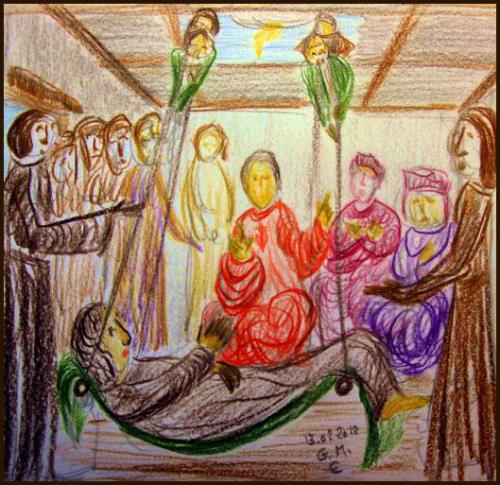
When he returned to Capernaum after some days, it was reported that he was at home. 2So many gathered around that there was no longer room for them, not even in front of the door; and he was speaking the word to them. 3Then some people* came, bringing to him a paralyzed man, carried by four of them. 4And when they could not bring him to Jesus because of the crowd, they removed the roof above him; and after having dug through it, they let down the mat on which the paralytic lay.5When Jesus saw their faith, he said to the paralytic, ‘Son, your sins are forgiven.’


What a scene! These friends are true problem solvers. Their paralyzed friend needs help and they head toward Jesus.  There were so many people that they couldn’t get in the house. So they head up to the roof and tear it open to lower their friend down to Jesus.  That is determination infused with deep love for their friend.  As you all shared story after story with me about Bob, this Bible story just shouted to be told.  I can imagine Bob up on that roof.  Quietly figuring out the physics of the friend on the mat, the ropes, the hole in the roof, and Jesus’ location.  Working with the other friends to figure out how to bring their paralyzed friend to Jesus’ attention.

On the flip-side, I can also see Bob as the friend on the mat.  The one who desperately needs care from other people and also needs the attention Jesus.  In my conversations with Bob, he was acutely aware of his imperfections – the limits of how far his humanity could get him.  And this is where his testimony as a Christian is so powerful.  He worshiped Sunday after Sunday with the awareness and humility of the paralyzed friend on the mat who can’t help but capture Jesus’ attention and hear Jesus’ promise of forgiveness of sins.

This begs a question to the opposite.  And that is, how might God go about getting our attention?  What are the means by which that may have been possible?  God, at some point, needs to grab our focus in ways that we might have some shot at understanding.  God needs to speak in human terms – much like the friends risking their own lives and limbs to lower their friend to Jesus.

Think about it this way: What are our first thoughts when we hear of someone who dives into a raging river to save someone from drowning, saves that person but succumbs and dies in the flood waters themselves?  What kinds of things do we say to honor the soldier who returns again and again to the firefight to save fallen friends?  Jesus says, “No one has greater love than this, to lay down one’s life for one’s friends.”  After all, how much more can be given?[1]  Jesus was tried, crucified, dead and buried.  In every way that the cross could be offensive, it is.

It’s offensive to think that the cross, and Jesus hanging there, was necessary or effective in any way.  That we even need saving is offensive.  That this appalling execution can change anything about real life seems at worst a massive deception and at best an utter folly.  And yet, alarmingly, and quite surprisingly, it does.  Jesus death on the cross changes everything because Jesus is God and God is Jesus.  And God’s self-sacrificing death on a cross means that God would rather die than lift a hand in violence against us.  This is the God that Bob counted on and this is the God that shows up for Bob.

Jesus is focused on the goal of bringing people back into relationship with God.  That is what the language of forgiveness means.  God is not irresistible. But God always takes us back. The self-sacrificing love of God, given fully on the cross, draws us back into relationship with God. [2]  God has already opened up whatever we perceive the barriers to be between us and God.

The love of God in Christ Jesus moves from God to us – we don’t create its momentum or its arrival, God’s love is simply given.  The love of God in Christ Jesus moves from God to Bob.  And because it is God’s movement to us, God’s movement to Bob, God gives us a future with hope as God also brings Bob into a future with God.  Amen.


[1] Craig Koester, class notes, Luther Seminary: Gospel of John class: John’s Theology of the Cross.  December 1, 2010.  I am sincerely grateful for Dr. Koester’s faithful witness as a master of holding aspects of Jesus Christ’s life and work in formative tension.  His work is beautiful, articulate, and draws me more deeply into faith and love of Jesus.

[2] Koester, course notes, 12/1/2010.  For further study see: Craig R. Koester, The Word of Life: A Theology of John’s Gospel (Grand Rapids: Eerdmans, 2008).


Called Good (Friday) for a Reason [OR Radical Inclusion is the Religious Freedom of the Cross] – John 18-19

Called Good (Friday) for a Reason – John 18-19

Caitlin Trussell with Augustana Lutheran Church for Good Friday on April 3, 2015


[sermon begins after the two Bible readings excerpted from John 18-19]

John 18:15-18, 25b-27   Simon Peter and another disciple followed Jesus. Since that disciple was known to the high priest, he went with Jesus into the courtyard of the high priest, 16 but Peter was standing outside at the gate. So the other disciple, who was known to the high priest, went out, spoke to the woman who guarded the gate, and brought Peter in. 17 The woman said to Peter, “You are not also one of this man’s disciples, are you?” He said, “I am not.” 18 Now the slaves and the police had made a charcoal fire because it was cold, and they were standing around it and warming themselves. Peter also was standing with them and warming himself.

25 Now Simon Peter was standing and warming himself. They asked him, “You are not also one of his disciples, are you?” He denied it and said, “I am not.” 26 One of the slaves of the high priest, a relative of the man whose ear Peter had cut off, asked, “Did I not see you in the garden with him?” 27 Again Peter denied it, and at that moment the cock crowed.

John 19:16-18, 25b-30, 40-42 Then [Pontius Pilate] handed him over to them to be crucified. So they took Jesus; 17 and carrying the cross by himself, he went out to what is called The Place of the Skull, which in Hebrew is called Golgotha. 18 There they crucified him, and with him two others, one on either side, with Jesus between them.

25b Meanwhile, standing near the cross of Jesus were his mother, and his mother’s sister, Mary the wife of Clopas, and Mary Magdalene. 26 When Jesus saw his mother and the disciple whom he loved standing beside her, he said to his mother, “Woman, here is your son.” 27 Then he said to the disciple, “Here is your mother.” And from that hour the disciple took her into his own home. 28 After this, when Jesus knew that all was now finished, he said (in order to fulfill the scripture), “I am thirsty.” 29 A jar full of sour wine was standing there. So they put a sponge full of the wine on a branch of hyssop and held it to his mouth. 30 When Jesus had received the wine, he said, “It is finished.” Then he bowed his head and gave up his spirit.

40 [Joseph of Arimathea] took the body of Jesus and wrapped it with the spices in linen cloths, according to the burial custom of the Jews. 41 Now there was a garden in the place where he was crucified, and in the garden there was a new tomb in which no one had ever been laid. 42 And so, because it was the Jewish day of Preparation, and the tomb was nearby, they laid Jesus there.


[sermon begins]


We began Lent on Ash Wednesday confronted with our own mortality.  Ashes are smeared on our foreheads in the sign of the cross and we are told, “Remember that you are dust, and to dust you shall return.”  A glaring reminder that life on the planet, our baptismal journey, ends in death.

Death leaves us longing for the spiritual. But in the meantime, we are stunned by its lack.  There is no heartbeat, no breath.  All is quiet.  From where we sit on this side of death there is no dressing it up.  At the bedside or roadside or war-side, wherever we encounter death, it is stark, austere, and unnerving in its lack of immediate meaning.  Death is simply absence.  Gone.  On this side of death, it is nothing more.

We begin Lent faced with our own mortality and a sign of the cross.  At the end of Lent this Good Friday, we are confronted by the cross itself.  Longing for the spiritual, we are stunned by its lack.  There is no heartbeat, no breath.  All is quiet after the betrayal, denial, ridicule, and execution.  The adrenalin fades.  The frantic hype is gone.  “It is finished.”  Jesus’ last words.  Finished.  All that’s left is to put him in a tomb and leave him there.

But the quiet of death breeds disquiet. Unnerved by the immediate lack of meaning the attempts to make meaning begin immediately.  Centuries of Christian thought have produced atonement theory after atonement theory.  Some more satisfactory than others.  Regardless, Gerhard Forde argues that all of these theories hold us “in a false relation to God,” most often reducing Jesus’ death to an unsatisfactory commercial transaction.[1]

Time and again in the New Testament, Jesus’ death is explained simply as “for us”.[2]  That is all.  “For us.”  Which necessarily means that Jesus died “for you.”  Jesus died for you.

Jesus died for you for the forgiveness of sins.  Because isn’t that what Jesus did in his life here on earth?  With the authority of God, he announced forgiveness time and again, and time and again, until finally he was killed for it.  Forgiveness, already available, already announced by Jesus, was that for which Jesus was killed.  He spoke a word of forgiveness until he hung on a cross for it.  For you.

The hands of the betrayer, the hands of the denier, the hands of the ridiculer, the hands of the executioner.  Those hands are ours hands in all the ways we take things into our own hands.  Determined to put conditions on what God’s gives to us unconditionally, we cannot hear this word of forgiveness.  We can’t hear it for other people.  And we can’t hear it for ourselves.

The cross is God’s answer to the re-imagining of God that we do. That re-imagining that leaves us separate from God.  Oh, so you think you know who God is?  Well, what about a God who hangs dead on a cross and gets buried in a tomb rather than use divine power over and against the very creatures whom God loves. Jesus said, “When I am lifted up, I will draw all people to myself.”  Jesus on the cross simultaneously reveals the scope of divine power poured out to reveal the depth of divine love as we are drawn toward God.  When the self-sacrificing love of God, given fully, is made known to you, when this message of divine love gets through to you, you are drawn by God back into relationship. [3]

With great intention, Jesus hangs on the cross.  And, in one of his final acts while still breathing, does something radical.  Jesus turns to his own mother and then to the beloved disciple and redefines their relationship with the cross in between them.  “‘Woman, here is your son…then he says to the disciple, ‘Here is your mother.’”

Not only does Jesus draw us into relationship with God through the cross but Jesus redefines our relationship with each other at the foot of the cross – standing with the cross between us, Jesus intervenes.  Drawn back into the relationship with God our Father, Jesus the Christ turns us towards each other in a new way.  And God knows the world needs us to be with each other differently than we are at the moment.  Look as close as the cranky person next door or exclusion laws masquerading as religious freedom in several of these United States.  And look as far away as murder by plane crash in the French Alps or execution across religious differences at the Garissa University in Kenya.  We need every bit of help we can get to stand down and stand with each other.  As Anne Lamott writes, “You can safely assume that you’ve created God in your own image when it turns out that God hates all the same people you do.”[4]

At the cross, love is freely taken up for us and for the sake of the people next to us.  In the same moment, we have everything to do with what happened at the cross and we have nothing to do with it.  We are culpable AND we are passive spectators who are being handed a stark realization of our common powerlessness.  In this way, the cross cannot be used as a method to live life.  The cross is the way we experience life.  Longing for the spiritual, we are often stunned by its lack.  Yes, the cross is the way we experience life.  Humbled by our participation in a death on a cross, made confident through the self-sacrificing love of God.  The cross is radically inclusive of all people which necessarily includes you.

Jesus says, “It is finished.”  Can you hear the whisper?  Finished.  His final moment. All that’s left is to put him in a tomb and leave him there.[5]


[1] Gerhard O. Forde.  A More Radical Gospel: Essays on Eschatology, Authority, Atonement, and Ecumenism (Eerdmans Publishing: Grand Rapids, 2004), 221.

[2] Ibid.

[3] Koester, course notes, 12/1/2010.  For further study see: Craig R. Koester, The Word of Life: A Theology of John’s Gospel (Grand Rapids: Eerdmans, 2008).

[4] Anne Lamott.  Traveling Mercies (New York: Pantheon Books, 1999).

[5] On Good Friday, cross and tomb are the focal point so that hope is reflected out of suffering that is real rather than as false optimism denying painful realities.