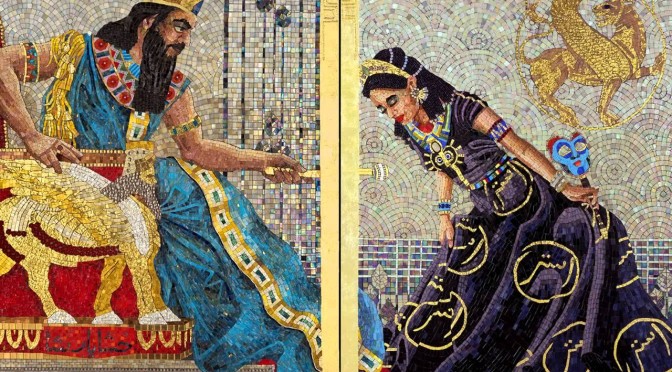
We Begin at the End [OR “YOU Are The Man”] Galatians 2:15-21; Luke 7:36-8:3; Psalm 32; and 2 Samuel 11:26-12:10, 13-15


Pastor Caitlin Trussell with Augustana Lutheran Church on June 12, 2016

[sermon begins after 2 Bible readings; the King David story and the Psalm are at the end of sermon]

Galatians 2:15-21 We ourselves are Jews by birth and not Gentile sinners; 16 yet we know that a person is justified not by the works of the law but through faith in Jesus Christ. And we have come to believe in Christ Jesus, so that we might be justified by faith in Christ, and not by doing the works of the law, because no one will be justified by the works of the law. 17 But if, in our effort to be justified in Christ, we ourselves have been found to be sinners, is Christ then a servant of sin? Certainly not! 18 But if I build up again the very things that I once tore down, then I demonstrate that I am a transgressor. 19 For through the law I died to the law, so that I might live to God. I have been crucified with Christ; 20 and it is no longer I who live, but it is Christ who lives in me. And the life I now live in the flesh I live by faith in the Son of God, who loved me and gave himself for me. 21 I do not nullify the grace of God; for if justification comes through the law, then Christ died for nothing.

Luke 7:36-8:3 One of the Pharisees asked Jesus to eat with him, and he went into the Pharisee’s house and took his place at the table. 37 And a woman in the city, who was a sinner, having learned that he was eating in the Pharisee’s house, brought an alabaster jar of ointment. 38 She stood behind him at his feet, weeping, and began to bathe his feet with her tears and to dry them with her hair. Then she continued kissing his feet and anointing them with the ointment. 39 Now when the Pharisee who had invited him saw it, he said to himself, “If this man were a prophet, he would have known who and what kind of woman this is who is touching him—that she is a sinner.” 40 Jesus spoke up and said to him, “Simon, I have something to say to you.” “Teacher,” he replied, “speak.” 41 “A certain creditor had two debtors; one owed five hundred denarii, and the other fifty. 42 When they could not pay, he canceled the debts for both of them. Now which of them will love him more?” 43 Simon answered, “I suppose the one for whom he canceled the greater debt.” And Jesus said to him, “You have judged rightly.” 44 Then turning toward the woman, he said to Simon, “Do you see this woman? I entered your house; you gave me no water for my feet, but she has bathed my feet with her tears and dried them with her hair. 45 You gave me no kiss, but from the time I came in she has not stopped kissing my feet. 46 You did not anoint my head with oil, but she has anointed my feet with ointment. 47 Therefore, I tell you, her sins, which were many, have been forgiven; hence she has shown great love. But the one to whom little is forgiven, loves little.” 48 Then he said to her, “Your sins are forgiven.” 49 But those who were at the table with him began to say among themselves, “Who is this who even forgives sins?” 50 And he said to the woman, “Your faith has saved you; go in peace.”
8:1 Soon afterwards he went on through cities and villages, proclaiming and bringing the good news of the kingdom of God. The twelve were with him, 2 as well as some women who had been cured of evil spirits and infirmities: Mary, called Magdalene, from whom seven demons had gone out, 3 and Joanna, the wife of Herod’s steward Chuza, and Susanna, and many others, who provided for them out of their resources.

My mother has given each of us kids many things over the years.  There is one gift that is relevant today.  It’s a Webster’s Encyclopedic Unabridged Dictionary of the English Language.  I and my siblings each have one. Included with the gift is a metal or wooden book stand to put it on.  People walk into my living room, see the huge book on its wrought iron stand and assume it’s an old family Bible. Easy mistake when you walk into a pastor’s home.  It’s not a Bible.  But the dictionary came in at a close second to the Bible in my family.

When we’d hear a word and didn’t know what it meant, Mom would send us to the dictionary, always opened on the book stand, with a quick, “Go look it up.”  The equivalent of an old school web search except with legs and paper.  Off we’d go and come back to report our findings.  Words are a memorable part of my childhood.  Now words are the tools of my trade in the pulpit and beyond.

In the Galatians reading, we find Paul emphasizing certain words through repetition.  Paul redirects the church in Galatia using words like justification, law, works, and faith over-and-over.  Much as they were for Paul, these four words are tools of the trade for Lutheran preachers, too.  Justification. Law. Works. Faith.  Four words that make sense when, off we go, to look up and find Christ on the heavy wood of the cross.  To paraphrase Martin Luther in the introductory words of his Galatians lectures, we begin at the end.[1]

We begin at the end and the end is our justification – being made right with God through what God did in Christ.  This is passive on our parts.[2]  Simply receiving by faith what God has already done for us.

Luther argues this about Paul’s purpose in the letter to the Galatians: “Paul wants to establish the doctrine of faith, grace, the forgiveness of sins or Christian righteousness, so that we may have a perfect knowledge and know the difference between Christian righteousness and all other kinds of righteousness.”

Then Luther goes on to list various kinds of righteousness including:

Political righteousness that politicians, philosophers, and lawyers consider in regards to guilt, innocence, and justice.

Ceremonial righteousness that Christians consider in regards to preaching, worship, and sacraments.

Lastly, Luther emphasizes the righteousness of the Law, the commandments – righteous, indeed, but only after the passiveness of faith is given.

I care so much about this passive gift of justification we receive by faith.  I care about it personally for myself and for people like me who were raised in different faith traditions in which you never knew if you were good with God. A lot of how God and I were doing had to do with how well I could keep up with my own active righteousness in the Law.  I care a lot about it for people who have grown up in with the message of passive justification by grace through faith and leave the tradition without understanding the magnitude of this promise.

Here’s Luther again on this topic:

“Thus human reason cannot refrain from looking at active righteousness, that is, its own righteousness…”[3]  We’re an active people, after all.  Passive is a word used in the world that is often given a negative meaning.  But passive in terms of justification is something to revel in – floating in that baptismal promise until we get all pruny.

If there one thing I know, it’s people and their sin.  I’m difficult to surprise with the ways people hurt themselves, each other, and the planet.  If there’s one thing I know better, it’s me and my own sin.  I also know what Luther is talking about as he warns about how easily we fall into trusting our own works, our own active righteousness by which we try to justify ourselves.[4]

In the snippet of the story from Second Samuel, King David stands accused by Nathan.  David wants the woman who is married to Uriah.  He sends Uriah to battle in the front lines with the knowledge that he would die.  Then he marries Uriah’s wife.  Nathan is sent to challenge David with the truth.  Nathan tells him a story about a man who has acted unjustly.  So unjustly has the man acted that David’s “anger was greatly kindled against the man.”[5]  Nathan turns to him and says, “YOU are the man.”[6]

“YOU are the man.”  It’s crushing to stand accused and have the accusation be true.  It’s easy to try to explain it away even when our own culpability is so obvious.  Last week Pastor Ann preached about compassion.  She used the example of the mother whose child ended up in the gorilla enclosure and how quickly the critique and defense began – self-righteousness pouring in from all sides in the news and social media storm.  Pastor Ann encouraged us to remove ourselves from the bandwagon of accusing, pointing fingers.  Slow down our rush to judgment and consider ourselves – our reactions, our own moments of culpability.

This week many of us can’t look away from a rape trial that happened on the prestigious Stanford campus.  The accused is obviously guilty and his father’s justification for a lenient sentence is splattered across the media.  The hue and cry is so great that Congress plans to read the woman’s letter to the rapist into the congressional record.

The thing that gets me about this case is it’s irrefutable.  The crime was public, witnessed. The heroes caught the perpetrator and stayed with the woman while awaiting emergency personnel.  There is no he-said-she-said confusion on this one.  If Nathan were standing with the accused, he might say to him, “YOU are the man.”

The last few weeks, much has been discussed in public about rape on college campuses that includes the sexual assault scandal at Baylor University along with the separate incident at Stanford.  As recently as yesterday, a missing 18 year old woman was found dead in Larimer County – her ex-boyfriend the suspect.  The sense of entitlement that wounds and kills women is appalling.  The temptation to be Nathan and the Pharisee with accusing, pointing fingers is great.  I’ve certainly indulged in my own finger pointing along this line.

There is a challenge here from the scripture.  Jesus says to Simon the Pharisee, “Do you see this woman?”  It’s a convicting question.  “Do you see this woman?”  Simon, so quick to point out the woman’s sin and shame, overlooks his own.  There are many ways we do this pointing and shaming similarly.  Actively justifying our goodness in the world.  “Active righteousness” as Luther would call it.  Stacking up the good-wins in a column.  What would happen if we put our efforts to name ourselves righteous to the side?  Put our fingers away for a moment.  Specifically, confessing the ways that we as both men and women participate in a culture and a world that preys on women.

What would happen if our starting place is passive righteousness?  As Paul says it in verse from Galatians, “I have been crucified with Christ; it is no longer I who live but Christ who lives in me.”  What would happen?  Would Christ in us free us to confess our culpability in this culture that preys on women?  Would we become part of a culture shift?  Would we find the relief that the psalmist describes so well?   The Psalmist writes, “Then I acknowledged my sin to you, and I did not hide my iniquity; I said, “I will confess my transgressions to the Lord,” and you forgave the guilt of my sin… You are a hiding place for me; you preserve me from trouble; you surround me with glad cries of deliverance.”[7]

Passive righteousness is the end that serves as our beginning.  From there we begin living lives of courage.  We begin at the end – no longer content to let our own sin go unspoken.  This kind of courage is a bit thin in the culture at the moment and is an oh-so-desperately-needed gift.  This is a gift Christ offers through us for the sake of the world.  Claim the promise as you move through your week.  Say to yourself, “It is not I, but Christ who lives in me.”  This is most certainly true.


[1] Martin Luther. Introductory paragraph to Lectures on Galatians in Luther’s Works Volume 26, 1535.  (St. Louis: Concordia Publishing House, 1963), [3].

[2] Martin Luther, [4]

[3] Martin Luther, 5.

[4] Martin Luther, 9.

[5] 2 Samuel 12:5

[6] 2 Samuel 12:7

[7] Psalm 32:5, 7


Psalm 32 Happy are those whose transgression is forgiven, whose sin is covered. 2 Happy are those to whom the Lord imputes no iniquity, and in whose spirit there is no deceit. 3 While I kept silence, my body wasted away through my groaning all day long. 4 For day and night your hand was heavy upon me; my strength was dried up as by the heat of summer. (Selah) 5 Then I acknowledged my sin to you, and I did not hide my iniquity; I said, “I will confess my transgressions to the Lord,” and you forgave the guilt of my sin. (Selah) 6 Therefore let all who are faithful offer prayer to you; at a time of distress, the rush of mighty waters shall not reach them. 7 You are a hiding place for me; you preserve me from trouble; you surround me with glad cries of deliverance. (Selah) 8 I will instruct you and teach you the way you should go; I will counsel you with my eye upon you. 9 Do not be like a horse or a mule, without understanding, whose temper must be curbed with bit and bridle, else it will not stay near you. 10 Many are the torments of the wicked, but steadfast love surrounds those who trust in the Lord. 11 Be glad in the Lord and rejoice, O righteous, and shout for joy, all you upright in heart.

2 Samuel 11:26-12:10, 13-15 When the wife of Uriah heard that her husband was dead, she made lamentation for him. 27 When the mourning was over, David sent and brought her to his house, and she became his wife, and bore him a son. But the thing that David had done displeased the Lord,
12:1 and the Lord sent Nathan to David. He came to him, and said to him, “There were two men in a certain city, the one rich and the other poor. 2 The rich man had very many flocks and herds; 3 but the poor man had nothing but one little ewe lamb, which he had bought. He brought it up, and it grew up with him and with his children; it used to eat of his meager fare, and drink from his cup, and lie in his bosom, and it was like a daughter to him. 4 Now there came a traveler to the rich man, and he was loath to take one of his own flock or herd to prepare for the wayfarer who had come to him, but he took the poor man’s lamb, and prepared that for the guest who had come to him.” 5 Then David’s anger was greatly kindled against the man. He said to Nathan, “As the Lord lives, the man who has done this deserves to die; 6 he shall restore the lamb fourfold, because he did this thing, and because he had no pity.” 7 Nathan said to David, “You are the man! Thus says the Lord, the God of Israel: I anointed you king over Israel, and I rescued you from the hand of Saul; 8 I gave you your master’s house, and your master’s wives into your bosom, and gave you the house of Israel and of Judah; and if that had been too little, I would have added as much more. 9 Why have you despised the word of the Lord, to do what is evil in his sight? You have struck down Uriah the Hittite with the sword, and have taken his wife to be your wife, and have killed him with the sword of the Ammonites. 10 Now therefore the sword shall never depart from your house, for you have despised me, and have taken the wife of Uriah the Hittite to be your wife.13 David said to Nathan, “I have sinned against the Lord.” Nathan said to David, “Now the Lord has put away your sin; you shall not die. 14 Nevertheless, because by this deed you have utterly scorned the Lord, the child that is born to you shall die.” 15 Then Nathan went to his house. The Lord struck the child that Uriah’s wife bore to David, and it became very ill.


En Pointe, On Point: Dance Made It More Possible For Me To Live [OR Holy Trinity Sunday] John 16:12-15; Proverbs 8:1-4, 22-31; and Romans 5:1-5                    

Pastor Caitlin Trussell with Augustana Lutheran Church on May 22 2016

[sermon begins after 3 Bible readings; they’re all too good]

John 16:12-15 “I still have many things to say to you, but you cannot bear them now. 13 When the Spirit of truth comes, he will guide you into all the truth; for he will not speak on his own, but will speak whatever he hears, and he will declare to you the things that are to come. 14 He will glorify me, because he will take what is mine and declare it to you. 15 All that the Father has is mine. For this reason I said that he will take what is mine and declare it to you.

Romans 5:1-5 Therefore, since we are justified by faith, we have peace with God through our Lord Jesus Christ, 2 through whom we have obtained access to this grace in which we stand; and we boast in our hope of sharing the glory of God. 3 And not only that, but we also boast in our sufferings, knowing that suffering produces endurance, 4 and endurance produces character, and character produces hope, 5 and hope does not disappoint us, because God’s love has been poured into our hearts through the Holy Spirit that has been given to us.

Proverbs 8:1-4, 22-31 1 Does not wisdom call, and does not understanding raise her voice?
2 In the heights, beside the way, at the crossroads she takes her stand;
3 beside the gates in front of the town, at the entrance of the portals she cries out:
4 “To you, O people, I call, and my cry is to all that live.
22 The Lord created me at the beginning of his work, the first of his acts of long ago.
23 Ages ago I was set up, at the first, before the beginning of the earth.
24 When there were no depths I was brought forth, when there were no springs abounding with water.
25 Before the mountains had been shaped, before the hills, I was brought forth—
26 when he had not yet made earth and fields, or the world’s first bits of soil.
27 When he established the heavens, I was there, when he drew a circle on the face of the deep,
28 when he made firm the skies above, when he established the fountains of the deep,
29 when he assigned to the sea its limit, so that the waters might not transgress his command, when he marked out the foundations of the earth,
30 then I was beside him, like a master worker; and I was daily his delight, rejoicing before him always,
31 rejoicing in his inhabited world and delighting in the human race.

[sermon begins]


Jesus tells his disciples that, “I still have many things to say to you, but you cannot bear them now.”  That’s about as frustrating on the listeners’ side as it can get.  Imagine someone telling you that they’d fill you in on the main things if only you could understand them.  This happens all the time when we’re children.  The kids in the room know what I’m talking about.  In fact, Jesus starts his speech that includes the reading from John today by calling his disciples, “Little children…”[1]  Judas betrays Jesus, skulks off into the night, and Jesus starts talking using the endearment of “little children.”  There is a kindness in the endearment but there is also a limit that Jesus places on his listeners.  He knows and tells them that they cannot bear the weight of what he has to say.

When I was four, my feet found their way into a pair of ballet slippers.  There’s was a lot to learn.  A lot of strength to be gained.  But mostly, from my newly slippered perspective, there was love of the dance.  Body and music working together to make something new along with sounds of Bach and Tchaikovsky.  Classical ballet was a fairly consistent part of life even with the family relocations.  I don’t know how my mother did it through some of the family chaos.  It’s possible it made me easier to live with.  But truly, in hindsight, dance made it more possible for me to live.

Around the age of 13, my ballet teacher started talking about point shoes.  You know these shoes.  They’re part of the classic image of ballet dancers moving around on their toes.  For the dancer, point shoes are a big moment.  The joy of that moment of readiness is heady and alive.  There is much that goes into being ready.  Dancing en pointe means the strength and coordination are there to bear the weight of the body.  When the strength isn’t there – the toes can’t bear the body weight and it’s highly possible there will be pain and a lot of it.

Similarly, Jesus knows his disciples aren’t ready to bear the weight of what he has to say.  At this point in the story, Jesus is still alive.  There is no crucifixion or resurrection to give the disciples perspective.  Paul’s letter to the Romans is well after the crucifixion as the early church is making sense of what happened to Jesus.  Paul talks about the experience of suffering moving to endurance, character and, finally, hope.  Hope that comes through the love of God by the power of the Holy Spirit.  That’s a lot for him to put in one or two sentences.  Let’s slow it down a bit.

In the midst of suffering, it’s hard to have perspective and even harder when someone tries to give you their perspective.  It’s like the time-space continuum starts moving really differently.  This happens when you’re sick enough to land in the hospital or losing a loved one or lost a job or making a tough move or fighting depression.  Perspective is possible typically only after there’s been an experience and time passes.  Even then it can be a stretch to look back on the experience, realize you’ve come through it, and make any meaning out of it – framing it with other experiences.

We tend to think of this individually.  But the Proverbs reading tells us that Wisdom speaks publically.  “On the heights, beside the way, at the crossroads she takes her stand; beside the gates in front of the town, at the entrance of the portals she cries out…”  Wisdom speaks publically in the places where people are together.  Also in the Proverbs reading, Wisdom holds the perspective of time.  Before the beginning of the earth, before the heavens and the deep, Wisdom was there.  Part of wisdom is public when people are together and part of wisdom is time.  It’s difficult to gain perspective when we’re alone in the middle a mess.

Before seminary and becoming a pastor, I spent about 10 years as an adult worshiper. Listening to sermons was a highlight of worship and my week. Scripture and life come together – sometimes like a breath of fresh air and sometimes in a gnarly collision. Sometimes I agreed with the preacher and sometimes I didn’t.  Mostly I was thankful for the reminders week-after-week that the people described by scripture were often just as lost, just as forgetful, just as gifted, and just as loved by God as I am in this beautiful struggle called life.

I needed and still need the forgiveness and strength that are given freely week-after-week in confession, preaching, bread, and wine and reinforced by the worship liturgy both in words and body motion. When I worship now as a pastor, I’m still grateful for the chances to hear another preacher remind us that we’re just as lost, forgetful, gifted, and loved as everybody else.  That is a gift of perspective.  A gift of wisdom.

For ballet dancers, being ready to dance is partly about practicing coordinated movement with other dancers.  For people of faith, living this beautiful struggle called life is partly about regularly practicing the faith with other people.  Just as the disciples are together with Jesus in the Bible reading today, we are together with Jesus through scripture and worship by the power of the Holy Spirit.  So together, the Holy Spirit draws us into perspective and hope through the love of God.

This Sunday, we celebrate the Holy Trinity – God the Father, Jesus the Son, and the Holy Spirit.  The Trinity is shared experience of otherness within itself – separate yet whole.  A mystery revealed to us by Jesus who suffered, died, and lives again. The Trinity integrates us into shared experience with God and with each other through worship and life in the world.

The dance between Father – Spirit – Son makes it possible for us to live.

No one says it like Paul says it to the Roman church and also to us:

“Therefore, since we are justified by faith, we have peace with God through our Lord Jesus Christ, 2 through whom we have obtained access to this grace in which we stand; and we boast in our hope of sharing the glory of God. 3 And not only that, but we also boast in our sufferings, knowing that suffering produces endurance, 4 and endurance produces character, and character produces hope, 5 and hope does not disappoint us, because God’s love has been poured into our hearts through the Holy Spirit that has been given to us.”

Amen and thanks be to God.


Hymn of the Day sung by everyone in response to the sermon.

Come, Join the Dance of Trinity (ELW 412)

Come, join the dance of Trinity, before all worlds begun –

The interweaving of the Three, the Father, Spirit, Son.

The universe of space and time did not arise by chance,

But as the Three, in love and hope, made room within their dance.


Come see the face of Trinity, newborn in Bethlehem;

Then bloodied by a crown of thorns outside Jerusalem.

The dance of Trinity is meant for human flesh and bone;

When fear confines the dance in death, God rolls away the stone.


Come, speak aloud of Trinity, as wind and tongues of flame

Set people free at Pentecost to tell the Savior’s name.

We know the yoke of sin and death, our necks have worn it smooth;

Go tell the world of weight and woe that we are free to move!


Within the dance of Trinity, before all worlds begun,

We sing the praises of the Three, the Father, Spirit, Son.

Let voices rise and interweave, by love and hope set free,

To shape in song this joy, this life: the dance of Trinity.

[1] John 13:33a [Jesus says to his disciples] “Little children, I am with you only a little longer…”


Lin-Manuel Miranda of “Hamilton” Asks: “What’s the thing that’s not in the world that should be in the world?”  [OR: A Sermon for Pentecost]  John 14:8-17, 25-27; Genesis 11:1-6; Romans 8:14-17; Acts 2:1-21

Pastor Caitlin Trussell with Augustana Lutheran Church on May 15, 2016

[Sermon begins after the John reading. The Acts, Romans, and Genesis Bible readings are at the end of the sermon]

John 14:8-17, 25-27 Philip said to him, “Lord, show us the Father, and we will be satisfied.” 9 Jesus said to him, “Have I been with you all this time, Philip, and you still do not know me? Whoever has seen me has seen the Father. How can you say, “Show us the Father’? 10 Do you not believe that I am in the Father and the Father is in me? The words that I say to you I do not speak on my own; but the Father who dwells in me does his works. 11 Believe me that I am in the Father and the Father is in me; but if you do not, then believe me because of the works themselves. 12 Very truly, I tell you, the one who believes in me will also do the works that I do and, in fact, will do greater works than these, because I am going to the Father. 13 I will do whatever you ask in my name, so that the Father may be glorified in the Son. 14 If in my name you ask me for anything, I will do it. 15 “If you love me, you will keep my commandments. 16 And I will ask the Father, and he will give you another Advocate, to be with you forever. 17 This is the Spirit of truth, whom the world cannot receive, because it neither sees him nor knows him. You know him, because he abides with you, and he will be in you.
25 “I have said these things to you while I am still with you. 26 But the Advocate, the Holy Spirit, whom the Father will send in my name, will teach you everything, and remind you of all that I have said to you. 27 Peace I leave with you; my peace I give to you. I do not give to you as the world gives. Do not let your hearts be troubled, and do not let them be afraid.

[sermon begins]

One reason to get to a doctor’s appointment early is to fill out paperwork.  Another, more fun reason, is to cruise the magazines.  I’ve learned gems about stream fishing, NFC West football teams, and the latest architectural trends.  Most recently, Time Magazine’s 100 Most Influential People edition caught my eye.  I started it in a doctor’s office and, in a rare move, picked up a copy at the grocery story to finish it.  My curiosity was piqued by Lin-Manuel Miranda.[1]  He wrote and starred in the musical “Hamilton” that is nominated for 16 Tony Awards.  On his play-writing process, Mr. Miranda says, “I think of it like this, what’s the thing that’s not in the world that should be in the world?” Great question. “What’s the thing that’s not in the world that should be in the world?”

It’s a question that moves beyond simply reacting to events.  What I mean by “reacting to events,” is a bit Newtonian.  A lot of us learned this in school somewhere along the way – that every action has an equal and opposite reaction.  Action-reaction.  Except, somewhere along the way in human relationships, it became fashionable to escalate our reactions to stratospheric proportions.  No longer action-reaction. It’s action-super reaction.  And fear is the catalyst that seems to speed up the reaction time.  When left to its own devices, fear reactions quickly move beyond the processing speed of our brains’ gray matter.  A useful tidbit about fear…just because you think you’re thinking, doesn’t mean you’re using higher brain functioning.  Fear-based, reactive thinking tends to boil down to concerns about rewards and punishments.

The Genesis reading this morning about the Tower of Babel is a case in point.  The people make a plan to prevent being “scattered abroad upon the face of the whole earth.”[2] The plan involves available materials – “brick for stone and bitumen for mortar.”[3]  To build themselves “a city and a tower with a top in the heavens.” Their plan doesn’t work out as their language is confused and they’re “scattered abroad from there over all the earth, and they left off building the city.”  Their fear and plan didn’t prevent a thing.

Paul speaks directly about fear in his letter to the Roman church:

14 ‘For all who are led by the Spirit of God are children of God. 15 For you did not receive a spirit of slavery to fall back into fear, but you have received a spirit of adoption. When we cry, “Abba! Father!” 16 it is that very Spirit bearing witness with our spirit that we are children of God…’

Not a spirit of slavery to fall back into fear, but a spirit of adoption as children of God.  I highly recommend reading the full chapter of Romans 8 when you get the chance this week.  It pretty much rocks.

As creatures made in the image of God, we can think about the past and imagine into the future.[4] Sometimes we’ll get it right.  Sometimes we won’t.  This is why Mr. Miranda’s question is so enlivening. “What’s the thing that’s not in the world that should be in the world?”  Notice that the question is NOT, “What’s the thing in the world that I most need to protect myself from?”  It’s also NOT, “What’s the thing in the world that I most need to be anxious about?”

Mr. Miranda’s question kindles the imagination.  It is a creative question.  At the Rocky Mountian Synod Assembly two weeks ago, Dr. Shauna Hannan gave the key note series.[5]  She is a preaching professor at Pacific Lutheran Theological Seminary.  Her key-note was separated into four talks about creativity – God’s, creation’s, ours, and the Bible’s.  She led us through worshipful and specific creative tasks by way of the creation story in Genesis 1.  She talked about being aware of roadblocks to creativity.  One of my own roadblocks is fear.  When I’m fearful or anxious about an outcome – like, let’s just say a sermon deadline when the thoughts won’t gel and life is full – it’s tough for the imagination to kick in.

When we think about “creativity,” the tendency is to think of the arts – painting, poetry, dance, photography, etc.  Pentecost even inspires this artistic focus. There’s the vibrant red to symbolize the Holy Spirit and the “divided tongues, as of fire” that appeared among the people.  Look up images for Pentecost and flames abound.

Pentecost is one of those slippery church festival days because there is no explanation for it.  The sight of flames and people from all over the known 1st century world.  The sound of rushing wind and all those languages.  The Bible verses in Acts practically scream to be rendered artistically because the intellect is insufficient to capture it.  That’s the beauty of art and the wonder of a creating God.  On the creating process, God answers the question, “What’s the thing that’s not in the world that should be in the world?”  God’s answer?  The church.

Oh sure, there are many examples of the church regressing into “a spirit of slavery to fall back into fear.”[6] The church has done more than its share of injury to the world in crusading around sowing blame and reaping death.  There is much to confess, repair, and reconcile still today.

Did you also know that the church raced into towns during pandemics throughout the centuries?[7] Christians nursed the sick into health and consoled the dying. While some died themselves, others developed immunity to the deadly diseases and continued their work. Could this be a little of what Jesus means in the Gospel of John when he tells his disciples that they “will do greater works” than even Jesus?![8]

Most of what happens in the world, especially the good and the kind, is quieter.  The church will occasionally take on acts that have magnitude.  This congregation even has a few of those under its belt.  However, discounting the magnitude of our individual, faithful actions is habitual.  Most of what happens in the world – especially the good and the kind – doesn’t make the front page or go viral on YouTube or get nominated for 16 Tony awards. More often the church moves into the world less visibly through people of faith like you and me.

The creativity of that church looks a million different ways – bringing things that are not yet in the world but should be in the world.  It looks like speaking a kind word at the risk of appearing weak, de-escalating a tense scene, or sitting with someone in pain. It looks like company owners paying a living wage to their employees. It looks like hiring someone with a criminal record and not knowing if redemption is possible.  I know you can add to this list with experiences you’ve had on the receiving end of someone else’s creative interaction with you.  The good news is that we have a companion in creating what should be in the world for the sake of the world.

Jesus says in the Gospel of John:

“I have said these things to you while I am still with you. 26 But the Advocate, the Holy Spirit, whom the Father will send in my name, will teach you everything, and remind you of all that I have said to you. 27 Peace I leave with you; my peace I give to you. I do not give to you as the world gives. Do not let your hearts be troubled, and do not let them be afraid.”

Here’s the good news.  We are baptized and sent by the Holy Spirit as people of faith in the world to bring new things into the world in obedience to God our Father.  Our companion is the Spirit of dreams and visions.[9]  The prayer we pray over the newly baptized is a good prayer for us today as we have received a Spirit of adoption and are given peace by the same Spirit.[10]

Let us pray. We give you thanks, O God, that through water and the Holy Spirit you give your daughters and sons new birth, cleanse them from sin, and raise them to eternal life.  Sustain us with the gift of your Holy Spirit: the spirit of wisdom and understanding, the spirit of counsel and might, the spirit of knowledge and the fear of the Lord, the spirit of joy in your presence, both now and forever.  Amen.


[1] Time. The 100 Most Influential People: Lin-Manuel Miranda. Combined issue for May 2 and May 9, 2016. http://time.com/4299633/lin-manuel-miranda-2016-time-100/

[2] Genesis 11:4

[3] Genesis 11:3

[4] Pastor Deb Coté, Pastors’ Text Study conversation on May 10, 2016. Genesis 1:27

[5] Shauna K. Hannan, Ph.D., Biography Link: http://www.plts.edu/faculty/profile.php?id=shannan

[6] Romans 8:14-17

[7] Charles E. Moore. Pandemic Love: http://www.plough.com/en/topics/faith/discipleship/pandemic-love.  Rev. Moore is an educator and lives in the Bruderhof, an intentional community based on Jesus’ Sermon on the Mount.

[8] John 4:12

[9] Acts 2:17

[10] Romans 8:15  and John 14:27

___________________________________

Romans 8:14-17 14 For all who are led by the Spirit of God are children of God. 15 For you did not receive a spirit of slavery to fall back into fear, but you have received a spirit of adoption. When we cry, “Abba! Father!” 16 it is that very Spirit bearing witness with our spirit that we are children of God, 17 and if children, then heirs, heirs of God and joint heirs with Christ—if, in fact, we suffer with him so that we may also be glorified with him.

Genesis 11:1-9 Now the whole earth had one language and the same words. 2And as they migrated from the east,* they came upon a plain in the land of Shinar and settled there. 3And they said to one another, ‘Come, let us make bricks, and burn them thoroughly.’ And they had brick for stone, and bitumen for mortar. 4Then they said, ‘Come, let us build ourselves a city, and a tower with its top in the heavens, and let us make a name for ourselves; otherwise we shall be scattered abroad upon the face of the whole earth.’ 5The Lord came down to see the city and the tower, which mortals had built. 6And the Lord said, ‘Look, they are one people, and they have all one language; and this is only the beginning of what they will do; nothing that they propose to do will now be impossible for them.7Come, let us go down, and confuse their language there, so that they will not understand one another’s speech.’ 8So the Lord scattered them abroad from there over the face of all the earth, and they left off building the city. 9Therefore it was called Babel, because there the Lord confused*the language of all the earth; and from there the Lord scattered them abroad over the face of all the earth.

Acts 2:1-21  When the day of Pentecost had come, they were all together in one place. 2 And suddenly from heaven there came a sound like the rush of a violent wind, and it filled the entire house where they were sitting. 3 Divided tongues, as of fire, appeared among them, and a tongue rested on each of them. 4 All of them were filled with the Holy Spirit and began to speak in other languages, as the Spirit gave them ability. 5 Now there were devout Jews from every nation under heaven living in Jerusalem. 6 And at this sound the crowd gathered and was bewildered, because each one heard them speaking in the native language of each. 7 Amazed and astonished, they asked, “Are not all these who are speaking Galileans? 8 And how is it that we hear, each of us, in our own native language? 9 Parthians, Medes, Elamites, and residents of Mesopotamia, Judea and Cappadocia, Pontus and Asia, 10 Phrygia and Pamphylia, Egypt and the parts of Libya belonging to Cyrene, and visitors from Rome, both Jews and proselytes, 11 Cretans and Arabs—in our own languages we hear them speaking about God’s deeds of power.” 12 All were amazed and perplexed, saying to one another, “What does this mean?” 13 But others sneered and said, “They are filled with new wine.” 14 But Peter, standing with the eleven, raised his voice and addressed them, “Men of Judea and all who live in Jerusalem, let this be known to you, and listen to what I say. 15 Indeed, these are not drunk, as you suppose, for it is only nine o’clock in the morning. 16 No, this is what was spoken through the prophet Joel: 17 “In the last days it will be, God declares, that I will pour out my Spirit upon all flesh, and your sons and your daughters shall prophesy, and your young men shall see visions, and your old men shall dream dreams. 18 Even upon my slaves, both men and women, in those days I will pour out my Spirit; and they shall prophesy. 19 And I will show portents in the heaven above and signs on the earth below, blood, and fire, and smoky mist. 20 The sun shall be turned to darkness and the moon to blood, before the coming of the Lord’s great and glorious day. 21 Then everyone who calls on the name of the Lord shall be saved.’


Redemption: Vader, Peter…you?  John 21:1-19 and Acts 9:1-20

Pastor Caitlin Trussell with Augustana Lutheran Church on April 10, 2016

[sermon begins after two chunky Bible stories from John and Acts]

John 21:1-19 After these things Jesus showed himself again to the disciples by the Sea of Tiberias; and he showed himself in this way. 2 Gathered there together were Simon Peter, Thomas called the Twin, Nathanael of Cana in Galilee, the sons of Zebedee, and two others of his disciples. 3 Simon Peter said to them, “I am going fishing.” They said to him, “We will go with you.” They went out and got into the boat, but that night they caught nothing. 4 Just after daybreak, Jesus stood on the beach; but the disciples did not know that it was Jesus. 5 Jesus said to them, “Children, you have no fish, have you?” They answered him, “No.” 6 He said to them, “Cast the net to the right side of the boat, and you will find some.” So they cast it, and now they were not able to haul it in because there were so many fish. 7 That disciple whom Jesus loved said to Peter, “It is the Lord!” When Simon Peter heard that it was the Lord, he put on some clothes, for he was naked, and jumped into the sea. 8 But the other disciples came in the boat, dragging the net full of fish, for they were not far from the land, only about a hundred yards off. 9 When they had gone ashore, they saw a charcoal fire there, with fish on it, and bread. 10 Jesus said to them, “Bring some of the fish that you have just caught.” 11 So Simon Peter went aboard and hauled the net ashore, full of large fish, a hundred fifty-three of them; and though there were so many, the net was not torn. 12 Jesus said to them, “Come and have breakfast.” Now none of the disciples dared to ask him, “Who are you?” because they knew it was the Lord. 13 Jesus came and took the bread and gave it to them, and did the same with the fish. 14 This was now the third time that Jesus appeared to the disciples after he was raised from the dead. 15 When they had finished breakfast, Jesus said to Simon Peter, “Simon son of John, do you love me more than these?” He said to him, “Yes, Lord; you know that I love you.” Jesus said to him, “Feed my lambs.” 16 A second time he said to him, “Simon son of John, do you love me?” He said to him, “Yes, Lord; you know that I love you.” Jesus said to him, “Tend my sheep.” 17 He said to him the third time, “Simon son of John, do you love me?” Peter felt hurt because he said to him the third time, “Do you love me?” And he said to him, “Lord, you know everything; you know that I love you.” Jesus said to him, “Feed my sheep. 18 Very truly, I tell you, when you were younger, you used to fasten your own belt and to go wherever you wished. But when you grow old, you will stretch out your hands, and someone else will fasten a belt around you and take you where you do not wish to go.” 19 (He said this to indicate the kind of death by which he would glorify God.) After this he said to him, “Follow me.”

Acts 9:1-20 Meanwhile Saul, still breathing threats and murder against the disciples of the Lord, went to the high priest 2 and asked him for letters to the synagogues at Damascus, so that if he found any who belonged to the Way, men or women, he might bring them bound to Jerusalem. 3 Now as he was going along and approaching Damascus, suddenly a light from heaven flashed around him. 4 He fell to the ground and heard a voice saying to him, “Saul, Saul, why do you persecute me?” 5 He asked, “Who are you, Lord?” The reply came, “I am Jesus, whom you are persecuting. 6 But get up and enter the city, and you will be told what you are to do.”
7 The men who were traveling with him stood speechless because they heard the voice but saw no one. 8 Saul got up from the ground, and though his eyes were open, he could see nothing; so they led him by the hand and brought him into Damascus. 9 For three days he was without sight, and neither ate nor drank. 10 Now there was a disciple in Damascus named Ananias. The Lord said to him in a vision, “Ananias.” He answered, “Here I am, Lord.” 11 The Lord said to him, “Get up and go to the street called Straight, and at the house of Judas look for a man of Tarsus named Saul. At this moment he is praying, 12 and he has seen in a vision a man named Ananias come in and lay his hands on him so that he might regain his sight.” 13 But Ananias answered, “Lord, I have heard from many about this man, how much evil he has done to your saints in Jerusalem; 14 and here he has authority from the chief priests to bind all who invoke your name.” 15 But the Lord said to him, “Go, for he is an instrument whom I have chosen to bring my name before Gentiles and kings and before the people of Israel; 16 I myself will show him how much he must suffer for the sake of my name.” 17 So Ananias went and entered the house. He laid his hands on Saul and said, “Brother Saul, the Lord Jesus, who appeared to you on your way here, has sent me so that you may regain your sight and be filled with the Holy Spirit.” 18 And immediately something like scales fell from his eyes, and his sight was restored. Then he got up and was baptized, 19 and after taking some food, he regained his strength. For several days he was with the disciples in Damascus, 20 and immediately he began to proclaim Jesus in the synagogues, saying, “He is the Son of God.”

[sermon begins]

Picture a dinner table.  My husband Rob and my almost 17-year-old daughter Taryn are eating and chatting.  I get to talking about how I’ve been thinking about redemption lately.  (I’m pretty fun at a dinner table, let me tell you.) I talk a little about wondering what redemption means today and what redemption stories make sense to people across groups.  And then I say, “So I’ve been thinking about Darth Vader.”[1]  Without even a pause to blink, Taryn turns to her dad and says, “I thought she was going to say something about Jesus.”  Much hilarity ensues.

But she wasn’t far off in her assumption.  I’d been pondering the upcoming Bible verses that we heard read in worship today.  I’ve known they’ve been coming for a few weeks.  Deciding what to preach on Good Friday from Jesus’ Passion came from looking ahead to see when this story about Peter and Jesus would be told.[2]  There it was, scheduled for today.

The Good Friday sermon just before Easter Sunday emphasized the part of the Passion story when Peter denies knowing Jesus three times.[3] Peter is one of the original twelve disciples. He knows Jesus very well. Peter’s pledge of allegiance to the death was still warm when he started telling people he didn’t know Jesus.[4] Peter’s denials happen in the dark of night, over a charcoal fire, during Jesus’ crucifixion trial.  He chooses camouflage over courage and saying the easy thing over the right thing.  His denials of Jesus are an epic fail.  And Peter knows it.

In the Bible verses today, there’s Jesus standing on the beach just after daybreak.  Having apparently worked up quite the appetite after his resurrection, he cooks breakfast over a charcoal fire.  He passes around loaves and fish.  Everyone eats.  Then Jesus and Peter have their moment that includes questions, love, and ways to make amends.

Three denials from Peter before the crucifixion. Three pledges of love following the resurrection.  And Jesus in between those denials and pledges.  Jesus opens up a moment of redemption for Peter.  Interesting that Peter didn’t instigate this moment.  He didn’t launch into explanation or confession or ask for forgiveness.  Interesting that he’s hurt when Jesus keeps asking about the love.  Although Jesus would have at least three reasons to doubt what a profession of love from Peter means on the ground.  And, still, redemption comes whether or not Peter instigates it or understands it.

Saul’s story from the Acts reading is also one of redemption.  This man known as Saul zealously guards the faith of his ancestors to the point of attending the stoning of Jesus followers.  He watches the coats of the witnesses during the stoning and approves of the killing.[5]  He was hunting “anyone who belong to the Way, men or women,” so that “he might bring them bound to Jerusalem.”  Saul is frightening and poses real threat to people who don’t agree with him.  He is blinded on his way to do terrible things and Ananias is sent to him to heal him.

Ananias has no interest in being with the man who very recently was part of butchering Jesus followers.  Who can blame him?  But Ananias goes and does what is asked of him.  Saul immediately became a preacher.  Saul is “also known as Paul.”[6]  He ends up starting churches of Jesus followers and encouraging them with his visits and the letters we now read as part of the New Testament.  He is, in short, a man redeemed.

What is it about redemption?  People doing horrible things and seeming beyond all help.  Something happens.  And they are on a new course.  Relating differently to the people around them.  I wasn’t kidding when I said that I’d been thinking about Darth Vader.  The story of Star Wars is a long arc to Vader’s redemption.  (I’m not addressing the 7th film in this statement).  Audiences cheer it.  Fans argue about it.  There’s something about redemption that captures our imagination.

For Peter and Paul, and one could argue Vader, there are people involved in these redemption stories.  For Peter, there is Jesus in his resurrected body.  For Paul, there is Ananias who is fearful and faithful.  For Vader, there is Luke.  Bottom line: There are other people involved in the redemption.

As part of my work at the women’s prison, I met a woman we’ll call Jane.  During the Bible Study before Friday evening worship, the group of women and I were discussing the Ten Commandments found in the book of Exodus.[7]  Jane eventually raised her hand and said that she had broken every one of the commandments.  She looked at the Bible verses again, nodded, and said, “Yup, every one.”  She talked about Jesus’ love and the church in which she heard about it, not believing it could be for her.  Until, one day, she did.

I attended a parole hearing for Jane who was to serve a life sentence for murdering her lover’s wife.  The family of the woman who was murdered was outraged that the hearing was even happening.  Jane did not receive parole at that time.  She did eventually.  Jane’s story is not an easy one. There is carnage in her history.  Her redemption is messy, fragile, and uncomfortable – for her victim’s family and, therefore, for her.  You can’t pretty it up with a bow or a Hollywood movie or a sermon.

What about those of us who may not have as big of a story as Jane, Peter, or Paul?  What about redemption stories that simmer quietly and are still in their “before” moment?  Some of us know what I’m talking about.  Whether it’s quiet addictions that are slowly breaking relationships – a favored chemical or porn or incessant gaming.  Or behind-the-scenes behavior that can be masked in public – rage and abuse that is verbal or violent or sexual.  Or public behavior that is deemed acceptable but destroys people – jonesing after power by way of gossip or ridicule or racism.

Redemption doesn’t erase the reality or consequence of what we’ve done.  Redemption allows for a different way of living moving forward – consequences and all.  After Jane’s parole was denied, her reaction was disappointment and also some clarity that ministry does and will continue to happen in the prison.  Her conversion did not negate the reality of the murder she committed.  The woman she murdered is still dead and missed by her family.  Neither did Saul’s conversion negate what he did. Thomas, the Jesus follower, was still dead by stoning.

How do you suppose Peter took the news that Jesus came back?  Given his denial of Jesus during the trial, Peter’s initial thoughts about resurrection likely included some fear.  But there was Jesus.  Offering redemption and a way to make amends.

Amends are often insufficient and suspect, especially for the people who are hurt by our behavior.  But there’s Jesus, giving Peter something to do in the face of what he has done.  Jesus said to Simon Peter, “Simon son of John, do you love me more than these?” He said to him, “Yes, Lord; you know that I love you.” Jesus said to him, “Feed my lambs.” 16A second time he said to him, “Simon son of John, do you love me?” He said to him, “Yes, Lord; you know that I love you.” Jesus said to him, “Tend my sheep.” 17He said to him the third time, “Simon son of John, do you love me?” Peter felt hurt because he said to him the third time, “Do you love me?” And he said to him, “Lord, you know everything; you know that I love you.” Jesus said to him, “Feed my sheep.”

Jesus’ offer is on the table for you.  Even though you haven’t asked for it and maybe aren’t ready for it.  Do you think because you screwed up that you don’t deserve a second chance?[8] Forgiveness is the “gracious irritant” that leads to redemption.[9]  Notice again that redemption isn’t self-made and it doesn’t happen in the dark.  Other people are involved.  It happens in the light of day.  There is honesty.  There are consequences.  There is also freedom.

Amen and alleluia.


[1] George Lucas. Star Wars I-VI. http://lucasfilm.com/star-wars

[2] ELCA Lutherans, as a general rule, follow the Revised Common Lectionary that schedules scripture readings over a three year cycle. Read about the RCL at http://www.elca.org/Lectionary

[3] John 18:15-27

[4] John 13:37 Peter said to [Jesus], “Lord, why can I not follow you now? I will lay down my life for you.”

[5] Acts 7: 558 and 8:1 “Then they dragged [Thomas] out of the city and began to stone him; and the witnesses laid their coats at the feet of a young man named Saul…And Saul approved of their killing him.”

[6] Acts 13:9

[7] Exodus 20:1-17

[8] Diablo Cody. Ricki and the Flash. (Clinica Estetico, LStar Capital, and TriStar Pictures, 2015). http://www.imdb.com/title/tt3623726/companycredits?ref_=tt_ql_dt_5

[9] L. Gregory Jones. Embodying Forgiveness. (Grand Rapids: Wm. B. Eerdmans Publishing Co, 1995), xvi.

For Berniece, A Celebration of Life at Her Funeral – 1 Corinthians 13 and John 14:1-4

Pastor Caitlin Trussell with Augustana Lutheran Church on April 5, 2016

[sermon begins after two Bible readings]

1 Corinthians 13 1 If I speak in the tongues of mortals and of angels, but do not have love, I am a noisy gong or a clanging cymbal. 2 And if I have prophetic powers, and understand all mysteries and all knowledge, and if I have all faith, so as to remove mountains, but do not have love, I am nothing. 3 If I give away all my possessions, and if I hand over my body so that I may boast, but do not have love, I gain nothing. 4 Love is patient; love is kind; love is not envious or boastful or arrogant 5 or rude. It does not insist on its own way; it is not irritable or resentful; 6 it does not rejoice in wrongdoing, but rejoices in the truth. 7 It bears all things, believes all things, hopes all things, endures all things. 8 Love never ends. But as for prophecies, they will come to an end; as for tongues, they will cease; as for knowledge, it will come to an end. 9 For we know only in part, and we prophesy only in part; 10 but when the complete comes, the partial will come to an end. 11 When I was a child, I spoke like a child, I thought like a child, I reasoned like a child; when I became an adult, I put an end to childish ways. 12 For now we see in a mirror, dimly, but then we will see face to face. Now I know only in part; then I will know fully, even as I have been fully known. 13 And now faith, hope, and love abide, these three; and the greatest of these is love.

John 14:1-4  “Do not let your hearts be troubled. Believe in God, believe also in me. 2 In my Father’s house there are many dwelling places. If it were not so, would I have told you that I go to prepare a place for you? 3 And if I go and prepare a place for you, I will come again and will take you to myself, so that where I am, there you may be also. 4 And you know the way to the place where I am going.”

[sermon begins]

The morning after Berniece died, Arvid and two of their four children – Karen and Eric – sat at the kitchen table covered in papers of all kinds.  Some of those papers included Bible verses and hymns that Berniece and Arvid had discussed and written down in preparation for the days when their funerals would come.  There was a readiness to finish the planning that would become part of the celebration of her life even in the shock of Berniece’s death less than 18 hours before. Her death was, and is, a shock.  She’d been feeling a little more tired than usual but not sick.  After 90 years of life and 63 ½ years of marriage, the loss catches us off guard.

Around that kitchen table, in their home of 45 years, there were also stories to tell.  Stories of Berniece in her single years deciding where to go next as she enjoyed her friends while teaching short-hand and bookkeeping in Bottineau.  Stories of meeting Arvid over a pair of shoes sold and a first date that came at the not-so-subtle encouragement of his brother.  Stories of football and popcorn leading to a full decade of marriage and children arriving in the ‘50s with the big move to Denver that followed the four births.  Story after story that unfolds Berniece’s life and the love shared with family and friends.

While her death is a shock, her scripture choices come as no surprise.  A woman who loved out of her strength would know the cost of love described by the Apostle Paul in his letter to the Corinthian church.  This is a deep and abiding love.  As Karen put it, the kids knew that their mother “loved us no matter what stupid thing we did.”  Karen’s description of Berniece is a sermon-in-a-sentence of First Corinthians 13 in which Paul writes, “Love is patient; love is kind…it bears all things, believes all things, hopes all things, endures all things…love never ends.”  Berniece “loved us no matter what stupid thing we did.”  Such a love.

Such a love comes out of not only strength but also the clarity of imperfection, the clarity of humility, the clarity of grace.  You see, clarity about one’s own imperfection opens up the possibility of grace for someone else’s imperfection.  Out of the clarity of imperfection, one might say out of the clarity of our own sin, comes a bit of awareness of how much God must love us.  The kind of love we share pales in comparison to so great a love.  As Paul puts it, “now we see through a mirror dimly but then we will see face-to-face.” Paul not only describes love between individuals.  Paul describes the behavior of love expected in the church.  The behavior of love that serves as a bridge across differences.  The behavior of love that comes in person.  The behavior of love that is asked of us but, first and foremost, in the in-person love of Jesus on a cross.

To describe looking through the dim side of a mirror, Christians will often refer to living on “this side of the cross.”  The resurrection-side of the cross is simply too much to fathom in a world in which we can so clearly see real problems.  In this way, the truth of the cross is closer to home than the resurrection. It’s a truth we get deep in our gut. The truth that being human involves real suffering and pain.  The truth of God’s self-sacrificing love. The truth that God would rather die than raise a hand in violence against the world that God so loves.  The truth that forgiveness comes from the cross as Jesus says, “Father, forgive them, for they know not what they do.”  The truth about the unflinching love of God in the face of our failures.  Those are hard truths but we can get at them from our own experiences of love, forgiveness, self-sacrifice, pain, suffering, and death.  We can get at them from this side of the cross.

Jesus’ words from the Gospel of John that Berniece chose are also from this side of the cross.  [Jesus says to the people with him,] “And if I go and prepare a place for you, I will come again and will take you to myself, so that where I am, there you may be also.”[1]  These words are a promise that we can understand only through a mirror dimly.  But these words are the promise today for Berniece who now knows God’s promise fully even as she is fully known by God.  She is taken fully into God and is at rest.  This is God’s promise for Berniece and this is God’s promise for you.

Amen and thanks be to God for new life.

[1] John 14:3


It Seemed to Them an Idle Tale [OR How Idle Tales DO Pile Up] – Luke 24:1-12

Pastor Caitlin Trussell with Augustana Lutheran Church on Easter Sunday – March 27, 2016

[sermon begins after the Bible reading]

Luke 24:1-12 But on the first day of the week, at early dawn, they came to the tomb, taking the spices that they had prepared. 2 They found the stone rolled away from the tomb, 3 but when they went in, they did not find the body. 4 While they were perplexed about this, suddenly two men in dazzling clothes stood beside them. 5 The women were terrified and bowed their faces to the ground, but the men said to them, “Why do you look for the living among the dead? He is not here, but has risen. 6 Remember how he told you, while he was still in Galilee, 7 that the Son of Man must be handed over to sinners, and be crucified, and on the third day rise again.” 8 Then they remembered his words, 9 and returning from the tomb, they told all this to the eleven and to all the rest. 10 Now it was Mary Magdalene, Joanna, Mary the mother of James, and the other women with them who told this to the apostles. 11 But these words seemed to them an idle tale, and they did not believe them. 12 But Peter got up and ran to the tomb; stooping and looking in, he saw the linen cloths by themselves; then he went home, amazed at what had happened.

[sermon begins]


Note-taking. Now there’s a topic filling sanctuaries across the land today.  You know, note-taking…jotting something down to remember something for later. It shows up in our day-to-day in one form or another.  In a meeting a work.  In a class at school. In a kitchen at home.  Or, even, in a church sanctuary near you.  One of the things I get to do with this church is read sermon notes written by our confirmation students who are in the 6th through 8th grade.

Yvonne and I both read their notes and write comments or ask another question in response to what’s been written.  These sermon notes are treasures.  As students, there’s a time to be honest about what is heard. As families, there’s a chance to talk about faith in a different way.  As a preacher, I learn a lot about how my sermons are heard – or are not hearable.  As a pastor, I learn a lot about what these young people are thinking about life, faith, and church – beyond what they tell me during the Children’s Sermons on these steps every Sunday.

There are some great questions in the most recent batch of sermon notes.  One of my favorites is, “How does taking notes help have a better connection with God?”  That’s a fair question especially if you’re the one who’s taking notes. It remains to be seen whether or not my answer about the value of listening differently to sermons is legit.  This is where it gets personal for me. I started going back to church as an adult after being a religious refugee for about a decade. My own notes filled the margins of the worship bulletins during the sermon.  Partly so I could remember what was said. And just maybe so I could ask the pastor about it later if I had the chance.  I had a lot of questions about what I had long set aside as an “idle tale.”[1]

These intrepid women from Galilee. Mary Magdalene, Joanna, Mary the mother of James, and the others were are there.  We’re told just earlier in the story that “the women who followed him from Galilee” were lurking about at the crucifixion, watching Jesus take his last breaths “from a distance.”[2]  We’re told that these women who “had come with him from Galilee” were watching when Jesus is taken down from the cross by Joseph of Arimathea.  “They saw the tomb and how his body was laid.”[3]   Apparently, he was laid to rest without the rituals of burial because these intrepid women of Galilee left the tomb and “prepared spices and ointments” in the time remaining before the required rest on the Sabbath.

We pick up the story on the first day of the week, after the Sabbath, when the women from Galilee return to the tomb to pack Jesus’ body in spices.  His body is not there.  The tomb is open and empty which they find perplexing.  Angels dazzle them and the women drop face down in terror. The angels ask them that great question, “Why do you look for the living among the dead? He is risen.”  Then the angels go on to say this really great thing, “Remember how he told you in Galilee…?”  And they remind the women that Jesus had told them he would die and rise again.  It made no sense the first time they heard it from Jesus.  Standing in the empty tomb, it’s sinking in just a little differently.   Then they remember what Jesus had said while still alive.  Isn’t that the way of hindsight?  We often don’t know what to make of something until more time passes and more information is available. Until we are reminded and have others to offer a new perspective on what we think we already know.

The intrepid women from Galilee head out from the tomb to tell the guys what happened.  “They told all this to the eleven and to all the rest…But these words seemed to be an idle tale and they did not believe them.”  Idle tale is a cleaned up version of the Greek word leros – garbage, drivel, baloney are euphemisms that get close.  Keep adding to the list and you’ll start adding words that are more like the salty speech of sailors or what farmers cart around as fertilizer. [4]  You can almost hear the eleven and the others saying to the women and each other, “That’s leros!”  The only time it’s used in scripture is right here, in Luke.[5]  A pithy, disrespectful response to the women’s report.

Those closest to Jesus can’t fathom the resurrection.  Jesus had told them about it during his ministry. They had been in Jerusalem and either watched or knew about Jesus’ execution. They knew he was dead, entombed.  But, regardless of what Jesus told them when he was alive, they know that the dead stay dead.  Of course they do.  It’s what makes sense.  Yet, the intrepid women of Galilee start chipping away at that truth.

In response to “that leros,” Peter races to the tomb and returns home amazed.  The story says nothing about his belief.  Another confirmation sermon-note writer recently asked, “Is it okay to be skeptical about God and his works?”  To which I would answer that skepticism finds good company with Peter this week…and next Sunday also as we’ll hear about Thomas’ unbelief.

For today, though, the intrepid women from Galilee are the real standouts.  They stuck around at the cross.  They showed up at the tomb. They go from perplexed, to terrified, to preaching, within a short period of time.  They remember what Jesus told them before he died and are no longer looking for the living among the dead.  A greater truth has broken through.  Death is now the idle tale.  By the power of God, the dead don’t stay dead.

In many ways the truth of the cross is closer to home than the resurrection. It’s a truth we get deep in our gut. The truth that being human involves real times of suffering and pain.  The truth of God’s self-sacrificing love. The truth that God would rather die than raise a hand in violence against the world that God so loves.  The truth that forgiveness comes from the cross as Jesus says, “Father, forgive them, for they know not what they do.”  The truth about the unflinching love of God in the face of our failures.  Those are hard truths but we can get at them from our own experiences of love, forgiveness, self-sacrifice, pain, suffering, and death.

Resurrection. Now that’s little more slippery.  A God who brings life out of death is unpredictable…destabilizing.  Here’s what I know.  Twenty years ago I had spent a decade outside of the church and was a decade into my work as a nurse. I would have laughed at you if you told me I’d be a Christian preacher.  There was a lot that had to die inside of me and God is not done yet.  You see, idle tales are easy. The leros piles up everywhere and we love getting out our shovels to heap it higher.  We tell idle tales in our personal lives as we hide our secrets.  We tell idle tales as we form our families with unrealistic standards of perfection.  We tell idle tales at school and work as the striving creates unlivable pressure cookers out of our lives.  We tell idle tales as we talk politics.

In contrast, the truth that God loves the world so much that “the Son of Man must be handed over to sinners, and be crucified, and on the third day rise again” is a story that saves in the here-and-now.  The saving story is the love of God who lived and died and lives again as Jesus the Christ.  That leros that you protect so carefully? Watch out, God wastes nothing as despair is turned to hope and as death is turned to life.

Amen and alleluia!


[1] Luke 24:11 But these words seemed to them an idle tale, and they did not believe them.

[2] Luke 23:49

[3] Luke 23:50-56

[4] Anna Carter Florence, Preaching Moment on WorkingPreacher for June 2, 2008.

[5] Ibid.

Worthiness Is Off The Table [OR Good Friday IS “Just About Love”] John 18:15-27

Pastor Caitlin Trussell with Augustana Lutheran Church on Good Friday – March 25, 2016

[sermon begins after Bible reading]

John 18:15-27   Simon Peter and another disciple followed Jesus. Since that disciple was known to the high priest, he went with Jesus into the courtyard of the high priest, 16 but Peter was standing outside at the gate. So the other disciple, who was known to the high priest, went out, spoke to the woman who guarded the gate, and brought Peter in. 17 The woman said to Peter, “You are not also one of this man’s disciples, are you?” He said, “I am not.” 18 Now the slaves and the police had made a charcoal fire because it was cold, and they were standing around it and warming themselves. Peter also was standing with them and warming himself. 19 Then the high priest questioned Jesus about his disciples and about his teaching. 20 Jesus answered, “I have spoken openly to the world; I have always taught in synagogues and in the temple, where all the Jews come together. I have said nothing in secret. 21 Why do you ask me? Ask those who heard what I said to them; they know what I said.” 22 When he had said this, one of the police standing nearby struck Jesus on the face, saying, “Is that how you answer the high priest?” 23 Jesus answered, “If I have spoken wrongly, testify to the wrong. But if I have spoken rightly, why do you strike me?” 24 Then Annas sent him bound to Caiaphas the high priest. 25 Now Simon Peter was standing and warming himself. They asked him, “You are not also one of his disciples, are you?” He denied it and said, “I am not.” 26 One of the slaves of the high priest, a relative of the man whose ear Peter had cut off, asked, “Did I not see you in the garden with him?” 27 Again Peter denied it, and at that moment the cock crowed.

[sermon begins]

The cross tells the truth. The truth about living. The truth about dying. The truth about God.  And the truth that we can’t handle the truth.

I don’t mean truth as hypothesis-and-supporting-points true.  I mean truth as we know it in our guts true.  The truth that gets lived out in the day-to-day.  The kind of truth we know when we worry about the assassination of someone who puts themselves at risk in the world for the good of the world over what’s good for themselves.  The kind of truth that knows suffering is real over the false optimism that denies real pain.

A few months ago, a young man very dear to me was sitting in my kitchen telling me about God and church. He told me that, “It can’t just be about love.”  But here’s the thing…it can just be about love because it is the truth.  God would rather die than raise a hand in violence against the very people ready to crucify.  God would rather die than point an accusing finger at his friends caught in the kiss of betrayal and cowardice of denial.  Love of this kind is beyond comprehension.  The truth is that we can’t handle the truth.

Peter certainly can’t get his head around it.  A murder trial is in the works and Peter is a bestie of the accused.  Peter is so close to Jesus that he follows him to the trial.  He’s also so close to Jesus that he doesn’t want people to know the truth of how close.  When the bonds of friendship are tested, Peter fails. Epically.  Peter had just said to Jesus, “I will lay down my life for you.”  Peter’s pledge of allegiance to the death was still warm and then this happened:

The woman said to Peter, “You are not also one of this man’s disciples, are you?” He said, “I am not.”

[The slaves and the police standing around the charcoal fire with Peter] asked him, “You are not also one of his disciples, are you?” He denied it and said, “I am not.”

One of the slaves of the high priest, a relative of the man whose ear Peter had cut off, asked, “Did I not see you in the garden with him?” 27 Again Peter denied it, and at that moment the cock crowed.

In John’s gospel, Peter’s denials are interrupted by Jesus’ testimony to Annas, the high priest.  Jesus is composed during the questioning.  He resists false accusations by the priest and protests excessive use of force by the police. [1]  Throughout the story of his passion, Jesus moves toward the cross with the courage that clarity brings.  The clarity of one who loves the world so much that death is preferable to raising a hand against it – a self-sacrificing love of the highest order.  You see, it CAN “just be about love” when it’s the truth about God’s love for the world.

Peter’s failure is written about in each of the four different gospels.  There are different twists each time but it’s in there four times. This story was very important to the early church.[2]  Why might that be so? In other Bible verses, Peter is described by Jesus as the one on whom the church will be built.  Peter’s failure is an important story because “heroic faith is not a requirement to be a disciple.”[3]

The cross is the natural end-point of Jesus being Jesus and us being ourselves.  When left to our own devices, we prioritize camouflage over courage and say the easy thing over the true thing.  Fortunately, Jesus’ death on the cross has no bearing on worthiness.  If it did, how would anyone know if they were ever worthy enough?  Worthiness is off the table…or off the cross, as the case may be. What’s left?  Jesus.  On a cross.  For you.

Jesus lives and dies the truth about the unflinching love of God in the face of our failures.  Your qualifications of worth are not on trial.

Do you leave Jesus hanging when you have a chance to confess him?  This love is for you.

Don’t think you love God enough to do the right thing for someone else?  This love is for you.

Not being honest about the doubt that plagues you?  This love is for you.

It IS “just about love.” The truth is that we are people who can’t handle the truth of God’s love.  The truth that nothing can separate us from the love of God in Christ Jesus.[4]  Not even us. Because in the end, it’s about Jesus.  On a cross. For you.


[1] David Lose. John 18:24-27…in the Meantime. March 4, 2015. http://www.davidlose.net/2015/03/john-18-24-27/

[2] Ibid.

[3] Ibid.

[4] Romans 8:35, 37-39  Who will separate us from the love of Christ? Will hardship, or distress, or persecution, or famine, or nakedness, or peril, or sword?  37No, in all these things we are more than conquerors through him who loved us. 38For I am convinced that neither death, nor life, nor angels, nor rulers, nor things present, nor things to come, nor powers, 39nor height, nor depth, nor anything else in all creation, will be able to separate us from the love of God in Christ Jesus our Lord.

A Baptism in the P.I.C.U – John 12:1-8

Pastor Caitlin Trussell with Augustana Lutheran Church on March 13, 2016

[sermon begins after the Bible story]

John 12:1-8 Six days before the Passover Jesus came to Bethany, the home of Lazarus, whom he had raised from the dead. 2 There they gave a dinner for him. Martha served, and Lazarus was one of those at the table with him. 3 Mary took a pound of costly perfume made of pure nard, anointed Jesus’ feet, and wiped them with her hair. The house was filled with the fragrance of the perfume. 4 But Judas Iscariot, one of his disciples (the one who was about to betray him), said, 5 “Why was this perfume not sold for three hundred denarii and the money given to the poor?” 6 (He said this not because he cared about the poor, but because he was a thief; he kept the common purse and used to steal what was put into it.) 7 Jesus said, “Leave her alone. She bought it so that she might keep it for the day of my burial. 8 You always have the poor with you, but you do not always have me.”

[sermon begins]

There are Bible moments so absurd and disruptive that they are difficult to imagine.  Mary’s anointing of Jesus is one of them.  Oil and hair and fragrance are dripping, cascading, and emanating.  There is no ignoring this moment if you’re around that dinner table.

Lazarus is there, having just recently been raised from the dead by Jesus.  His story is told in the chapter just before the reading today.[1]  We can imagine this dinner as a celebration.  Lazarus is back and people are ready to party.  His sister Martha is serving. Judas is there enjoying the circle of friendship as a disciple of Jesus.  Then there’s Lazarus’ other sister, Mary of Bethany. Her exuberance knows no bounds. Her adoration of Jesus must be expressed.  And so it goes, with dripping oil, cascading hair, and emanating fragrance.  A feast of the senses at a table set for dinner.

How are we to understand this adoration she pours on Jesus?  The purity and price of the nard are emphasized.  A rare, imported Himalayan treasure.  A year’s wages.  The nard’s purity and price lead me to wonder about the purity of Mary’s adoration and the cost to herself as she disrupts the dinner party.

One cost is Judas’ poor opinion.  Judas feels free to give his opinion. He demeans her adoration with pious words.  He attempts to put her into her place and uses the poor to do so.  His argument is a vulgar appropriation of the poor – using them as a means to an end.  Jesus is having none of it and slams Judas’ argument.  There are plenty of other Jesus stories that assure us of his determination to eradicate poverty and not leave the poor to their subsistence or our hands clean of their plight.  Regardless of Jesus’ intervention, what does Judas’ poor opinion matter?  He can put it into pious language all he wants.  Mary’s joy will not be stolen by him or anyone else.  Judas’ disapproval is but a pittance.

A few years ago, a fellow seminarian said about Mary’s anointing of Jesus that if he had long hair this is what he would do for someone similarly important to him.  His comment opens the story slightly differently as the imagination plays across gender and time between Mary of Bethany and our moment in time today.  What does adoration look like on a personal level this century?  Set celebrity culture aside for a moment.  Groupies are a different conversation. Mary is in her home. Jesus is known to Mary and her family personally over the course of time.  Her adoration of Jesus is pure and costly.  And she is breaking gender barriers all over the place.  She is a woman of her time whose hair should be tucked away.  She should not be touching a man in the company of others.  In fact, it is life-threatening for her to do so. He, a man, would ordinarily rebuke her like Judas does.  Yet, there they are, oil dripping, hair cascading, and fragrance emanating.

There is something else happening in parallel to Mary’s adoration.  After raising Lazarus from the dead, Jesus is now a target for death himself. The story of Lazarus raised from the dead is followed by the plot developing to arrest Jesus and kill him. [2] And then we get this dinner party. Mary of Bethany calls Jesus “Lord” in previous texts and now anoints him.  Jesus talks openly about his death when he says to Judas, “Leave her alone…She bought it so that she might keep it for the day of my burial.”[3]  The implication is that she is anointing him for his death.

This past week I received a phone call from a man who asked me to come baptize his one month old son who was on life support.  They were at Children’s Hospital having been flown in by Flight for Life.  He was not expected to live. We arranged for me to come out that evening.  Via text, the father rescheduled our time for the following morning since the baby’s mother was arriving in the middle of the night from out-of-state.  When I arrived, they were both in the room along with the baby’s grandparents.

We talked briefly.  I assured them that, despite whatever we thought we were doing, this moment is first and foremost about God’s promise to be present for their baby even in this most painful time.  Then, with water from a clay bowl, this little one was baptized in the name of the Father, and of the Son, and of the Holy Spirit.  His head dried with the linen baptismal napkin from the church.  I told him he was sealed by the Holy Spirit and marked with the cross of Christ forever while making the sign of the cross on his forehead with oil-lotion scented with frankincense and myrrh.

As the fragrant cross was made on his forehead, Mary’s anointing popped into my mind along with these words from Thanksgiving for Baptism in the funeral liturgy which begins, “When we were baptized into Christ Jesus, we were baptized into his death.”[4]  These words took on new meaning for me in the P.I.C.U. this week.

After this little one was baptized, I handed the parents the un-lit baptismal candle and told them that his light was shining even in his short life and that God is with him.  The family and I shared the bread and wine of communion and then the grandfather asked if I would give this little one “last rites.”  I briefly explained that I would pray what we call the “Commendation of the Dying.” And so we did.  He died within the next few days.

The anointing of this little one in baptism echoes with Mary’s anointing of Jesus before he entered Jerusalem for the last time.  It also echoes the prayer and anointing for healing that you can choose to receive during this worship service.  The Health Minister will anoint your hands with olive oil and say this prayer for you: “May our Lord Jesus Christ uphold you and fill you with his grace, that you may know the healing power of his love…Amen.”

Lent invites reflection on our own baptism.  We reflect on the things that are being “put to death” in us so that something else, something we cannot imagine on our own, may come to life in us by the power of the Holy Spirit through each of our baptisms.  This is part of the healing for which we pray.

Jesus is about life and living.  Lazarus discovered it first-hand. Mary of Bethany adores and anoints Jesus.  She adores and anoints him for the life he brings even as she prepares him for the death he will face because there are those who find his life threatening.  But, even in Lent, we are an Easter people – celebrating that Jesus brings life even through the darkest times by way of his death on a cross.  We remember this promise at funerals with these words, “We were buried therefore with him by baptism into death, so that as Christ was raised from the dead by the glory of the Father, we too might live a new life.”[5]  This new life is for today.  For you.  Our baptism is God’s daily promise by way of a cross and a savior in whom “we live and move and have our being.”[6]   All glory be to God for this indescribable gift![7]


[1] John 11:1-44 – These verses tell the story of Lazarus’ illness, death, and being raised from the dead by Jesus.

[2] John 11:45-57 – These verses tell the story of the plot to arrest Jesus and put him to death for bringing Lazarus to life.

[3] John 12:7

[4] Evangelical Lutheran Worship. Funeral. (Minneapolis: Augsburg Fortress, 2006), 280.

[5] Ibid.

[6] Acts 28:17

[7] 2 Corinthians 9:15

A sermon for Phil and for you – Luke 2:25-32

Pastor Caitlin Trussell with Augustana Lutheran Church on March 1, 2016

[sermon begins after Bible reading – additional readings at end of sermon; Phil chose the scripture as part of planning his own funeral.]

Luke 2:25-32  Now there was a man in Jerusalem whose name was Simeon;* this man was righteous and devout, looking forward to the consolation of Israel, and the Holy Spirit rested on him. It had been revealed to him by the Holy Spirit that he would not see death before he had seen the Lord’s Messiah.* Guided by the Spirit, Simeon* came into the temple; and when the parents brought in the child Jesus, to do for him what was customary under the law, Simeon* took him in his arms and praised God, saying,
‘Master, now you are dismissing your servant* in peace,
according to your word;
for my eyes have seen your salvation,
   which you have prepared in the presence of all peoples,
a light for revelation to the Gentiles
and for glory to your people Israel.’

[sermon begins]

Mary and Joseph are faithful, religious parents.  Part of what this means is that they bring Jesus to Jerusalem at the designated time in infancy to present him to the Lord.  Reverent and expectant, they likely approach the temple with the kind of anticipation many families approach the baptismal font.[1]  It is a big day in the life of this small, holy family.  Into the city of Jerusalem they go, winding their way through town and into this holy place.  They’re not entirely sure what will happen but there is ritual that can be anticipated.  What couldn’t be anticipated is Simeon.

Simeon also winds his way into the temple that day as guided by the Holy Spirit.  Likely an old man, “it had been revealed to him that he would not see death before he had seen the Lord’s Messiah.”[2]  In his enthusiasm at finally meeting the Messiah, he scoops Jesus away from his mother and into his own arms.  That would have been surprising enough for Jesus’ parents.  But Simeon adds to the strangeness of the moment by praising God in song:

“Master, now you are dismissing your servant in peace, according to your word; for my eyes have seen your salvation, which you have prepared in the presence of all peoples, a light for revelation to the Gentiles and for glory to your people Israel.”[3]

It’s easy to get swept away into the beauty of Simeon’s Song along with its heady lyrics.  He sings about God’s salvation in the presence of all people, Jew and Gentile alike.  Simeon’s excitement is infectious.  Art work depicting Simeon singing to the baby Jesus is filled with joy, awe and tears.  What’s easy to miss is that Simeon is ready to die.  This song is entitled the Nunc Dimittis which means in Latin, “Now send away.”[4]  It’s a song sung in Communion liturgies and compline prayers at the end of the day.  It’s a song of comfort but it is also stark.  Simeon is so faithful and so ready to die.

Phil’s choosing of his own funeral scripture gives us a glimpse of his own faithfulness.  He chose more scripture than is included today.  A bit like he couldn’t stop once he got going on it.  The main theme across the scripture he chose is God’s faithfulness.  All about who God IS.  God’s faithfulness, not our own.  And, yet, the many stories I’ve heard about Phil from Kevin and others of you, are a testimony to Phil’s faith.

A favorite story, told by Phil to Kevin, is one from when Phil was very small.  Small enough to be lifted onto the counter by his parents.  Small enough to lean into them as they leaned toward him so that they could share in their “three-corner kiss.”  Phil was raised by faithful parents who shared their love of him and their love of God with him.  As a baby he was baptized in the sacrament that washed him in God’s promises.

Phil trusted in God’s promises along the way – as a child of the Depression, as a soldier in the Army, as a business and music major in college, as a husband of sixteen years who lost his wife to cancer, and as a choir member totaling 64 years of his life.  God’s faithful promises were lived in and by Phil as he became a Stephen Minister as well as a long-time home communion visitor – taking hope and forgiveness through the sacrament of Holy Communion to people who could no longer get to church.  Along with these ministries, many of you shared with me that Phil would call you on your birthday.  Kevin told me that Phil would take the birthday lists from the church newsletter so that he could track and celebrate your birthdays with a phone call.  Such a gift.

Ultimately, Phil’s faith was a gift.  A gift to him from God that continued to give to the people around him.  Living his gift of faith came with the clarity about his own imperfections and the limits of his humanity.  He worshiped Sunday after Sunday with the awareness and humility of someone in need of a savior.  He worshiped to hear Jesus’ promise of forgiveness and love again…and again…and again.  In the end, Phil was ready.  His body and mind as fragile as his tattered, well-worn Bible with the pages falling out.

As Phil and his parents shared their “three-corner kiss,” they shared the love of God the Father, God the Son, and God the Holy Spirit through their love for each other.  As Simeon shared the joy of God’s salvation, he sang praises to God, holding the baby Jesus, guided by the Holy Spirit.  The testimony of these two faithful people was separated by millennia and also separated by Jesus’ death on a cross.  In the waters of baptism, God’s promises claim Phil through that cross.  God’s promises also claim you.  At the beginning of the service we gave a Thanksgiving for Baptism.  Hear those words again:

When we were baptized in Christ Jesus, we were baptized into his death. We were buried therefore with him by baptism into death, so that as Christ was raised from the dead by the glory of the Father, we too might live a new life. For if we have been united with him in a death like his, we shall certainly be united with him in a resurrection like his.[5]

This is God’s promise for Phil as his baptismal journey on earth ends with his death and he is received into the peace of a loving God.  And this is God’s promise for you.  You are now dismissed in peace, according to the Word of God.[6]  Amen.


[1] David Lose.  “The Oddest Christmas Carol” on Luke 2:25-38 for Working Preacher on December 25, 2011.  https://www.workingpreacher.org/craft.aspx?post=1510

[2] Luke 2:26

[3] Luke 2:29

[4] Lose, ibid.

[5] Evangelical Lutheran Worship (hymnal). Life Passages: Funeral. (Minneapolis: Augsburg Fortress, 2006), 280.

[6] Luke 2:29 – Simeon sings, “Master, now you are dismissing your servant in peace, according to your word…”


Isaiah 12:2-6  Surely God is my salvation; I will trust, and will not be afraid, for the Lord God is my strength and my might; he has become my salvation. 3With joy you will draw water from the wells of salvation.

4And you will say in that day: Give thanks to the Lord, call on his name; make known his deeds among the nations; proclaim that his name is exalted. 5Sing praises to the Lord, for he has done gloriously; let this be known in all the earth. 6Shout aloud and sing for joy, O royal Zion, for great in your midst is the Holy One of Israel.


Psalm 139:1-10

1Lord, you have searched me and known me.
2 You know when I sit down and when I rise up;
you discern my thoughts from far away.
3 You search out my path and my lying down,
and are acquainted with all my ways.
4 Even before a word is on my tongue,
Lord, you know it completely.
5 You hem me in, behind and before,
and lay your hand upon me.
6 Such knowledge is too wonderful for me;
it is so high that I cannot attain it.
7 Where can I go from your spirit?
Or where can I flee from your presence?
8 If I ascend to heaven, you are there;
if I make my bed in Sheol, you are there.
9 If I take the wings of the morning
and settle at the farthest limits of the sea,
10 even there your hand shall lead me,
and your right hand shall hold me fast.

Lamentations 3:21-26

But this I call to mind,
and therefore I have hope:
The steadfast love of the Lord never ceases,
his mercies never come to an end;
they are new every morning;
great is your faithfulness.
‘The Lord is my portion,’ says my soul,
‘therefore I will hope in him.’
The Lord is good to those who wait for him,
to the soul that seeks him.
It is good that one should wait quietly
for the salvation of the Lord.

Divine Mercy is the Last Word [OR Give Up on Divine Punishment Already] – Luke 13:1-9

Pastor Caitlin Trussell with Augustana Lutheran Church on February 28, 2016

[sermon begins after the Bible reading]

Luke 13:1-9 At that very time there were some present who told him about the Galileans whose blood Pilate had mingled with their sacrifices. 2 He asked them, “Do you think that because these Galileans suffered in this way they were worse sinners than all other Galileans? 3 No, I tell you; but unless you repent, you will all perish as they did. 4 Or those eighteen who were killed when the tower of Siloam fell on them—do you think that they were worse offenders than all the others living in Jerusalem? 5 No, I tell you; but unless you repent, you will all perish just as they did.”

6 Then he told this parable: “A man had a fig tree planted in his vineyard; and he came looking for fruit on it and found none. 7 So he said to the gardener, “See here! For three years I have come looking for fruit on this fig tree, and still I find none. Cut it down! Why should it be wasting the soil?’ 8 He replied, “Sir, let it alone for one more year, until I dig around it and put manure on it. 9 If it bears fruit next year, well and good; but if not, you can cut it down.’ ”

[sermon begins]

My husband worked many different jobs as a kid up through his years as a college student.  In our house we have a digital clock that he bought with paper route money in middle school.  Whether or not to keep the clock is a topic of conversation that bubbles up every few years.  You can see by its presence how those conversations go.  Some of Rob’s jobs lasted longer than others depending on his age and the season of the year.  Tales from his summers of hot tar roofing come up every so often.  And, for a period of weeks, he pruned apple trees.  Pretty consistently in the apple orchards there were apple trees. Just like in vineyards there are pretty consistently grape vines.  Apple trees make apple orchards and grapes make vineyards.  See how that works?

Yet today, in the Bible verses about the vineyard, there is a fig tree.  Maybe not the most understandable move for a vineyard owner.  Fig trees take a fair amount of the surrounding water, they create shade over the vines, and they grow fruit that attract birds who wouldn’t discriminate between eating tasty figs and eating tasty grapes.[1]   He made the unusual move to plant the tree so he can also do whatever he wants to it.  It’s not bearing fruit?  That seems like a good enough reason to get rid of it.  The order is given to the gardener, “Cut it down!”  This comes as no surprise in the book of Luke.  In Luke, the third chapter, John the Baptist gave a speech to the crowds who lined up at the Jordan River.[2]  The crowds came for the baptism of repentance for the forgiveness of sins.  John the Baptist hollered at the crowds to bear fruit worthy of repentance.  He also warned them that the trees that didn’t bear fruit would be cut down.

Note this carefully in the reading today: No tree is cut down in the vineyard.  Why not?  There’s a gardener.  A thinking gardener.  This gardener wants to put some manure on the tree and give it some time to bear fruit.  In verse 8, the gardener says, “Sir, let it alone…”  In Greek, the word translated “let it alone” can also be translated “forgive.” [3]  The Greek form of the word is the same here in verse 8 as it is when Jesus says the words from the cross in Luke: “Father, forgive them, for they know not what they are doing.”[4]  Let it alone.  Forgive.  This is language of urgent grace.  Of grace that is as expansive as it is urgent and timely.

Time is something that ran out for the people in the first part of the Bible reading.  There’s a gory murder of Gentiles by Pilate and there are the people crushed by the tower of Siloam.  Jesus tells the crowds that the peoples’ sin did NOT cause their deaths.  Divine punishment is not the explanation for the tragedies.  And, in reverse, this also means that there’s no assurance that staying on the right side of God means safety in an unpredictable world.  From those tragic deaths, Jesus leads into the parable of the fruitless fig tree and the impatient vineyard owner.

One historical reading of this parable makes God the vineyard owner and Jesus the gardener.  The problem with this reading is that it sets up God as angry and malicious which, David Lose argues, is not consistent with Luke.[5] In Luke, Jesus describes God as a father who runs with robes flying toward his prodigal son who finally comes home.[6]  And, alternately, Jesus describes God as the woman who searches high and low for a lost coin, rejoicing when it is found.[7]  God and Jesus are not pitted against each other in Luke so why would we read the parable of the fig tree that way?

David Lose suggests an alternate reading.  Still allegory but this one more consistent with Luke.  In this reading, God is the gardener.  The vineyard owner represents the crowds listening to Jesus.  The crowds think people get what they deserve – good or bad.  This is the same crowd thinking that the people who died tragically somehow got what they deserved because of their sin.  In crowd logic, it follows that people get the good that they deserve too.  Jesus is saying something quite different than people get what they deserve – either bad or good.

Jesus asks the crowd two questions beginning with “Do you think that…?”   He asks them if they think the Gentiles deserved their murders.  He asks them whether they think the people crushed under the fallen tower deserved their deaths.  He answers his own question by saying to them, “No, I tell you.”   In the parable of the fig tree, the assumption is that the fig tree is on a time table to bear its fruit and show its value. The gardener asks the vineyard owner for some time to do some tending to see what might grow.

Time is something that seems in short supply.  A canceled appointment can be a gift of time.  Somebody showing up unexpectedly can be a gift of time filled.  Time opening up differently than we thought can be gift.  In the parable, the gardener is opening up time against the threat of a tree getting cut down.  No tree gets cut down in today’s parable.  In fact, the gardener is clear that he won’t be cutting any trees down.  He gives the job back to the vineyard owner.  The owner will be the one cutting, not the gardener.

Some of us are reading a book during Lent about the Lord’s Prayer.[8]  A couple weeks ago we focused on the part of the Lord’s Prayer in which we ask God that, “Thy kingdom come.”  We can so easily make this kingdom about God’s vengeance.  About God’s kingdom coming to cut down the people who deserve to be cut down.  But that interpretation does an injustice to the parable of the fig tree.  It also does little by way of Jesus’ death on a cross.

We pray, “Thy kingdom come…”  This petition includes a kingdom where God dies on a cross rather than lifting a hand in violence against anyone.  A kingdom where the response to sin is mercy not punishment.  A kingdom on earth in which we will die but we will perish as people knowing that mercy exists even now, today.  A kingdom led by God who calls us to repentance and into life.  That IS the kingdom that is here and that is coming.  A kingdom proclaimed from a cross: “Father, forgive them, for they do not know what they are doing.”  A kingdom where God’s last word is mercy.


[1] James Richardson. “Fig Trees in the Vineyards?” March 3, 2013 on Fiat Lux.  http://spmcrector.blogspot.com/2013/03/fig-trees-in-vineyards.html

[2] Luke 3:1-9

[3] Luke 13: 8 ἄφες Aorist Imperative Active, 2nd Person Singular http://biblehub.com/interlinear/study/luke/13.htm

Luke 23:34 ἄφες Aorist Imperative Active, 2nd Person Singular http://biblehub.com/interlinear/study/luke/23.htm

[4] John Petty. Commentary on Luke 13:1-9 for Lent 3, February 22, 2016. http://www.progressiveinvolvement.com/progressive_involvement/2016/02/lent-3-luke-13-1-9.html

[5] David Lose. Commentary on Luke 13:1-9, February 22, 2016 for “…in the Meantime.” http://www.davidlose.net/2016/02/lent-3-c-suffering-the-cross-and-the-promise-of-love/

[6] Luke 15:11-32

[7] Luke 15:8-10

[8] Henry F. French. Book of Faith: 40 Days with the Lord’s Prayer.  (Minneapolis: Augsburg Books, 2009).

Pastor, Preacher, Speaker