
Tag Archives: Freedom

John 13:1-17, 31-35b and Exodus 12:1-14 “Confusion and Mystery” [Or A Sermon for Maundy Thursday]

John 13:1-17, 31-35b and Exodus 12:1-14 “Confusion and Mystery” [Or A Sermon for Maundy Thursday]

Caitlin Trussell on April 17, 2014 for Augustana Lutheran Church
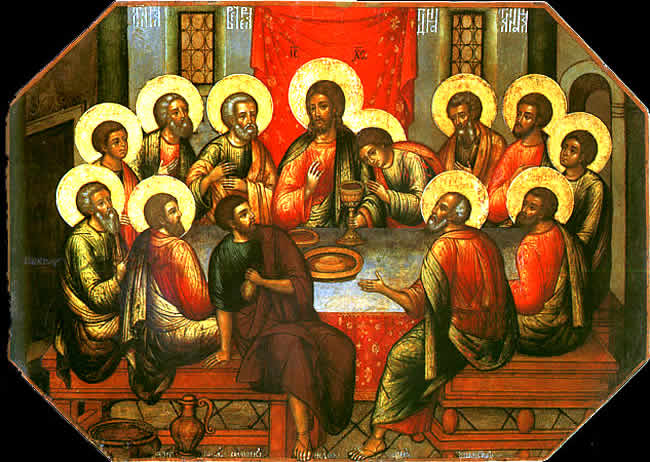
 

John 13:1-17, 31-35b Now before the festival of the Passover, Jesus knew that his hour had come to depart from this world and go to the Father. Having loved his own who were in the world, he loved them to the end. 2The devil had already put it into the heart of Judas son of Simon Iscariot to betray him. And during supper 3Jesus, knowing that the Father had given all things into his hands, and that he had come from God and was going to God, 4got up from the table, took off his outer robe, and tied a towel around himself. 5Then he poured water into a basin and began to wash the disciples’ feet and to wipe them with the towel that was tied around him. 6He came to Simon Peter, who said to him, “Lord, are you going to wash my feet?” 7Jesus answered, “You do not know now what I am doing, but later you will understand.” 8Peter said to him, “You will never wash my feet.” Jesus answered, “Unless I wash you, you have no share with me.” 9Simon Peter said to him, “Lord, not my feet only but also my hands and my head!” 10Jesus said to him, “One who has bathed does not need to wash, except for the feet, but is entirely clean. And you are clean, though not all of you.” 11For he knew who was to betray him; for this reason he said, “Not all of you are clean.”
12After he had washed their feet, had put on his robe, and had returned to the table, he said to them, “Do you know what I have done to you? 13You call me Teacher and Lord — and you are right, for that is what I am. 14So if I, your Lord and Teacher, have washed your feet, you also ought to wash one another’s feet. 15For I have set you an example, that you also should do as I have done to you. 16Very truly, I tell you, servants are not greater than their master, nor are messengers greater than the one who sent them. 17If you know these things, you are blessed if you do them. 31When he had gone out, Jesus said, “Now the Son of Man has been glorified, and God has been glorified in him. 32If God has been glorified in him, God will also glorify him in himself and will glorify him at once. 33Little children, I am with you only a little longer. You will look for me; and as I said to the Jews so now I say to you, ‘Where I am going, you cannot come.’ 34I give you a new commandment, that you love one another. Just as I have loved you, you also should love one another. 35By this everyone will know that you are my disciples, if you have love for one another.”

[Read Exodus text at end of sermon]


Here we are beginning what’s been come to be called the Three Days.  Lent is drawing to close and inasmuch as Lent is a deepening, the Three Days begins with this evening of Maundy Thursday and takes us deeper yet.  There are many people who don’t take the Lenten elevator down to these levels. They become darker and more confusing.

We start with the Exodus story of Passover.  The Hebrews are gearing up to leave Egypt, their home and their enslavement going back hundreds of years.  They have to pack fast and be ready to move fast.  Pharaoh will not be happy.  It’s probably safe to say that he and many other Egyptians will grieve deeply well beyond the Hebrews departure.  After all, the slaves will be gone and their first born boys will be dead.  The Hebrew people take the unleavened bread, the fast-food of their time, and get out of Egypt with nothing but turmoil behind them; turmoil that will close in fast on their heels as they head out into exile.

This time of disorientation, this time of freedom, is then to be remembered for all time.  The last verse of the reading today says, “This day shall be a day of remembrance for you. You shall celebrate it as a festival to the Lord; throughout your generations you shall observe it as a perpetual ordinance.”  In the ensuing centuries, Jewish people all over the world remember God’s act of freeing their ancestors from slavery in the celebration of Passover.  The time of confusion organized into a ritual of remembrance.  Remembering what God has done, leaving the door open for what God will do next.

From the Exodus we fast-forward to the first century.  Jesus is in a room with some friends…and an enemy.  And Jesus does something startling.  He takes off his robe and puts a towel around his waist.  These actions of disrobing and girding are the not-so-subtle movements of a warrior preparing for battle.[1]  But then Jesus takes a knee in a position of surrender.  He begins to wash feet in a way that no ordinary host, and certainly no warrior, ever would.  This is, after all, a dirty task ordinarily taken on by the slaves of the household.  Interesting, isn’t it?  That we just talked about freedom from slavery and here Jesus is willingly taking on the work of a slave.  Note that everyone gets their feet washed.  Everyone gets clean feet including Judas.  Judas who will end up betraying Jesus not too much later in the story and Peter who will deny that he ever knew Jesus.

The same Peter who does not want Jesus doing the work of a slave by washing his feet suddenly becomes the Peter who wants Jesus to wash his whole body.  Peter is insistent in two different directions.   Peter seems to be trying to figure out this latest twist in the action and how to respond.  His effort to keep up with Jesus’ meaning leaves his head spinning and, once again, has him saying things that make no sense.  Although we can’t blame him really – Jesus takes first prize for saying confusing things.

Just before the story of Jesus washing the feet of the disciples, he makes a speech to his disciples that includes him saying, “Whoever believes in me believes not in me but in him who sent me. And whoever sees me sees him who sent me. I have come as light into the world, so that everyone who believes in me should not remain in the darkness.”[2]  Jesus washing the feet of his disciples gives us a hint of what this light in the darkness looks like, what God in the world looks like.  Like a warrior, girded for battle, who takes a knee in surrender and empties himself for those around him.

From there, Jesus says, “I give you a new commandment, that you love one another. Just as I have loved you, you also should love one another.”[3]  And with this, the disciples’ confusion hits a new level.  Jesus’ command, his mandatum from which we get the term Maundy Thursday, precedes his death on the cross but includes his death on the cross.[4]  The mystery of what Jesus is doing during the foot-washing and what Jesus will do on the cross is utterly confusing to everyone involved.  This may partly explain why many people don’t take the Lenten elevator down to these levels.  After all, how are we to engage in the mystery of these Three Days that begin with a foot-washing and end in a tomb?

The short answer is that we don’t.  We don’t engage the mystery.  The mystery engages us.

At Christ’s command, he organizes our confusion into a ritual of remembrance.  “Do this in remembrance of me,” he says.  But it is not only ritual and it is not only memory.

Christ is untamed by the tidiness of the table and the reverence with which we approach him.  This is Jesus after all – in bread and wine given and shed for you.  In this meal, the self-sacrificing love of God is poured out and through us with the fierceness of a warrior poured out in surrender – drawing us deeper into the mystery of the cross and claiming us in God’s name.


Exodus 12:1-14  The LORD said to Moses and Aaron in the land of Egypt: 2This month shall mark for you the beginning of months; it shall be the first month of the year for you. 3Tell the whole congregation of Israel that on the tenth of this month they are to take a lamb for each family, a lamb for each household. 4If a household is too small for a whole lamb, it shall join its closest neighbor in obtaining one; the lamb shall be divided in proportion to the number of people who eat of it. 5Your lamb shall be without blemish, a year-old male; you may take it from the sheep or from the goats. 6You shall keep it until the fourteenth day of this month; then the whole assembled congregation of Israel shall slaughter it at twilight. 7They shall take some of the blood and put it on the two doorposts and the lintel of the houses in which they eat it. 8They shall eat the lamb that same night; they shall eat it roasted over the fire with unleavened bread and bitter herbs. 9Do not eat any of it raw or boiled in water, but roasted over the fire, with its head, legs, and inner organs. 10You shall let none of it remain until the morning; anything that remains until the morning you shall burn. 11This is how you shall eat it: your loins girded, your sandals on your feet, and your staff in your hand; and you shall eat it hurriedly. It is the passover of the LORD. 12For I will pass through the land of Egypt that night, and I will strike down every firstborn in the land of Egypt, both human beings and animals; on all the gods of Egypt I will execute judgments: I am the LORD. 13The blood shall be a sign for you on the houses where you live: when I see the blood, I will pass over you, and no plague shall destroy you when I strike the land of Egypt.
14This day shall be a day of remembrance for you. You shall celebrate it as a festival to the LORD; throughout your generations you shall observe it as a perpetual ordinance.


[1] Craig R. Koester, Professor of New Testament at Luther Seminary, lecture content from the course: Gospel and Epistles of John in Fall Semester 2010.

[2] John 12:44-46

[3] John 13:34

[4] Living Lutheran (online), “The Three Days: Traditions of Maundy Thursday, Good Friday, and Easter.”  http://www.elca.org/en/Living-Lutheran/Ask-a-Pastor/2013/10/~/link.aspx?_id=8A91118FE3E341839E13E7444A33CBF6&_z=z

Matthew 5:21-37; 1 Corinthians 3:1-9 “A Matter of Life and Death in the Here and Now [Or This Preacher Tackles Those Adultery and Divorce Verses]”

Matthew 5:21-37; 1 Corinthians 3:1-9 “A Matter of Life and Death in the Here and Now [Or This Preacher Tackles Those Adultery and Divorce Verses]”

February 16, 2014 – Caitlin Trussell

Augustana Lutheran Church, Denver, CO


Matthew 5:21-37 “You have heard that it was said to those of ancient times, “You shall not murder'; and “whoever murders shall be liable to judgment.’ 22 But I say to you that if you are angry with a brother or sister, you will be liable to judgment; and if you insult a brother or sister, you will be liable to the council; and if you say, “You fool,’ you will be liable to the hell of fire. 23 So when you are offering your gift at the altar, if you remember that your brother or sister has something against you, 24 leave your gift there before the altar and go; first be reconciled to your brother or sister, and then come and offer your gift. 25 Come to terms quickly with your accuser while you are on the way to court with him, or your accuser may hand you over to the judge, and the judge to the guard, and you will be thrown into prison. 26 Truly I tell you, you will never get out until you have paid the last penny.

27 “You have heard that it was said, “You shall not commit adultery.’ 28 But I say to you that everyone who looks at a woman with lust has already committed adultery with her in his heart. 29 If your right eye causes you to sin, tear it out and throw it away; it is better for you to lose one of your members than for your whole body to be thrown into hell. 30 And if your right hand causes you to sin, cut it off and throw it away; it is better for you to lose one of your members than for your whole body to go into hell.

31 “It was also said, “Whoever divorces his wife, let him give her a certificate of divorce.’ 32 But I say to you that anyone who divorces his wife, except on the ground of unchastity, causes her to commit adultery; and whoever marries a divorced woman commits adultery.

33 “Again, you have heard that it was said to those of ancient times, “You shall not swear falsely, but carry out the vows you have made to the Lord.’ 34 But I say to you, Do not swear at all, either by heaven, for it is the throne of God, 35 or by the earth, for it is his footstool, or by Jerusalem, for it is the city of the great King. 36 And do not swear by your head, for you cannot make one hair white or black. 37 Let your word be “Yes, Yes’ or “No, No'; anything more than this comes from the evil one.


Let’s get a few things straight about these verses right from the get-go.  If we think this is some kind of Jesus-versus-sinner smack down that includes only some people, let’s think again.  It looks to me like the final score would be Jesus: 7 billion; people: 0. Borrowing Paul’s words from the Corinthians reading, there is no milk for children here, it’s all solid food.

Over and over in these verses Jesus says, “You’ve heard it said…but I say to you…”

It isn’t enough not to murder; Jesus orders us to choose our words oh so carefully.

It isn’t enough not to commit adultery; Jesus orders us see other people as people, not objects.

It isn’t enough not to divorce; Jesus orders us not to throw people away on a whim.

It isn’t enough not to lie; Jesus orders us to live so truthfully that we’ve no need to make an oath.

If you spend any time around a Lutheran church, it won’t take too long before someone would say that Jesus is talking about “law” in these verses.  To which some of us could nod and agree and move on as if we understood what that means.  Hanging around the same Lutheran church you might hear over time that the law “leads to death while the gospel gives life.”[1]  Another catchy phrase but I wonder if it has lost some punch over time; wildly misinterpreted to mean the law doesn’t matter so domesticated into spiritual milk, not solid food.  Let’s try to stay squarely in the solid food category here this morning shall we?

I’ve been on a tear about these verses this week.  They come on the heels of my family attending a funeral for the young adult son of some friends of ours.  He took his own life after physically surviving a tour in Afghanistan.  Hearing Jesus’ words through Eric’s despair, gives those words urgency.  We are a people who are given new life and freedom in Jesus.  Out of this new life and freedom we are called to “offer hope and healing in Jesus Christ”.[2]  If this is a given, then Jesus’ words are directed to us and into our relationships with other people.

No longer self-centered, we are made Christ centered – made free to look deeply into the cracks and fractures of those relationships for our own culpability.  And Jesus gives us four places to start looking: Anger – Adultery – Divorce – Oaths.

None of these places are comfortable and there are easy ways to end up in the proverbial ditch along the way.  But I believe that Jesus words have life and death implications for us in the here and now which makes the risk of the ditch worth it.  I’ll make you a deal.  I’ll try to avoid any ditches and you can tell me me if you think I ended up in one (pastor.caitlin.trussell@gmail.com).

Have you ever been angry with someone?  That deep, simmering kind of anger that may even have had a righteous origin?  But somewhere along the way the righteousness part of the anger was lost and now it hangs around like a bitter, old friend. The anger simmers on a slow, inside burn that keeps us away from the one who made us angry but also cuts us off from everyone else.  Making us prisoners of our own anger, our own private hell on earth.   Perhaps it is because there is no life in this anger that Jesus is so adamant about reconciliation.  Not to be confused with a bland acceptance of the status quo, reconciliation is a commitment to stay in relationship across intellectual disagreement and injured feelings.  Because, left unchecked, anger has a way of infecting families, communities, institutions, and countries.  Any of this sounding familiar?

In the adultery verses, Jesus focuses on those of us doing the looking.  He challenges our treatment of people as objects that exist for our pleasure.  What’s the harm, we might ask?  Just as anger destroys relationship and creates hell on earth, treating people as objects denies relationship and creates hell on earth.  On a smaller scale, once we make an object of someone, someone who exists for our pleasure, then what’s to stop us from hurting them when they make us unhappy?  The violence of partner and child abuse has at its roots the objectification of people.  So too does the modern day human trafficking and slavery crisis.  Jesus’ hyperbole about gouging out our eyes and cutting off our hands if they lead us to make people into objects is attention getting.   People are not to be treated as objects and it seems that Jesus is challenging us to consider the ways in which we are doing so and to stop doing it.

A few things need to be said right off the bat about this divorce text.  First, Jesus is likely talking here about the practice of divorce that left women and children vulnerable both physically and financially.  And second, the church across time and place has done a miserable job on the topic of divorce and has inflicted the pain of isolation on many families already devastated by divorce – in fact the church could stand to do some confession in this regard.  Please hear this clearly, there are times when divorce is the least broken choice.  If we are all broken people, then any of our decisions are also broken.  A few obvious examples are marriages that end due to addictions, mental health issues, and abuse.

All of that being said, what challenge might those of us who are married hear from Jesus’ words?   Maybe it helps to hear that courage is possible, remembering that we are made free by Jesus to look deeply into the cracks and fractures of our marriages for our own culpability.  Some of us may need to confess our part in the mess.  Some of us might need a coach or counselor to help us engage with indifference or mediate the anger.  For some of us, our marriages still may not make it but reconciliation around certain issues may give co-parenting or healing after divorce some traction.

At first glance, the fourth challenge laid out by Jesus may seem almost anticlimactic.  However, many of us are involved in daily work that puts pressure on us.  Our jobs put food on the table and a roof over our heads.  Dealing honestly in our work environments can sometimes feel precarious.  What Jesus is asking here is often not easy and may be difficult to tease apart during a work day filled with contract negotiations or sales figures.  In fact, we could go so far to say that the temptation here may be similar to adultery – that to deal falsely with someone might start with making an object out of them, making them a means to an end.

Jesus is talking life and death issues in this text today; life and death in the here and now for us and for other people.  He is laying down the law that brings life through the gospel.   May we, who are made free by Christ, be unleashed into the costly discipleship that brings life to each other.  Amen.


[1] One interpretation of 2 Corinthians 3:1-11 focusing on verse 6.

[2] Augustana Luther Church mission statement: Guided by the Holy Spirit we gather in Christian community, reach out and invite, offer hope and healing in Jesus Christ, and walk humbly with God.  http://augustanadenver.org/pages/aboutus/aboutus.html

1 Corinthians 3:1-9

1 And so, brothers and sisters, I could not speak to you as spiritual people, but rather as people of the flesh, as infants in Christ. 2 I fed you with milk, not solid food, for you were not ready for solid food. Even now you are still not ready, 3 for you are still of the flesh. For as long as there is jealousy and quarreling among you, are you not of the flesh, and behaving according to human inclinations? 4 For when one says, “I belong to Paul,” and another, “I belong to Apollos,” are you not merely human? 5 What then is Apollos? What is Paul? Servants through whom you came to believe, as the Lord assigned to each. 6 I planted, Apollos watered, but God gave the growth. 7 So neither the one who plants nor the one who waters is anything, but only God who gives the growth. 8 The one who plants and the one who waters have a common purpose, and each will receive wages according to the labor of each. 9 For we are God’s servants, working together; you are God’s field, God’s building.

Matthew 11:16-19, 25-30 “Freedom: Not a Free-For-All”

Matthew 11:16-19, 25-30 “Freedom: Not a Free-For-All”

July 4, 2011 – Caitlin Trussell

Risen Lord Lutheran Church, Conifer, CO


Matthew 11:16-19, 25-30 “But to what will I compare this generation? It is like children sitting in the marketplaces and calling to one another, 17 “We played the flute for you, and you did not dance; we wailed, and you did not mourn.’ 18 For John came neither eating nor drinking, and they say, “He has a demon'; 19 the Son of Man came eating and drinking, and they say, “Look, a glutton and a drunkard, a friend of tax collectors and sinners!’ Yet wisdom is vindicated by her deeds.”

25 At that time Jesus said, “I thank you, Father, Lord of heaven and earth, because you have hidden these things from the wise and the intelligent and have revealed them to infants; 26 yes, Father, for such was your gracious will. 27 All things have been handed over to me by my Father; and no one knows the Son except the Father, and no one knows the Father except the Son and anyone to whom the Son chooses to reveal him. 28 “Come to me, all you that are weary and are carrying heavy burdens, and I will give you rest. 29 Take my yoke upon you, and learn from me; for I am gentle and humble in heart, and you will find rest for your souls. 30 For my yoke is easy, and my burden is light.”


I’m going to ask a super fashionable question.  I’m going to ask one of those questions that lands preachers right on top of the popularity scale and gets us invited to all the best parties.  Now I’m not looking for an out loud answer – don’t panic – just keep your answer quietly and privately in your head.  Ready?  What is that thing you do that you do not want to do?  What is that thing you do that you hate?  …………While thinking about Paul’s words in Romans, my own answer to that question keeps bubbling up in my head without me even having to ask the question.  It is as if regret and shame are ready and willing to set up shop at a moment’s notice.  Listen to Paul’s words of confession, “I do not understand my own actions. For I do not do what I want, but I do the very thing I hate.”  He is so immersed in this idea that he writes it again with a bit of a tweak, a few verses later, “For I do not do the good I want, but the evil I do not want is what I do.”

But along with the regret and shame there is something else that sets up shop inside of me too.  Something powerful that competes against regret and shame – there is a powerful relief.  Relief that I, and my life, get named – get called out so that, even if for just a moment, the pretending that takes so much energy goes away.  Thank God Paul names his humanity in Romans 7.  So that even if just for a bit of time we can see our situation named too.  “I do not do what I want but I do the very thing that I hate.”

For Paul, this sin is not a morality tale.  Yes, sin has effect and consequence but for Paul it is so much bigger than the language we so often use of “right and wrong” or “good and bad.”  There is simply that which kills and that which brings life.  If I accuse you of immorality or bad theology or not-really-being-a-Christian-or-a patriot-or-a-good-person, then I elevate myself while lowering you, in a sense while killing that which you hold dear.

Matthew’s gospel gives us a perfect example of the critique that happens when others aren’t doing what we think they should do, when people aren’t living up to our standards.  [Jesus said] “But to what will I compare this generation? It is like children sitting in the marketplaces and calling to one another,   17 “We played the flute for you, and you did not dance; we wailed, and you did not mourn.’   I hear Jesus chastising those who would superimpose their standards of right religion, of acceptable living, onto others.   After all, it is so much easier to accuse you of not doing what I want you to do than to hold up the mirror of Paul’s words to our own lives – “I do not do what I want but I do the very thing that I hate.”

In part for this reason of naming the reality of sin, we began today’s Service of the Word in confession together.  But naming sin is not the ultimate reason we confess together.  In Matthew Jesus also says, “Come to me, all you that are weary and are carrying heavy burdens, and I will give you rest.   29 Take my yoke upon you, and learn from me; for I am gentle and humble in heart, and you will find rest for your souls.   30 For my yoke is easy, and my burden is light.”

These are lovely words –“Come to me, you that are weary…I will give you rest.”  Even saying them I get that they are full of promise.  Yoking to Jesus is poetic language to be sure but what might it mean?  Even Paul, who gives this litany of powerlessness to sin, ends his speech with “Thanks be to God through Jesus Christ our Lord!”  Why does he do that?!  Why do any of us do that?

First off, a yoke tutorial seems in order.  While first century listeners would make immediate sense of this, we do not.  Although some of you may have grown up on a farm or currently farm so let’s just say you’re probably light years ahead of me on being able to explain this one but please bear with me.  Yoking means placing two animals together under a long, formed piece of word designed for the purpose of being able to move animals in a particular direction but also to allow the more experienced, seasoned animal to guide the younger, less able one.  Yoking was a method that made the work happen and taught the animals how to do what they are meant to do.

Those of us who have struggled with attempting to control our own sin, and who have hit bottom in such a way that we don’t even recognize ourselves, understand that trying harder on our own doesn’t work.  Thinking that if we just dig deeper or start over tomorrow or the next day or the day after that….we’ve realized that there are just not enough days to exert the kind of control we think we have that changes the situation for the long term.  Paul would call this being yoked to sin.  And that a sinner recognizes this yoke of sin for what it is and that this is the very place where grace meets us.

One of the things that Jesus has done and is doing is freeing us from this false idea of complete and utter independence from God and from each another.  This freedom is not a free-for-all but it is a yoked freedom.  We are not set free into a bunch of new rules – into a new morality of good and bad.  We are liberated by the yoke of Christ into new relationship with God and with each other.  This allows us to be in community with each other not as a community of mediocre people whom some call hypocrites.  But rather draws us into a living body as a community of sinners who say that transformation is possible although it is not I but Christ who lives in me – utterly dependent on God to work in us and through us and also to forgive us whenever we hurt ourselves or each other

Audacious freedom is bestowed to you by the Holy Spirit through the waters of baptism and sustained by that same Spirit. Drawn into relationship with Jesus who saves us from ourselves and says, “I see you and I intend something quite different than you may intend for yourself.  I intend for you to be as you’ve been created to be – a new creation.  And now you are forgiven, now you are freed from having to do it all and having to be it all.  Welcome home.”

And together with Paul, “Thanks be to God through Jesus Christ our Lord.”