
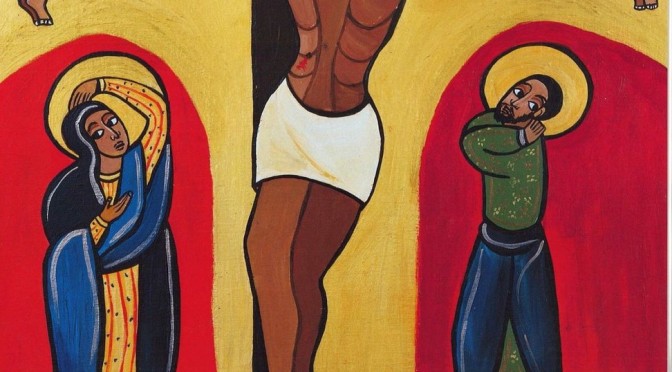
**sermon art: Jesus’ Mother, Beloved Disciple by Laura James
Caitlin Trussell with Augustana Lutheran Church on April 3, 2026
The Gospel of John, chapters 18 and 19 [grab a Bible or web search the readings]
[sermon begins]
How are we to understand the goodness of Good Friday? Is it like how kale is good for us but really not that tasty? A violent execution seems an odd thing to commemorate much less celebrate, especially in a time when the world is wrestling with disturbing violence and deep pain. Today of all days, it’s especially important to understand that it’s not the violence of the cross that is redemptive. It’s not the pain of Jesus that saves us. It’s easy to get lost in the message of the cross because the earliest Jesus followers who wrote down their experiences couldn’t quite figure it out either.
The goodness of Good Friday has to do with God’s goodness. More specifically, the goodness of Good Friday has to do with Jesus who embodies God. In the Gospel of John, God is Jesus and Jesus is God. The love of God in Jesus, the audacity of grace personified in Jesus, the ultimate power of that love, so enraged his enemies and fueled the mob mentality that ultimately killed him. Jesus ate meals with unlovable people, he had public conversations with women no one spoke to, and he had secret conversations with religious leaders who opposed him by day. The list of his ever-expanding circle of grace and love is endless.
Finally, when the threat of his grace, the threat about who is included in the love of God, became too great, he was killed for it. Grace and unconditional love are that powerful. Jesus predicted his death because dying for goodness’ sake was anticipated as the inevitable attempt to do away with love. Hate’s last gasp against love’ great, disruptive power. Hate will always try to do away with love. But Jesus will always love us more than any of us can hate him.
The goodness of Good Friday reminds us that we are not abandoned in suffering. God suffers with us. God absorbs our suffering into God’s heart. Good Friday also tells the truth about suffering caused by violence. Large acts of violence are obvious. War, terror, and murder are clearly seen. There are also the smaller acts of violence that destroy relationships and murder people’s spirits and our own spirits – lies, gossip, passive aggression, dissing someone’s body rather than debating their ideas or confronting their hurtful behavior. The list of our violent ways is as endless as we are creative in inflicting ourselves against the ones we love and the ones we hate. The level we inflict suffering on each other, and on the earth and all its creatures, knows no bounds.
The goodness of Good Friday reminds us that the cross is the place where we struggle in the darkness and the very place where God meets us. We live in this darkness in different ways – failure, addiction, confusion, doubt. God loves you through the cross, in the darkest places that you don’t tell anyone about. The truth is that most of us are capable of just about anything given the right set of circumstances. The goodness of Good Friday isn’t about pointing away from ourselves to other people who cause suffering. It’s also a sacred space to wonder and be honest about the pain that we cause as well.
Confessions of sin extend to systems that we’re a part of—institutions, countries, governments, families, friendships, communities, and even churches. Systems that hold us captive to sin from which we cannot free ourselves. What does free us? Jesus on the cross. Jesus on the cross holds up a mirror in which we can see our own reflections. Our reflections that simultaneously reveal God’s beauty in us as well as the sin we inflict on each other and cannot justify. No matter how many times we enshroud our sin in self-righteousness, the cross tells us otherwise.
We often act without awareness of how our actions may hurt someone else. That’s why our worship confessions talk about things we’ve done and things we’ve failed to do. That’s why we talk about our sin. Sin gives us language for the way we hurt other people and ourselves with our actions – actions that separate us from each other and God. But nothing can separate us from the love of God in Christ Jesus.[1] Good Friday’s goodness creates space to experience life-giving compassion from the heart of God in the face of our sin. God’s SELF-sacrifice in Jesus also reminds us that Jesus’ death is NOT payment to an angry God or a hungry devil. That’s just divine child abuse. Jesus is a revelation of the goodness of God, taking our violence into himself on the cross and transforming death into life through SELF-sacrifice. The cross surprises us with grace in the face of sin.
God reveals the truth of our death dealing ways while reminding us that God’s intention for humankind is good.[2] Jesus was fully human and fully divine. His life’s ministry and his death on the cross reveal his humanity and our own, reminding us about the goodness for which we were created. The cross awakens that goodness. Jesus’ full and fragile humanity was displayed on the cross. He sacrificed himself to the people who killed him for his radical, excessive love. He did not raise a hand in violence against the people and the world that God so loves. Jesus’ self-sacrificing goodness clears our eyes to see God’s intention for our human life together. Jesus loves us more than we could ever hate him or anyone else.
Our connection with each other is also revealed in the goodness of Good Friday. From the cross, Jesus redefined connection, kinship, and belonging. Hear these words again from the gospel reading:
“Meanwhile, standing near the cross of Jesus were his mother, and his mother’s sister, Mary the wife of Clopas, and Mary Magdalene. 26When Jesus saw his mother and the disciple whom he loved standing beside her, he said to his mother, “Woman, here is your son.” 27Then he said to the disciple, “Here is your mother.” And from that hour the disciple took her into his own home.” [3]
From the cross, with some of his last breaths, Jesus did this incredible thing. Jesus knows we need belonging. He connects people through and beyond suffering. This is NOT a reason for suffering. Simply one truth about it. When we suffer and feel most alone, Jesus reaches out from his own suffering to give us to each other. To belong to each other. God’s heart revealed through the cross destroys the illusion of our isolation and connects us to each other once more. In each other, we’re given kinship and appreciation for the gift and mystery of being alive. In God we live and move and have our being through God’s goodness in Jesus on the cross.
In the end, the cross isn’t about us at all. It’s about the self-sacrificing love of Jesus who reveals God’s ways to show us the logical end of ours—our death-dealing ways in the face of excessive grace and radical love. We struggle to believe that God applies this grace and love to everyone. It’s hard enough to believe that there’s a God who loves us. It’s downright offensive that God loves our greatest enemy as much as God loves us. But that is God’s promise in the goodness of Good Friday.
There is nothing you can do or not do to make God love you any more or any less. The same holds true for the person you like the least. Jesus loves you more than you can hate anyone AND Jesus loves that person, too. Offensive? For sure. And also reassuring. Because if God’s love includes everyone then it also includes you. God’s arms are opened to all in the outstretched arms of Jesus on the cross, receiving us by God’s reckless grace because Good Friday is reveals that God’s goodness is love.[4] Thanks be to God and amen.
_______________________________________________
[1] Romans 8:38-39
[2] Genesis 1:26-31 God creates “humankind.”
[3] John 19:25b-27
[4] 1 John 4:7-21