
Tag Archives: Sin

John 18:1-19:42 “Think Again” [a sermon for Good Friday]

John 18:1-19:42 “Think Again”

March 29, 2013 – Caitlin Trussell

Augustana Lutheran Church, Denver, CO


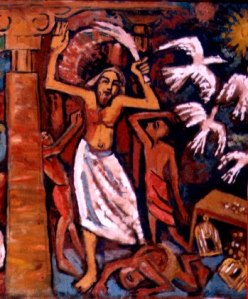
Pick a spot, any spot, in Jesus’ crucifixion.  There are many places to sit, stand or lie down.  We can betray, deny, judge, rant, abandon or despair.  Go ahead, pick a spot, because those characters are us.  Those characters who run amok and rail against Jesus, ridicule him, or despair in his death are us.  The irony of being a part of this cast of characters is that the person who hangs on the cross is the precisely the one who saves us.  Jesus was tried, crucified, dead and buried.  In every way that the cross could be offensive, it does indeed offend.


It offends the sophisticated thought of modern people to think that the cross, and Jesus hanging there, was necessary or effective in any way.  That we even need saving offends our enlightened sensibilities.  That this appalling execution can change anything about real life seems at worst a massive deception and at best an utter folly.  And yet, alarmingly, and quite surprisingly, it does.  Jesus death on the cross changes everything.  Jesus insists, time and again in the gospel, that God and Jesus are one.  Jesus is in God and God is in Jesus.


Think on this for a moment.  How might God go about getting our attention?  What are all the ways in which that may have been possible?  God, at some point, needs to grab us in ways that we might have some shot at understanding.  God needs to speak in human terms.  When we hear of someone who dives into a raging river to save someone from drowning, saves that person but succumbs and dies in the flood waters, what are our first thoughts?  What kinds of things do we say to honor the soldier who returns again and again to the firefight to save fallen friends?  Wow!  Spectacular save!  How selfless!  And on and on goes the praise and adoration.  Earlier in the Gospel of John, Jesus says, “No one has greater love than this, to lay down one’s life for one’s friends.”  After all, how much more can be given?[1]


In the Gospel of John as a whole, and in this reading from John on this Good Friday, Jesus is aware and focused on the goal of bringing people back into relationship with God.  Somewhere along the way, as human creatures we lost our way.  Rather than living into the image of God we became much more interested in placing ourselves in the center of things and holding God to the outskirts, leaving us free to make God into whatever image we choose – distorting God.[2]  It is in that re-creation of God that we are separate from God, powerless to repair what has happened.  This separateness, this breach, this distance between us and God is called sin.  Out of that separateness, that breach, that distance, that sin, comes all the ways in which we hurt each other and ourselves; inflicting sins against each other, ourselves, and God.


The cross is God’s answer to all of that re-imagining of God that we are so wont to do. That re-imagining that leaves us separate from God.  Oh, so you think you know who God is?  Well, what about a God who hangs dead on a cross and needs to be buried in a tomb rather than use divine power over and against the very creatures whom God loves.  Jesus said, “When I am lifted up, I will draw all people to myself.”  Jesus on the cross simultaneously reveals the scope of divine power poured out to reveal the depth of divine love as we are drawn toward the God who saves us.  When the self-sacrificing love of God, given fully, is made known to you, when this message of divine love gets through to you, you are drawn by God back into relationship. [3]


With great intention, Jesus hangs on the cross.  And, in one of his final acts while still breathing, does something radical.  Jesus turns to his own mother and then to the beloved disciple and redefines their relationship with the cross in between them.  “‘Woman, here is your son…then he said to the disciple, ‘Here is your mother.’”


Not only does Jesus draw us into relationship with God through the cross but Jesus redefines our relationship with each other at the foot of the cross – standing with the cross between us, Jesus intercedes for us on each other’s behalf.  Drawn back into the relationship with God our Father, Jesus the Christ turns us towards each other in new ways.  Here, at the cross, love is freely taken up for us and for the sake of the people standing next to us.  In the same moment we have everything to do with what happened at the cross and we have nothing to do with it.


We are, first and foremost, passive spectators who are being handed a radical realization of our powerlessness.  As people in and around the story of the crucifixion, we think we know what’s happening and that the power is ours to create the story.  It is our turn on this day to hear God say, “Think again.”


[1] Craig Koester, class notes, Luther Seminary: Gospel of John class: John’s Theology of the Cross.  December 1, 2010.  I am sincerely grateful for Dr. Koester’s faithful witness as a master of holding aspects of Jesus Christ’s life and work in formative tension.  His work is beautiful, articulate, and draws me more deeply into faith and love of Jesus.

[2] Dietrich Bonhoeffer, Creation and Fall, (Minneapolis: Fortress Press, 2004), 113.  This is a great text for deepening into the theological reflection on the “The Fall” that breached God’s intention for the creature as imago dei, in the image of God.

[3] Koester, course notes, 12/1/2010.  For further study see: Craig R. Koester, The Word of Life: A Theology of John’s Gospel (Grand Rapids: Eerdmans, 2008).

 

Luke 13:1-9 “The Promise of Judgment”

Luke 13:1-9 A sermon for this 3rd Sunday in Lent, March 3, 2013

March 3, 2013 – Caitlin Trussell

Augustana Lutheran Church, Denver, CO

Luke 13:1-9 At that very time there were some present who told him about the Galileans whose blood Pilate had mingled with their sacrifices. 2 He asked them, “Do you think that because these Galileans suffered in this way they were worse sinners than all other Galileans? 3 No, I tell you; but unless you repent, you will all perish as they did. 4 Or those eighteen who were killed when the tower of Siloam fell on them–do you think that they were worse offenders than all the others living in Jerusalem? 5 No, I tell you; but unless you repent, you will all perish just as they did.”
6 Then he told this parable: “A man had a fig tree planted in his vineyard; and he came looking for fruit on it and found none. 7 So he said to the gardener, “See here! For three years I have come looking for fruit on this fig tree, and still I find none. Cut it down! Why should it be wasting the soil?’ 8 He replied, “Sir, let it alone for one more year, until I dig around it and put manure on it. 9 If it bears fruit next year, well and good; but if not, you can cut it down.’ ”


Those poor, poor Galileans.  Those poor, misguided religious pilgrims who walked and prayed and sacrificed as they put one foot in front of the other to acknowledge the God of their ancestors as they put their faith into action.  We can picture the earthy, rural Galileans laughing and crying with each other, with their families, while the rest of the city moves about its business.  And, then, out of nowhere, comes Pontius Pilate. The villain extraordinaire, the ne’er-do-well to end all ne’er-do-wells – the Pharaoh to the enslaved Israelites, the Osama bin Laden to millions of people both living and dead, the shooter in Newtown to our beloved children and teachers.  We can almost hear the hiss of the crowd as Jesus mentions his name.

And what about those poor people who were flattened by the tower of Siloam?  What of them?  We can imagine the thoughts of the people listening to Jesus.  The people for whom this was a fresh event and who could probably name some of the people killed that day.   We can imagine them thinking with relief that they were not standing by that tower on that day.  We can imagine them wondering about God in the midst of that tragedy.  Their attention is drawn to the death and destruction like bees to honey as they try to answer the question, “Why?”

Jesus speaks to them with the well-known traumas of the day fresh on everyone’s minds.  The people are pulsing with fear and survivor guilt as Jesus revisits the stories.  The people are looking for a comforting word – ears tuned, necks craned toward Jesus. And what does he do?  He disappoints them.

It’s important to note that what Jesus is doing here is separating the sin of the people from the calamities that befall people.  There is no connection between the horror that Pilate inflicts and the sin of the people that he inflicts it upon.  There is no connection between the Tower of Siloam and the sin of the people in the wrong place at the wrong time when the tower falls.  Jesus disconnects the sin of the people from the calamity that befalls them and, for all intents and purposes, tells the people to stop gawking in that direction.  They aren’t going to find any good news about themselves through the misfortune of others.  Nor are they going to find a God that is against others and, therefore, for themselves.  God’s judgment is not doled out as calamities in our lives.

Jesus is separating sin from calamity but Jesus is NOT separating sin from judgment.  Judgment has simply been moved to a different place away from the punishment of calamity.  Jesus says, “…unless you repent, you will all perish just as they did.”  Hmmmm…“Just as they did…just as they did.”  Jesus is separating sin from punishment and, in the same breath, he is comparing the people who are dead to the people who are listening to him.  The comparison being that those who have died were unrepentant just as the people standing before him are unrepentant.  They are unable to see all the ways in they work against God and work against each other.  And until they can see this, acknowledge this work against God and each other, they are unrepentant.

Perhaps this is where the fig tree can help us out. You all know this one right?  The parable of the barren fig tree has to be in the, what, top five most favorite parables ever?  Okay, so…no, not a well-known parable.  But this parable seems to follow Jesus’ calamity stories as some kind of explanation.

The vineyard owner is angry about a tree that has not borne fruit in three years and he wants to cut it down.  The gardener stalls the owner’s anger and asks for more time for the tree.  Take note that it is not more time for the same disappointing barrenness.  This is not a stay that delays an inevitable execution.  The gardener promises to tend this tree with fertilizer, giving it the chance to bear fruit, fruit that is worthy of the repentance from which it springs.

The people to whom Jesus is speaking are called out.  They are called out as unrepentant.  In the Psalmist’s words we sang earlier, they are called out as dry.  Today, we are being called out as well, called out as dry as the barren fig tree.  Repentance begins in this moment of being called out.  A word comes from outside ourselves and reverberates with truth as it moves inside.  There is nowhere to hide from the reality in us that is being named; the reality of the ways in which we move away from and work against God and each other, the reality of our sin.

This is one of the reasons why speaking out loud the confession and forgiveness when we gather for worship feels like air to some of us.  Not by way of shaming but by way of naming, we confess and are brought together in the light of truth – the truth about ourselves, our need and our God.   Being named for who we are and what we have done is called judgment.  And as we listen to Jesus in the text today, Jesus very much connects sin and judgment.  This, of course, is totally fine when it’s someone else’s sin that gets questioned or named or judged.  It feels more than a little difficult when it’s our own.

During the Apostle’s Creed we name Jesus as the one who will come again to judge the living and the dead.  This isn’t a far off threat.  This is a promise here, in the moment of now.  We speak these words in spite of the bad rap that surrounds the notion of judgment.  Quite possibly one of the worse things to be labeled is “judgmental.”  And, yet, it is exactly judgment when God names something about us that is true, something we are in no rush to confess about ourselves.  It is God’s judgment that convicts us and draws us to the surrender of repentance.  And it is at that point where the gardener nourishes us.

This is a moment when the whole creed becomes so important.  Because then what do we say together?  We believe in the Holy Spirit, the holy catholic church, the communion of saints, the forgiveness of sins…wait, wait a second now, what was that…the forgiveness of sins?!

God judges and God forgives.

God judges and God forgives in the proclamation of forgiveness.

God judges and God forgives in the waters of baptism.

God judges and God forgives in the bread and wine from Christ’s table.

God judges and God forgives in the reconciliation one to another in this body of Christ, this church.

God judges and God forgives as the one who resuscitates us and births divine love in our lives.


This IS the nourishment that is laid down around our dryness in the face of God’s judgment;

Nourished here, in this place, by this God so that our lives are a testament to the one who sustains us.  Nourished here, we can then bear the fruit of Christ in us, serving our neighbors – for the sake of our neighbors and for our own sake as others turn to serve us.

Nourished here, we can then sing with the Psalmist, “O God, you are my God, I seek you, my soul thirsts for you; my flesh faints for you, as in a dry and weary land where there is no water. 2 So I have looked upon you in the sanctuary, beholding your power and glory.  3 Because your steadfast love is better than life, my lips will praise you. 4 So I will bless you as long as I live; I will lift up my hands and call on your name. 5 My soul is satisfied as with a rich feast, and my mouth praises you with joyful lips 6 when I think of you on my bed, and meditate on you in the watches of the night;7 for you have been my help, and in the shadow of your wings I sing for joy. 8 My soul clings to you; your right hand upholds me.”

John 2:13-22 “Using God and Loving Things”

John 2:13-22 “Using God and Loving Things”

March 9, 2012 – Caitlin Trussell

New Beginnings Church at Denver Women’s Correctional Facility


John 2:13-22 – The Passover of the Jews was near, and Jesus went up to Jerusalem. 14 In the temple he found people selling cattle, sheep, and doves, and the money changers seated at their tables. 15 Making a whip of cords, he drove all of them out of the temple, both the sheep and the cattle. He also poured out the coins of the money changers and overturned their tables. 16 He told those who were selling the doves, “Take these things out of here! Stop making my Father’s house a marketplace!” 17 His disciples remembered that it was written, “Zeal for your house will consume me.” 18 The Jews then said to him, “What sign can you show us for doing this?” 19 Jesus answered them, “Destroy this temple, and in three days I will raise it up.” 20 The Jews then said, “This temple has been under construction for forty-six years, and will you raise it up in three days?” 21 But he was speaking of the temple of his body. 22 After he was raised from the dead, his disciples remembered that he had said this; and they believed the scripture and the word that Jesus had spoken.


A long, long time ago, in the year 350, there lived a man named…Augustine.  He tells his story in a book titled The Confessions – he simply pours it all out, the good, the bad, and the ugly…saint and sinner…all of it…and how God met him in the middle of it.  Fast-forwarding sixteen hundred years to this past Sunday, I was preaching at a congregation that I had preached at one other time, one year ago.  A woman came up to me before worship began and told me that she needed to speak with me.  So we arranged to meet back up after the service.   We sat together in the back of sanctuary, the worship space.  This was her 3rd time visiting this congregation and she told me that had spent very little time in church throughout her 60 years.  In the span of just a few minutes and speaking quickly, she spoke of the sin in her life, some of which had happened over 30 years ago.  She then told me that she was too much of a sinner to be in church and then she fell quiet.


“First,” I said, “you need to know that God forgives you all your sins.”  She closed her eyes, took a deep breath and began to tear up and said, “Oh, that feels good.”  After a few moments of quiet, the second thing I said to her was that, “One of the things I love about being in Lutheran-land is that we all come before God as sinners, all of us are level with each other at the foot of the cross…so, as a sinner, you’re in the right place.”


So, you may be asking yourself, what do St. Augustine and this woman have in common – across time, gender and life situation? St. Augustine wrote, all those many years ago, that sin can be described as what comes from the mixing up of what God has given us to use and what God has given us to love.  His argument is that God means for us to love God and use things but somewhere along the way we use God and love things…we use God and love things.  We have mixed up use and love.


Today’s scene in the temple started me wondering about this mix up between what we use and what we love.  Jesus is furious.  The temple has become a marketplace, a place where God is being used and everyone is part of using everyone else as a commodity, as currency, as cash.  Relationship has been transaction.


If we’re not very careful in this story, we end up standing behind Jesus, cheering him on, placing ourselves on his side, comfortable that our opinions about God and Jesus are the blameless ones.  I wonder, though, if our rightful place in this story is in the position of the sellers – the ones who use God and love things so much so that in our use of God we end up using each other in such as way that our relationships are transactions.  We see this time and again, right?  The ways in which we use each other, and the ways others use us, create deep pain.  Let’s be clear, while we’re at it, that this is not only a problem magnified within these walls, this is a problem within this world, inside all of us!  And it is into the mixed up mess of use and love that Jesus comes crashing in to clean house.


Jesus cleans house by first taking the problem into his own body.  In the Bible story for today, Jesus says that his body is the temple which will be destroyed – hung on a cross – and that he will raise it again three days later.  There is hope after all because Jesus does what we cannot do when left on our own – first in his body and then in ours.  Jesus fights this fight in us daily by virtue of our baptism.  Jesus attacks our sin and sends it packing, right out the door like the sheep and the cattle of the temple.

In his clearing of the temple, Jesus challenges us to look at the way in which we use and the way we love.

In his dying on the cross, Jesus destroys the power of sin and its death dealing way.

And in his rising again, Jesus heals us into new life.

In the name of Jesus Christ, may you be strengthened and filled with God’s grace, that you may know the healing power of the Spirit.  Amen.