Tag Archives: MLK Jr.

A Third Way in a Mad World

Caitlin Trussell with Augustana Lutheran Church on January 25, 2026

[sermon begins after two Bible readings; one more Bible reading is at the end of the sermon]

Matthew 4:12-23 Now when Jesus heard that John had been arrested, he withdrew to Galilee. 13 He left Nazareth and made his home in Capernaum by the sea, in the territory of Zebulun and Naphtali, 14 so that what had been spoken through the prophet Isaiah might be fulfilled:
15 “Land of Zebulun, land of Naphtali,
on the road by the sea, across the Jordan, Galilee of the gentiles
16 the people who sat in darkness
have seen a great light,
and for those who sat in the region and shadow of death
light has dawned.”
17 From that time Jesus began to proclaim, “Repent, for the kingdom of heaven has come near.”
18 As he walked by the Sea of Galilee, he saw two brothers, Simon, who is called Peter, and Andrew his brother, casting a net into the sea—for they were fishers. 19 And he said to them, “Follow me, and I will make you fishers of people.” 20 Immediately they left their nets and followed him. 21 As he went from there, he saw two other brothers, James son of Zebedee and his brother John, in the boat with their father Zebedee, mending their nets, and he called them. 22 Immediately they left the boat and their father and followed him.
23 Jesus went throughout all Galilee, teaching in their synagogues and proclaiming the good news of the kingdom and curing every disease and every sickness among the people.

Isaiah 9:1-4There will be no gloom for those who were in anguish. In the former time [the Lord] brought into contempt the land of Zebulun and the land of Naphtali, but in the latter time he will make glorious the way of the sea, the land beyond the Jordan, Galilee of the nations.
2 The people who walked in darkness
have seen a great light;
those who lived in a land of deep darkness—
on them light has shined.
3 You have multiplied exultation;
you have increased its joy;
they rejoice before you
as with joy at the harvest,
as people exult when dividing plunder.
4 For the yoke of their burden
and the bar across their shoulders,
the rod of their oppressor,
you have broken as on the day of Midian.

[sermon begins]

Last week at my gym, the question of the day was, “What is a skill you have and the aha moment that took it to the next level?” My skill was caramelizing onions. The aha moment was that caramelizing onions will NOT be rushed. They just take time and tending. Don’t believe those five-minute recipes. Once I got my head around the time they take, yum. Time I’m willing to take because I love to cook. And time I’m willing to take because there was a time in recent years when cooking the things I love to eat wasn’t available to me. The sensuality of cooking manifests in taste, touch, smell, and sounds. And the artistry of it shows in colors, textures, and layers. Combining edible things into more than the sum of their parts reminds me that the world is an enchanted place. An enchanted place that sustains our bodies with all that we need. Wouldn’t it be nice if the world worked the way that cooking does? A list of ingredients, combined in just the right way at the right time and temperature, blend to sensually and artistically nourish life. Alas. The tragedy is that we keep returning to the same tricks to turn the world in our favor.

In our reading from Matthew, Jesus’ ministry begins after John was arrested. We’re given no details about John’s arrest but it’s a really big, ultimately deadly deal. John didn’t survive his imprisonment. Remarkably, Jesus used the same words that John used to inaugurate his ministry, “Repent, for the kingdom of heaven has come near.” That’s a bold move by Jesus given that the one who had been saying those words was now in the custody of Herod Antipas, the ruler of Galilee who also answered to Rome. Jesus repeating John’s proclamation isn’t less risky because it’s already been said. Jesus’ risk increased because he knowingly connects his message with John’s.

More than just turning away from bad things, repent in the Bible means to be of a new mind.[1] Herod Antipas wasn’t a fan of new perspectives. He liked his own ideas, thank you very much. Hence, John’s arrest. Jesus didn’t let that slow him down. If fact, he doubled down on repentance and the kingdom of heaven coming near in light of the abiding promise quoted from Isaiah:

The people who sat in darkness
have seen a great light,
and for those who sat in the region and shadow of death
light has dawned.

Matthew quoted the Isaiah reading that we heard today, too. Isaiah was a prophet when the Northern Kingdom of Israel was invaded by the Assyrians under the reign of Tiglath-Pileser III. Into this dark time, Isaiah prophesied about God’s presence and abiding promise in that moment and into the future. A future that introduces a third way, a way of joy and exultation and a new light dawning.

In Matthew, Jesus’ ministry reveals this dawning light by calling people to a new mind. I can’t express just how much his call means to me as someone who grew up in a fundamentalist Christian tradition. Due to that upbringing, I resist fundamentalism in all its forms. Fundamentalism is any religious movement that advocates strict conformity.[2] I would tweak that slightly to say that any movement can develop a religious fervor that advocates strict conformity and creates fear.

A few weeks ago, it was my turn in Children’s Chapel with the Augustana Early Learning Center kiddos. The celebration of Epiphany about the wise men who followed a star to see the sweet little Jesus had just passed, so I read them the story from the Spark Bible that are in our pews. We talked about camels, and the star, and the scary King Herod (Herod Antipas’ dad) who was afraid of what a newborn king would mean. When I read to the kids that King Herod was afraid, a few of the kids said and repeated, “I’m never afraid!” As a former nurse, I paused the story to talk about fear and that we all feel afraid sometimes. I taught them that there’s a small part of the brain in our heads called the amygdala and that we can feel afraid before we even know what’s happening. And when we feel afraid it’s really important to find someone to talk to, to say we’re afraid, and to have them help us calm our bodies down. Then we continued with the Bible story, sang the Hippo Song at top speed, and ended our chapel time sitting with our eyes closed while I led us in taking 10 deep breaths. I count out loud. Breathe in one…breathe out. Breathe in two…breathe out. Their lungs are smaller than mine, so I try to pace that for them.  And then we prayed.

I tell that story in depth because we have some of those kids and their families joining us for preschool Sunday today. But also because we’re in a time in our country that stirs up fear and where there is fear there is fundamentalism. And fundamentalism draws hard lines between worthy people and unworthy people, makes us afraid of them, and makes it easier to hate them. After cancer and remission a few years ago, I cannot hold hate in my body. I won’t do it. That’s not to say that I don’t get scared or frustrated or even angry. But hate doesn’t solve anything and my body can’t sustain it. Hate is a choice and a behavior much like love is a choice and a behavior.

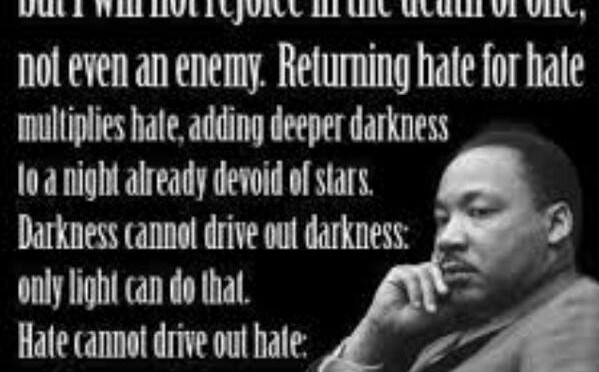
In a sermon titled “The Most Durable Power,” Reverend Doctor King preached against this very thing. He said, “Let no man pull you so low as to hate him.”[3] Let no man pull you so low as to hate him. Reverend King went on to argue that love doesn’t attempt to defeat and humiliate but to bring justice for all, the oppressed and the oppressor. A new way of living together. Dare we say a third way in our mad world.

Just as Jesus went through Galilee proclaiming a new mind, he also reached out in mercy, “curing every disease and every sickness among the people.” This wasn’t just a nice thing to do. We’ll see throughout the gospel of Matthew that mercy and wholeness are an essential part of Jesus’ message. We’ll hear it next week as he begins preaching the Sermon on the Mount in chapter 5. He’ll preach about life lived in opposition to the things that bring suffering and death.[4]

Paul’s first letter to the Corithian church touches on the third way. Thank God for that first century church in Corinth. Their disunity and factionalism meant that Paul had to write to them and in Paul’s writing we’re privy to the early church’s teachings.[5] He doesn’t shame the congregation in Corinth or lecture them to be nice. He preaches about the cross and the different kind of community that’s possible because the cross is the great leveler. In that community, in that world view, power and might are not the way forward. Love is the way forward. Love is the most durable power.

Jesus invites people to follow him in this Way of love. He doesn’t conscript people by force and fear to wage a war against his opponents. In fact, it’s the opposite. He invites people into the ministry of mercy that he began in Galilee of the gentiles. He invites us to follow his third way in a mad world. To follow him in love and see where it leads. Thanks be to God. And amen.

______________________________________________________

[1] Metanoia is the Greek word. Literally “a new mind.” #1065: Third Sunday after Epiphany – January 25, 2026 – Working Preacher from Luther Seminary

[2] Britannica

[3] Martin Luther King Jr. “The Most Durable Power,” Excerpt from Rev. Dr. King’s Sermon at Dexter Avenue Baptist Church on 6 November 1956. “The Most Durable Power,” Excerpt from Sermon at Dexter Avenue Baptist Church on 6 November 1956 | The Martin Luther King, Jr. Research and Education Institute

[4] Matt Skinner, Professor of New Testament, Luther Seminary, St. Paul, MN. Sermon Brainwave podcast.#1065: Third Sunday after Epiphany – January 25, 2026 – Working Preacher from Luther Seminary

[5] Ibid.

__________________________________________________

1 Corinthians 1:10-18 Now I appeal to you, brothers and sisters, by the name of our Lord Jesus Christ, that all of you be in agreement and that there be no divisions among you but that you be knit together in the same mind and the same purpose. 11 For it has been made clear to me by Chloe’s people that there are quarrels among you, my brothers and sisters. 12 What I mean is that each of you says, “I belong to Paul,” or “I belong to Apollos,” or “I belong to Cephas,” or “I belong to Christ.” 13 Has Christ been divided? Was Paul crucified for you? Or were you baptized in the name of Paul? 14 I thank God that I baptized none of you except Crispus and Gaius, 15 so that no one can say that you were baptized in my name. 16 I did baptize also the household of Stephanas; beyond that, I do not know whether I baptized anyone else. 17 For Christ did not send me to baptize but to proclaim the gospel—and not with eloquent wisdom, so that the cross of Christ might not be emptied of its power.
18 For the message about the cross is foolishness to those who are perishing, but to us who are being saved it is the power of God.

The Hope That God Has in Store for Us [OR Jesus Wasn’t Baptized a Christian]

**sermon art: The Baptism of Christ by Daniel Bonnell

Caitlin Trussell with Augustana Lutheran Church on January 11, 2026 – Baptism of Our Lord Sunday

[sermon begins after the Bible reading]

Matthew 3:13-17 Jesus came from Galilee to John at the Jordan, to be baptized by him. 14 John would have prevented him, saying, “I need to be baptized by you, and do you come to me?” 15 But Jesus answered him, “Let it be so now, for it is proper for us in this way to fulfill all righteousness.” Then he consented. 16 And when Jesus had been baptized, just as he came up from the water, suddenly the heavens were opened to him and he saw God’s Spirit descending like a dove and alighting on him. 17 And a voice from the heavens said, “This is my Son, the Beloved, with whom I am well pleased.”

[sermon begins]

Over the past few weeks of the Christmas season, we’ve been rightly focused on the sweet baby Jesus—celebrating both his birth to Jewish parents, and the Epiphany of his arrival as a gift to all the nations, to the non-Jews. To us. Today we turn from the sweet baby to the grown-up bearded Jesus. Things happen fast in Matthew’s gospel. Last week we heard about the wise men who followed a star to bring gifts to the baby Jesus. Today we gather on the festival of the Baptism of Our Lord – the day when Jesus plunges into the waters of baptism. In this plunge, all righteousness is fulfilled, all that is pure, sacred and holy is fulfilled. Jesus’ plunge into the waters of John’s baptism is a saturating and surprising immersion into the flow of God’s righteousness. And, as Jesus came up from the waters, the Spirit landed on him like a dove as God proclaims, “This is my Son, the Beloved…” Jesus’ baptism is an astounding act followed by an awesome announcement. It may surprise you to learn that his baptism was not a Christian one.

Ritual washing was and continues to be common among our Jewish cousins in the faith. John was not baptizing people in the name of the Father, and the Son, and the Holy Spirit. His was a baptism of repentance.[1] The Bible doesn’t give us a lot about Jesus and John the Baptist’s relationship aside from their mothers knowing each other.[2] John was a mysterious figure out in the wilderness calling people to repent. People flocked to him from Jerusalem and all Judea to be baptized with water for repentance.

Repentance is commonly understood as a moral move. Like, I was doing something bad and now I’m going to start do something good instead. But the word repentance here in Matthew means something more like a changed mind or a new understanding.[3] For Jesus, this baptism didn’t wash away sin as much as it revealed what God had in store for him next.[4] A thrilling scene of the spirit descending on Jesus, imparting the power to speak for God, and the authority to drive out unclean spirits.[5] A thrilling scene into which God speaks for others to hear, “This is my Son, the Beloved…”

While Jesus didn’t receive a Christian baptism, many of us were baptized with water in the name of the Father, and the Son, and the Holy Spirit. Baptized into Jesus’ death and resurrection to follow where he leads, to see what God has in store for us next. What’s in store for us next is sometimes clear. Like with Welcome 150’s mission that is to connect us more closely with God, each other, and the wider community. More than a building renovation, Welcome 150 points us to God’s future for us in concrete and transcendent ways. The Epiphany matching gift opportunity is energizing and hopeful. As Pastor Michael preached last Sunday, “Christmas delivers light…Epiphany hands it over to us and gives us what we need to move forward.” His sermon was a powerful reminder that we are entrusted with the light, to carry it, to share it, and to move forward with it.

Our almost 150-year-old congregation has worshiped in three different buildings. Caring for an historic building like this Mid-Century Modern queen is a new learning curve. Together we decided to learn what God has in store for us by shining the light through this place and expanding our accessibility, welcome, energy efficiency, and more. Welcome 150 is a means to a mission centered on the good news of Jesus.

Figuring out what God has in store for us next is also where things can get spicey. Our unity in baptism is not the uniformity of a hive mind. Attending a church meeting of any kind reveals diversity that allows for rich conversation. As a case in point, Pastor Michael is leading a six-week series on Faith and Civic Life. Upwards of 45 people came here last Tuesday at 10 a.m. and 7 p.m. to tease apart what it means to follow Jesus and to live in this country. The classes explore the deep connections between Christian faith, discipleship, and civic life. Rooted in the ELCA’s Study of Civic Life & Faith, this series creates space for learning, reflection, and thoughtful conversation, even when we do not all agree.

Reverend Doctor Martin Luther King Jr. argued that a positive peace is the presence of justice, and a negative peace is the absence of tension. We don’t tend to enjoy this formative tension. Tension pulls us out of our comfort zones and asks hard questions. Questions that need to be asked in our country across decades and even centuries. We began as a divided country from our very inception. The hope of religious freedom for European immigrants was eclipsed by the obliteration and relocation of the native peoples who long lived on this land and continue to do so. The dream of prosperity was manifested in the south AND the north first on the shoulders of enslaved black Africans and then on the shoulders of various immigrant communities who’ve arrived seeking their own dreams. The historical record right on up through today is loaded with conflict about who belongs in this country and who doesn’t. We’ve moved beyond spicey into matters of life and death.

About as timely as it gets, this Tuesday’s class led by Pastor Michael asks the question, “How Do Christians Address Controversial Civic Issues?” All are welcome. Bring your curiosity, your convictions, your questions, and your hope. This is an invitation to grow in faith, deepen understanding, and practice thoughtful, faithful engagement in the public square. Practice gives us a chance of remaining connected across the divide by the power of God’s love.

We complicate Jesus’ command to love in as many ways as humanly possible. But the Beloved Son leads us by example into what God has in store for us next. He blessed strangers and non-Jews, he ate meals with unlovable people, he had public conversations with women no one spoke to, and he had secret conversations with religious leaders who opposed him by day. When Jesus was arrested just before his crucifixion, one of his friends tried to fight off the guards arresting him and Jesus told him to put the sword away. Jesus raised his hand in healing at the time of his arrest, not violence. Through the waters of baptism God promises to draw us into deeper relationship with God and into lives that are ever more Christ-shaped. In our community and across the country, it’s obvious that we need some saving. We need saving from ourselves and from the harm we inflict on one another even when we’re trying to do good.

Our ELCA Lutheran Presiding Bishop Yehiel Curry says it this way:

“We are a church dedicated to the work of justice and peace, hope and renewal, love and grace. We hope for greater justice in this world and peace for all humanity. We hope for renewal in God’s salvation.”[6]

Bishop Curry reminds us that renewal is possible because what God has in store for us is already fulfilled in the righteousness of God’s Son, the Beloved. A son given to us as a child born for us…authority rests on him and he is named the Prince of Peace.[7] A Savior who is “good news of great joy for all people.”[8] Thanks be to God for this indescribable gift,[9] in whom we are baptized and set free. Amen.

____________________________________________________________

[1] Matthew 3:11

[2] Luke 1:39-56

[3] Matthew L. Skinner. A Companion to the New Testament: The Gospels and Acts. (Waco: Baylor University Press, 2017) 118-119.

[4] Matthew L. Skinner, Professor of New Testament, St. Paul, MN. Podcast commentary on lectionary readings for January 11, 2026. #1063: Baptism of Our Lord – January 11, 2026 – Working Preacher from Luther Seminary

[5] Ibid.

[6] Presiding Bishop Yehiel Curry. Waiting With Hope. Living Lutheran, Winter 2025, page 50.

[7] Isaiah 9:6-7

[8] Luke 2:10-11 The angels announce Jesus’ birth to the shepherds in the field.

[9] 2 Corinthians 9:15

People of Courage

Caitlin Trussell with Augustana Lutheran Church on September 4, 2016

[sermon begins after 2 Bible readings]

Philemon 1:1-21 Paul, a prisoner of Christ Jesus, and Timothy our brother, To Philemon our dear friend and co-worker, 2 to Apphia our sister, to Archippus our fellow soldier, and to the church in your house: 3 Grace to you and peace from God our Father and the Lord Jesus Christ. 4 When I remember you in my prayers, I always thank my God 5 because I hear of your love for all the saints and your faith toward the Lord Jesus. 6 I pray that the sharing of your faith may become effective when you perceive all the good that we may do for Christ. 7 I have indeed received much joy and encouragement from your love, because the hearts of the saints have been refreshed through you, my brother. 8 For this reason, though I am bold enough in Christ to command you to do your duty, 9 yet I would rather appeal to you on the basis of love—and I, Paul, do this as an old man, and now also as a prisoner of Christ Jesus. 10 I am appealing to you for my child, Onesimus, whose father I have become during my imprisonment. 11 Formerly he was useless to you, but now he is indeed useful both to you and to me. 12 I am sending him, that is, my own heart, back to you. 13 I wanted to keep him with me, so that he might be of service to me in your place during my imprisonment for the gospel; 14 but I preferred to do nothing without your consent, in order that your good deed might be voluntary and not something forced. 15 Perhaps this is the reason he was separated from you for a while, so that you might have him back forever, 16 no longer as a slave but more than a slave, a beloved brother—especially to me but how much more to you, both in the flesh and in the Lord. 17 So if you consider me your partner, welcome him as you would welcome me. 18 If he has wronged you in any way, or owes you anything, charge that to my account. 19 I, Paul, am writing this with my own hand: I will repay it. I say nothing about your owing me even your own self. 20 Yes, brother, let me have this benefit from you in the Lord! Refresh my heart in Christ. 21 Confident of your obedience, I am writing to you, knowing that you will do even more than I say.

Luke 14:25-33 Now large crowds were traveling with [Jesus]; and he turned and said to them, 26 “Whoever comes to me and does not hate father and mother, wife and children, brothers and sisters, yes, and even life itself, cannot be my disciple. 27 Whoever does not carry the cross and follow me cannot be my disciple. 28 For which of you, intending to build a tower, does not first sit down and estimate the cost, to see whether he has enough to complete it? 29 Otherwise, when he has laid a foundation and is not able to finish, all who see it will begin to ridicule him, 30 saying, “This fellow began to build and was not able to finish.’ 31 Or what king, going out to wage war against another king, will not sit down first and consider whether he is able with ten thousand to oppose the one who comes against him with twenty thousand? 32 If he cannot, then, while the other is still far away, he sends a delegation and asks for the terms of peace. 33 So therefore, none of you can become my disciple if you do not give up all your possessions.

[sermon begins]

What is your deepest prayer?  The longing of your heart?  Can you even put it into words?  Some of us can and some of us can’t.  My public prayers come out in a somewhat organized way so that others have a shot a following along.  The silent prayers of my heart and mind?  Not so much.  Those prayers take flight like a hummingbird – first here, then there, then over there – a jumble of images, people’s faces, sentence fragments, sometimes just a single word.  It’s why I occasionally pray prayers written by other people.  Their words can chill out my search for words and help me let go into prayer.

Paul’s writings can land and lift like prayers.  Certainly not every word he’s written, but there are moments.  When I started reading Philemon a couple weeks ago it was that kind of experience.  The way he opens in greeting with grace and peace giving thanks for his friends.  His “appeal to [Philemon] on the basis of love” on behalf of Onesimus.[1]  Challenging Philemon about who a co-worker in the gospel can be.

Paul’s words to Philemon flutter at us.  There’s a sweetness on one side and steel on the other.  Love, love, love and do, do, do.  Paul loves Philemon AND Onesimus.  He wants them to get along in a new way. In Christ.  So he writes a letter.  From prison.  So many powerful words have come from sitting in captivity.  Bonhoeffer wrote in a concentration camp, Dr. King in a Birmingham Jail, and, apparently, prison inspired Paul to write too.

Writing in prison is definitely a thing.  In prison there’s time.  A lot of time.  When freedom is stripped away and there’s no room for choice, time opens up.  These people that I just named wrote before they were in prison as well.  It’s just that some of their most memorable writings came from prison.  Prison’s stark reality seems to bring a different kind of clarity.  If there’s little more to lose then for some people there seems to be even more to say.

I’d like to see Philemon’s response to Paul.  And then I wish we had a transcript from Onesimus. I want to know what these three men are thinking as this negotiation takes shape.  I can imagine all kinds of thing about Philemon.  Just like I can imagine that Onesimus has a bunch of opinions too.  Regardless, Paul has a lot to say to Philemon about changing his behavior.

How does someone stop doing something and start doing something else?  What are the ways and means that that happens?  Ideally, it comes from the inside.  Self-awareness of something and then a strategy for change.  There’s something more palatable about that process.  I get to identify my problem.  Wail and gnash teeth behind the scenes.  Make a plan.  And get going.  It sounds so tidy.  It’s part of the American ethos.  I get to become a better version of myself and no one’s the wiser because the process is internal, mostly private.

Internal self-improvement and privacy don’t seem to be a part of the Kingdom of God in the scenario between Paul and Philemon.  The letter is addressed to Philemon, some friends, and their church.  Eugene Peterson, a retired pastor and writer, asks this question:

What does it mean to represent the Kingdom of God in a culture devoted to the Kingdom of the Self?[2]

Well, for one thing, it seems to mean not doing things perfectly.  Representing the Kingdom of God looks like the cross that Jesus is talking about in Luke.  Listen to what Jesus tells the people following him on the road to Jerusalem: “Whoever does not carry the cross and follow me cannot be my disciple.” [3]

How many tower builders and kings do you think are in the crowd following Jesus on the road to Jerusalem?  How many in the crowd know what it feels like to decide to go to war or to design a building?  I’m going to guess with you that there aren’t many.  The people in the crowd have a greater chance of working in the tower as it is being built or being sent to the front lines in battle.  They’ve likely seen and known what it means when decisions about those things are made poorly.  Because people die when a tower falls or war goes badly.  It’s good for kings and tower architects to know what they’re doing.  The people in the crowd know that much.

What the people in the crowd don’t know is the extent of what the cross means.  They couldn’t.  The cross is more like towers that fall and wars that are lost.  Ironically, Jesus is talking to them about towers that stand and wars thoughtfully considered.  The cross is a shameful end.

In the honor-shame culture of the first century, shame and avoiding it is something that the people know about.  When Jesus asks them if they’re willing to hate their families, the word he uses for hate means disgrace rather the emotional state of hate we think of today.[4]  There are first century letters from parents complaining about their son or daughter joining the Christians.[5]  This was not good news in families.

I’ll say it again.  The people in the crowd do not know what the cross means.  Ironically, Jesus is talking to them about towers that stand and wars thoughtfully considered.  Yet, the cross is a shameful end.  More like towers that fall and wars that are lost.  Picking up a cross is not a recipe for success.  It’s a burden of shame.

As I continued to read Philemon during the last few weeks, I was drawn to what Paul isn’t saying.  He isn’t saying slavery is wrong.  He isn’t challenging the status quo of owning people.  He is challenging Philemon to treat his slave as a brother in Christ. Upwards of 35-40% of people were enslaved in the 1st century Greco-Roman world.[6]

Turns out the letter to Philemon and others of Paul’s writings were more recently used in history to support over 250 years of American Christian ownership of slaves.[7]  Even as a representative of the Kingdom of God, Paul’s reveals the limitations of his own humanity.  There is confession of sorts in Paul’s letter.  He can see only so far into kingdom freedom for Onesimus and Philemon.

As Jesus asks those following him to count the costs, he also knows our limitations.  Our comfort with the status quo can blind us to the suffering we inflict on ourselves and each other.  If Jesus’ death on the cross says anything it shows just how far we’ll go to keep things the same.

Jesus know this about us and gives us to each other like Paul, Onesimus, and Philemon – appealing to each other in love.  Not a sappy, sentimental kind of love.  The hard kind of love that inspires the courage both to speak and to listen.  The kind of love that saturates the life of Jesus, that leads to the self-sacrificing love of Jesus on a cross.  The same cross that shatters a culture devoted to the Kingdom of Self. The cross that heralds the Kingdom of God and draws us toward each other through the love of Jesus.

Thanks be to God.


[1] Philemon 1:9

[2] Eugene H. Peterson. Under the Unpredictable Plant: An Exploration in Vocational Holiness (Grand Rapids: Wm. B. Eerdman’s Publishing Co., 1992), 50.

[3] Luke 14:27

[4] John Petty.  Pentecost 16:::Luke 14:25-33 Commentary for September 4, 2016 http://www.progressiveinvolvement.com/progressive_involvement/2016/08/pentecost-16-luke-14-25-33.html

[5] Ibid.

[6] Christian A. Eberhart, Professor of Religious Studies, University of Houston. Commentary on Philemon for September 4, 2016 at WorkingPreacher.org http://www.workingpreacher.org/preaching.aspx?commentary_id=1767

[7] Peter Gomes. The Good Book. (New York: William Morrow and Company, 1996), 89.

Sharon Draper. Timeline of Slavery in America: 1501-1865. https://sharondraper.com/timeline.pdf

[8] Eugene H. Peterson. Under the Unpredictable Plant: An Exploration in Vocational Holiness (Grand Rapids: Wm. B. Eerdman’s Publishing Co., 1992), 50.