
Pastor Caitlin Trussell—November 1, 2026, Augustana Lutheran Church, Denver
[sermon begins after two Bible reads; the third reading is at the end of the sermon]
Matthew 5:1-11 When Jesus saw the crowds, he went up the mountain, and after he sat down, his disciples came to him. 2 And he began to speak and taught them, saying:
3 “Blessed are the poor in spirit, for theirs is the kingdom of heaven.
4 “Blessed are those who mourn, for they will be comforted.
5 “Blessed are the meek, for they will inherit the earth.
6 “Blessed are those who hunger and thirst for righteousness, for they will be filled.
7 “Blessed are the merciful, for they will receive mercy.
8 “Blessed are the pure in heart, for they will see God.
9 “Blessed are the peacemakers, for they will be called children of God.
10 “Blessed are those who are persecuted for the sake of righteousness, for theirs is the kingdom of heaven.
11 “Blessed are you when people revile you and persecute you and utter all kinds of evil against you falsely on my account. 12 Rejoice and be glad, for your reward is great in heaven, for in the same way they persecuted the prophets who were before you.”
Revelation 7:9-17 After this I looked, and there was a great multitude that no one could count, from every nation, from all tribes and peoples and languages, standing before the throne and before the Lamb, robed in white, with palm branches in their hands. 10 They cried out in a loud voice, saying,
“Salvation belongs to our God who is seated on the throne and to the Lamb!”
11 And all the angels stood around the throne and around the elders and the four living creatures, and they fell on their faces before the throne and worshiped God, 12 singing,
“Amen! Blessing and glory and wisdom
and thanksgiving and honor
and power and might
be to our God forever and ever! Amen.”
13 Then one of the elders addressed me, saying, “Who are these, robed in white, and where have they come from?” 14 I said to him, “Sir, you are the one who knows.” Then he said to me, “These are they who have come out of the great ordeal; they have washed their robes and made them white in the blood of the Lamb.
15 For this reason they are before the throne of God
and worship him day and night within his temple,
and the one who is seated on the throne will shelter them.
16 They will hunger no more and thirst no more;
the sun will not strike them,
nor any scorching heat,
17 for the Lamb at the center of the throne will be their shepherd,
and he will guide them to springs of the water of life,
and God will wipe away every tear from their eyes.”
[sermon begins]
One of my earliest memories of my grandmother is her wearing a lace veil to daily Catholic mass. Her shorter hair was curled and coiffed just so under the veil that draped lightly and mysteriously over her hair and shoulders. These veils are called mantillas, so named by faithful Spanish Catholics. My mother wore a longer mantilla veil when she married my first dad. I see her in her mantilla every time I walk through my dining room where her bridal portrait sits. I was intrigued by the veils of my family as symbols of faith as a small child, and I’ve become more intrigued by the way the image of a veil is used as a theological metaphor to describe the mysterious separation between this life and the next. On this side of death, we cannot see through the veil that obscures our view of eternal life with the full company of the saints in light. But we CAN see the promise that love is on both sides of the veil in this life and in the life to come. Isn’t that the promise of Christ’s cross? We don’t need to fear death because there is love on both sides of the veil—God’s love as well as the love of people who love us and died before us.
The Book of Revelation from which our first reading comes offers this promise of comfort, consolation, and encouragement, of love on both sides of the veil. It’s a shame to shy away from the Book of Revelation. Granted, a lot of its symbolism of oppressed people communicating in code is lost to us, although rapture theologians won’t let that stop them from trying to leave us behind.[1] The Book of Revelation is written to comfort people who have been through a “great ordeal” inflicted by the Roman Empire. A great ordeal that leaves them in need of the good news that there is love on both sides of the veil.
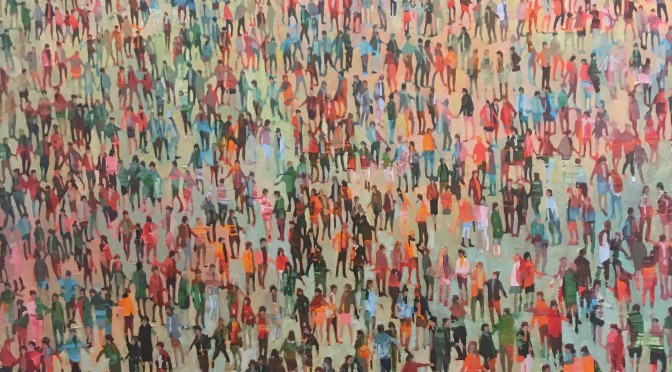
We’re told that, “there was a great multitude that no one could count, from every nation, from all tribes and peoples and languages, standing before the throne and before the Lamb…” There’s no way to imagine a limitation because it is all inclusive – “be it geographic, ethnic, numeric, linguistic, economic, and on and on the list goes.” [2] The Lamb is Jesus, described in the Book of Revelation, 1 Peter, and the Gospel of John as the Lamb or the Lamb of God who is sacrificial, redemptive, and salvific.[3] The same Lamb of God we sing to in prayer during the communion liturgy. The Lamb who will draw all people to himself.[4] The image of the Lamb on the throne makes heaven seem pretty crowded, doesn’t it?
Recently I drove by a sign that said, “Make Heaven Crowded.” I immediately made that perplexed face that I make as my brain jumped the theological hurdles of that phrase: “Make Heaven Crowded.” I sat at the red light and thought, “Isn’t heaven already crowded? Jesus makes heaven crowded. We don’t make heaven crowded.” And then I wondered what other people think and feel when they see that sign. Do people think of themselves as the ones who may or may not be up to the task of making heaven crowded? On the flipside, very few people find it appealing to be somebody else’s religious project. More importantly, heaven is already crowded through the cross of Christ whose death and resurrection draws all people to himself.[5] It’s all about the love on both sides of the veil.
The last verses of the Revelation text reads, “They will hunger no more, and thirst no more; the sun will not strike them, nor any scorching heat; for the Lamb at the center of the throne will be their shepherd, and he will guide them to springs of the water of life, and God will wipe away every tear from their eyes.” It’s tempting to minimize this promise of comfort with our own doubts. Several years ago, I was leading a Bible Study at the women’s prison. There I stood, waxing on about different ideas about heaven, when a woman told me it was all well and good that I had time to play with those ideas but she believed in a place and time when there would be no more hunger, no more thirst, and no more tears. She counted on it. She ended up being the preacher God put in our midst that day to remind us that there is love on both sides of the veil even when life on this side gets hard. And she is most certainly a saint.
The woman doesn’t fit the description of “saint” as it’s more commonly used to mean a “best-ever-super-great person.” But she does fit into the saints who are part of “a great multitude that no one could count, from every nation, from all tribes and peoples and languages…” She is a saint who defiantly proclaims grace in the face of all things to the contrary, claiming for herself the cross that bears all things, even bearing us through death into God’s loving embrace. There is nothing to fear when there is love on both sides of the veil.
The author of the reading from First John writes, “See what love the Father has given us, that we should be called children of God; and that is what we are.” As children of God, we are saints by baptism, not by our own action. At the same time, we are sinners, recipients of the grace that has been put in us through the Jesus’ death on a cross. This sainthood is Christ’s to give and it is given freely. Through his gift, we defiantly proclaim a living grace and bring peace in the face of ordeals great and small.
What are these ordeals? Let’s try those verses in Matthew to answer that question. Jesus tells the disciples that the kingdom is revealed into through a poor spirit, grief, hunger, thirst, persecution, and false accusations. How do we embody and reveal grace? We embody and reveal grace by being grace-filled with people. I hear these stories from you so often.
You’ve sat in the hallway at a nursing home waiting to visit someone and take the time to hear another resident’s story because they need to tell it to somebody.
You’re the one whose child died and you let someone sit with you silently while you felt everything and nothing all at once.
You’ve supported a friend whose spouse has left them.
You’re the one who’s “no” meant “yes” to someone who hurt you and needed to trust somebody else to help you heal.
You’ve been with the undocumented family who has no home.
You’re the victim of war who was caught in the crossfire and immigrated to safety in a new place with new people that you had no choice but to trust.
You’ve been with each other in places that seem the most forsaken by God because, if the cross means anything, it means God shows up in the worst possible places and situations. Love on this side of the veil.
Grief, poor spirits, all the ordeals, are not mentioned by Jesus as things to achieve and wear as a badge of honor. These ordeals are the hard things that happen in life without explanation. Hard things that we get to bear with each other and for each other. I get to show up for you. You get to show up for me. We get to show up embodying grace for each other in situations that seem utterly hopeless. This is true when we don’t have words that fix it. Perhaps it’s true especially when we don’t have words that fix it. What’s most important is showing up for people regardless. Showing up, embodying grace, does not mean that we’re not afraid. It doesn’t mean that we’re not going to pay some kind of emotional or physical price for showing up. Showing up, sharing the suffering while embodying grace, is a gift we give each other in the face of really hard times; because it is a gift first given to us from the love of living grace on the other side of the veil.
See what love the Father has given you, children of God, for that is what you are.
Jesus shows up for the multitude, in the multitude, for you, and in you.
Children of God, for that is what you are, be at peace – the kingdom of heaven is yours through Christ’s love on both sides of the veil.
Thanks be to God and amen.
__________________________________________________
[1] Rapture theology is an historical development dating to the early 1800s.
[2] Eric Mathis, Professor of Music and Worship, Samford University. Commentary on Revelation 7:9-17 for November 2, 2014, at WorkingPreacher.org. https://www.workingpreacher.org/preaching.aspx?commentary_id=2182
[3] John 1:29, 1 Peter 1:18-19, Revelation chapters 5, 6, 7, 12, 13, 14
[4] John 12:32
[5] Ibid.
_________________________________________________
1 John 3:1-3 See what love the Father has given us, that we should be called children of God, and that is what we are. The reason the world does not know us is that it did not know him. 2 Beloved, we are God’s children now; what we will be has not yet been revealed. What we do know is this: when he is revealed, we will be like him, for we will see him as he is. 3 And all who have this hope in him purify themselves, just as he is pure.