
Tag Archives: family systems

Hard to Love, Harder to Learn [OR Dogs’ Guidance to Holy Land Blind Spots]

Pastor Caitlin Trussell, Augustana Lutheran Church, Denver—8/14/2026

[sermon begins after two Bible readings]

Matthew 15:21-28 Jesus left that place and went away to the district of Tyre and Sidon. 22 Just then a Canaanite woman from that region came out and started shouting, “Have mercy on me, Lord, Son of David; my daughter is tormented by a demon.” 23 But he did not answer her at all. And his disciples came and urged him, saying, “Send her away, for she keeps shouting after us.” 24 He answered, “I was sent only to the lost sheep of the house of Israel.” 25 But she came and knelt before him, saying, “Lord, help me.” 26 He answered, “It is not fair to take the children’s food and throw it to the dogs.” 27 She said, “Yes, Lord, yet even the dogs eat the crumbs that fall from their masters’ table.” 28 Then Jesus answered her, “Woman, great is your faith! Let it be done for you as you wish.” And her daughter was healed from that moment.

Romans 11:1-2a, 29-32 [Paul writes:] 1 I ask, then, has God rejected his people? By no means! I myself am an Israelite, a descendant of Abraham, a member of the tribe of Benjamin. 2a God has not rejected his people whom he foreknew.
29 For the gifts and the calling of God are irrevocable. 30 Just as you were once disobedient to God but have now received mercy because of their disobedience, 31 so also they have now been disobedient in order that, by the mercy shown to you, they also may now receive mercy. 32 For God has imprisoned all in disobedience so that he may be merciful to all.

[sermon begins]

One of the things that I’m most grateful for in my education to become a pastor is the individual counseling required by my seminary. Eight sessions had to be completed during our first year. Those eight sessions gave me a chance to name my family’s complicated story and where I fit in it, and to lighten the baggage I was carrying that was helpful to name before setting that bag down in a pastor’s office. Not long after I started my first call with Augustana, I thought it would be helpful to do more work on my blind spots. I knew a little about family systems theory, jumped online with the Bowen Center in Washington D.C., and found a local leadership coach near the church who’s been coaching me every couple of months ever since.[1]

One of the counseling hurdles after being raised in two wildly different Christian churches and having three dads in my life was figuring out what love meant to me. God’s love. Family love. People love. Self-love. Neighbor love. I wrestled with who was worthy of love including myself. It’s part of the reason being a Lutheran preacher is so compelling. We often talk about grace and grace is all about unconditional love, God’s unconditional love for you, for me, and for the world.

The human problem with understanding and receiving unconditional love is that we often experience love as conditional. Heck, all you have to do is spend two minutes in almost any family system, institutional system, or any time at all in social media to hear those conditions on love loud and clear. What’s not expected, is hearing conditions on love from Jesus responding to the shouting Canaanite woman.

We’re used to Jesus taking the higher ground. Here, he goes low, under the table low. His guys want Jesus to send the woman away for all the noise she’s making. Jesus doesn’t send her away though. He talks to her. More than talks, he blows up the conversation by calling her a dog. Some theologians think Jesus is learning something in his conversation with the woman. He was, after all, fully divine AND fully human. And humans learn. Arguably we don’t usually learn lessons quickly even with good coaching, especially lessons that reveal our blind spots. Perhaps we could applaud Jesus for his quick learning. Regardless, this is an uncomfortable story of encountering Jesus finding it harder to learn in a hard to love moment.

The Canaanite woman called Jesus “Lord” and “Son of David.” She knew the lingo, maybe she knew the rest of his genealogy too. It’s possible she had heard about the Canaanites in Jesus’ family tree listed in Matthew’s opening chapter to the gospel – Rahab the courageous prostitute, Tamar the righteous trickster, and Ruth the loyal daughter-in-law and great-grandmother to King David.[2] [3] Or perhaps Jesus had a physical feature that identified the Canaanite blood that also flowed in his veins through his family tree. Maybe she took one look at him and immediately knew they shared Canaanite blood.[4]

We’ll never know whether she knew but it’s possible that that she did and it’s possible that Jesus knew about the non-Jew, Canaanite women in his genealogy. Jewish heredity follows the mother because mothers are obvious, pregnant links. Regardless, this is when Jesus’ ministry expands to include non-Jews. Up to now, he’s instructed his disciples to stay within certain Jewish boundaries. Now they’re in Tyre and Sidon, north of Galilee and way north of Jerusalem, getting shouted at and possibly feeling a little defeated after all they’ve been through. First John the Baptist was executed by Herod. Then they fed over 5,000 hungry men, women, and children who were also on the move after John’s death. Then they spent a terrifying night on a boat at sea in a storm before debarking in Gennesaret to trek further north to Tyre and Sidon where they’re shouted at in welcome.

Breadcrumbs from feeding thousands could still be embedded in Jesus’ clothes while the Canaanite woman shouted. When she knelt before Jesus, she said, “Lord, help me.” He answered, “It is not fair to take the children’s food and throw it to the dogs.” Jesus’ comment vexes the faithful in every age including ours.

Jews didn’t historically keep or love dogs the way that their Greek and Roman counterparts did.[5] In antiquity, dogs were found in the households of all classes of people and were a symbol of loyalty in art and literature.[6]  Jesus’ dog accusation was flipped by the Canaanite woman who likely had a love of dogs much like dog lovers in our 21st century households.[7] Dogs in her town were fed under the table as beloved family members – crumbs falling over the table’s edge and lapped up by adored canine companions. Whatever this odd exchange between Jesus and the woman actually means, Jesus ends up rewarding the persistent loyalty of the woman by celebrating her faith and fulfilling her request. His ministry expanded to include a non-Jew, a Canaanite sibling by blood, under the watchful gaze of his disciples.

The expansion of his ministry is remarkable for there was no love lost between Canaanites and Jews over the centuries leading up to Jesus’ interaction with the woman. I wonder about the hard to love and harder to learn parts of this story as they translate into our own century 2,000 years later. We watch from afar as the natural enmity of millennia, stoked by post-World War II decisions to create the state of Israel, roils into the most recent war between Israel and Hamas leaving thousands of Israelis and tens of thousands of Palestinians dead including children.[8]

The staggering statistics are vital to personalize through stories of families and people and to work towards peace even when it seems impossible and somehow easier to ignore. Several months ago, I was invited to a mutifaith lunch led by Friends of Standing Together, a grassroots movement organizing Jewish and Palestinian citizens of Israel working for peace.[9] Closer to home in the United States and in our Rocky Mountain Synod, Sumud, an ELCA ministry meaning “steadfastness” in Arabic, advocates “nonviolent resistance through advocacy, education, social work and faith-rooted presence.”[10] Sumud partners with the Evangelical Lutheran Church in Jordan and the Holy Land (ELCJHL), on ministries in education, health care, justice and leadership and “practices accompaniment with this Arabic-speaking community of faithful Lutherans.”[11]

Last week, I spent a few hours of retreat time with 15 other faith leaders in the Multifaith Leadership Forum. Even in our small number, the faiths represented included Islam, Judaism, Buddhism, Bahai, and Christianity. We’ve built some trust in the group over the years. Even so, we carry our own loyalties and blind spots into our time together. Hard conversations about war and peace in the Holy Land, the birthplace of many of our world faiths, intermingled with our individual stories and relationships among the group. Everyone wishing there was an easy answer to ending a seemingly endless war and bringing an everlasting peace that prioritizes life over death. It’s hard to separate the political from the personal because politics affect real people in real time. Whether people eat or don’t, whether people are safe or not is deeply affected by what elected leaders say and do and by who they believe are worthy; and this includes war and peace.

The personal story may be one reason why the story of the Canaanite woman and Jesus is so powerful. Jesus learns mercy from the woman’s challenge to him to help her daughter. Confronted by her need for help, Jesus’ blind spot shifts to help her, crossing the boundaries of gender, ethnicity, and religion as he learns to love by the power of her coaching.

In my sermon two weeks ago, I emphasized God’s promises to the Jews wrestled with by the Apostle Paul, a Jewish-Christian convert, in his letter to the Roman church in the Bible’s book of Romans.[12] His wrestling continues in our reading today from Romans in which he emphasizes the extension of God’s promises of mercy to Jews and to all.

Today’s Gospel reading personalizes God’s promises between Jesus, the Canaanite woman, and her daughter. Through her story, we’re coached once more that God’s promises of grace and unconditional love are trustworthy for you, for us, and for the world through the ever-expanding ministry of the Lord Jesus. Ministry that includes the diversity of human siblings in skin along with our Savior who slipped on Jewish and Canaanite skin to reveal what hard love and harder learning look like. Ministry fueled by an extravagant, perplexing grace that cannot be contained by bread baskets or tables or ethnic division. For this, and for all that God is doing, we can say thanks be to God and amen.

_____________________________________________________

[1] The Bowen Center for the Study of the Family

[2] Matthew 1:3-6 Jesus’ genealogy [Tamar: Genesis 38; Rahab: Book of Joshua, Chapter 2; Ruth: Book of Ruth]

[3] Mitzi J. Smith, Professor of New Testament, Columbia Theological Seminary. Commentary on Matthew 15:10-28. Sermon Brainwave Podcast posted August 20, 2017. https://www.workingpreacher.org/preaching.aspx?commentary_id=4542

[4] Pastor Barbara Berry Bailey, St. Paul’s Lutheran Church, Denver, CO. Rocky Mountain Synod, ELCA, Metro East Preacher’s Text Study on August 11, 2020.

[5] Francis D. Lazenby. Greek and Roman Household Pets. The Classic Journal: Vol.44, No. 4 (Jan. 1949), 245-252 and Vol 44., No. 5 (Feb. 1949), 290-307. http://penelope.uchicago.edu/Thayer/E/Journals/CJ/44/4/Household_Pets*.html

[6] Ibid.

[7] Ibid., Smith.

[8] July 31, 2026. Middle East: Civilian death toll climbs in Gaza, Lebanon and West Bank as UN chief demands ‘the fighting must stop’ | UN News

[9] English | standing-together

[10] SUMUD: for Justice in Palestine and Israel

[11] Ibid.

[12] August 2, 2026, caitlintrussell.org. A Moment of Peace in the Cultural Chaos | Caitlin Trussell
Jesus Hits the Beach – John 21:1-19 [OR Nibbling on Fish and Family Systems – A Sermon with First Call Pastors and Deacons

Opening Worship for First Call Theological Education, Office of the Bishop, Rocky Mountain Synod, ELCA

Caitlin Trussell on April 27, 2022, 7 p.m.

[sermon begins after this Bible reading]

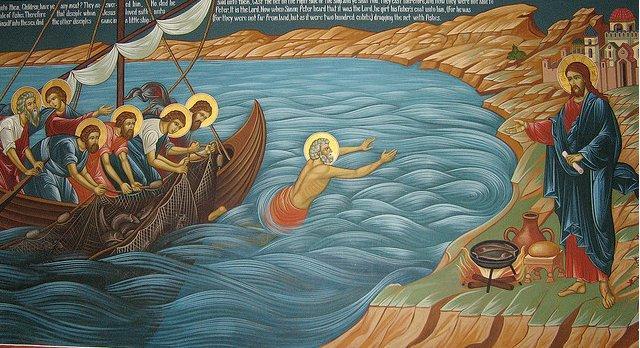
John 21:1-19 After [he appeared to his followers in Jerusalem,] Jesus showed himself again to the disciples by the Sea of Tiberias; and he showed himself in this way. 2Gathered there together were Simon Peter, Thomas called the Twin, Nathanael of Cana in Galilee, the sons of Zebedee, and two others of his disciples. 3Simon Peter said to them, “I am going fishing.” They said to him, “We will go with you.” They went out and got into the boat, but that night they caught nothing.
4Just after daybreak, Jesus stood on the beach; but the disciples did not know that it was Jesus. 5Jesus said to them, “Children, you have no fish, have you?” They answered him, “No.” 6He said to them, “Cast the net to the right side of the boat, and you will find some.” So they cast it, and now they were not able to haul it in because there were so many fish. 7That disciple whom Jesus loved said to Peter, “It is the Lord!” When Simon Peter heard that it was the Lord, he put on some clothes, for he was naked, and jumped into the sea. 8But the other disciples came in the boat, dragging the net full of fish, for they were not far from the land, only about a hundred yards off.
9When they had gone ashore, they saw a charcoal fire there, with fish on it, and bread. 10Jesus said to them, “Bring some of the fish that you have just caught.” 11So Simon Peter went aboard and hauled the net ashore, full of large fish, a hundred fifty-three of them; and though there were so many, the net was not torn. 12Jesus said to them, “Come and have breakfast.” Now none of the disciples dared to ask him, “Who are you?” because they knew it was the Lord. 13Jesus came and took the bread and gave it to them, and did the same with the fish. 14This was now the third time that Jesus appeared to the disciples after he was raised from the dead.
15When they had finished breakfast, Jesus said to Simon Peter, “Simon son of John, do you love me more than these?” He said to him, “Yes, Lord; you know that I love you.” Jesus said to him, “Feed my lambs.” 16A second time he said to him, “Simon son of John, do you love me?” He said to him, “Yes, Lord; you know that I love you.” Jesus said to him, “Tend my sheep.” 17He said to him the third time, “Simon son of John, do you love me?” Peter felt hurt because he said to him the third time, “Do you love me?” And he said to him, “Lord, you know everything; you know that I love you.” Jesus said to him, “Feed my sheep. 18Very truly, I tell you, when you were younger, you used to fasten your own belt and to go wherever you wished. But when you grow old, you will stretch out your hands, and someone else will fasten a belt around you and take you where you do not wish to go.” 19(He said this to indicate the kind of death by which he would glorify God.) After this he said to him, “Follow me.”

[sermon begins after this brief paraphrase of my adlib welcome]

I want to thank Chelsea for asking me to preach with you this evening. The high of finishing seminary and being ordained is one I remember well. She filled me in about the bumpy road of First Call Education over the last few years of pandemic and told me this is the first time you’ve been together synodically in this way, at least intentionally. We talked about the theme and practice of Family Systems thinking for your time togeher as well as hopes for these next couple of days too. It’s a joy to share this time with you. The gospel reading for this evening is the one for this coming Sunday. You’re welcome to use anything you hear this evening in preparation for Sunday. And you’re also welcome not to use it. Lastly, I bring you warm greetings from the sinner saints of Augustana Lutheran Church. Let’s get to it then…

[sermon actually begins]

We moved into a new house when my mom married my stepdad, Pops. He’d moved us from the East Coast to the West, from Catholicism to an austere, a capella, reformed faith tradition, and from subsidized housing to a single family home complete with olive and avocado trees, and a bird of paradise plant by the front door. My mother put dark brown carpet in the new house because the five of us kids, 4 to 13 years old, and my 17-year-old stepbrother and his friends brought in a lot of dirt and the occasional bleeding wound. Her solution was the darkest carpet short of black she could find. It ended up being a mess in the other direction because every pale piece of lint, paper, and dust showed in stark relief against the sea of brown.

Despite my mother’s best intentions getting us into family therapy after we left my mentally ill dad, some of my time was spent crying. Mom came up with a plan to make space for the tears. Vacuuming. Square footage of dark brown carpet awaited me. By the time I vacuumed my way from the dining room to the front hall, up and down the curved staircase, through the living room, and into the den, I had calmed down. Each tidy line that dark carpet reveals when vacuumed, like patterns in a Japanese sand garden, softened my reaction and organized my thinking. Mom had probably calmed down too because the vacuum drowned out the noise I was making. Then we could talk. Ah, the highs and lows of new life together knew no bounds.

Apparently, the new life of Jesus knew no bounds either. He really moved around in those early days of resurrection. Fresh from the tomb, Mary Magdalene mistook him for the gardener until Jesus said her name. That same Easter evening and a week later on the second Sunday in Easter, the disciples had a come-to-Jesus meeting with him in a locked room. Then Jesus hit the beach. “This was now the third time that Jesus appeared to the disciples after he was raised from the dead.” What is it with this guy and the number three? It’s not enough that he was raised on the third day, but he had to be sighted three times afterwards? Then he offers Peter a three-part absolution to mirror Peter’s three-part denial at Jesus’ trial – directing Peter’s love for Jesus to tending his flock.

Love for Jesus leads us to so many unexpected places. Some of us end up following a call towards the kind of flock-tending that Jesus asked of Peter. The same Peter who’d just jumped wildly into to the water to get to Jesus while the rest of the disciples rowed the boat ashore. At this point in the disciples’ relationships, they must have all known each other well. Their foibles and follies recounted over meals and during the long walks between towns. Processing their experiences with each other to become better able to tell a story of their own to feed Jesus’ sheep.

About a year and a half into my now nine-year call, I had an interaction that didn’t go well. Suffice it to say that I’d just met a person who decided to project a bunch of assumptions onto me that didn’t apply. This person had enough power in the system that my confident, capable self was caught off guard. Soon afterwards, I was in my car, in a parking lot, in a full-on ugly cry – simultaneously feeling ridiculous while realizing that I needed help to think. I had enough wherewithal to recognize these tears as old ones, but it was going to take more than vacuuming lines into brown carpet to settle this down. A few of my colleagues at the time had talked about Family Systems work. How we grew up reacting and acting in ways that once served a purpose that no longer exists, but we still react and act in those unexamined ways given the right set of circumstances.

I’d dabbled in Family Systems thinking at the start of my call, but getting to know the church and my call was distracting those first few months and it fell off my radar. Fast-forward to the year and half mark, in that parking lot. I knew that the colleagues I most respected were regularly in some of kind of therapy or spiritual direction. So I found myself a family systems coach and I connected with a few like-minded colleagues who spoke systems language. The slow, painstaking work of figuring out old patterns and reactions began alongside training my brain to think in new ways. Not just synthesize data or process my emotions – although that’s important. Really think. The kind of thought that aligns new information and responses with deeply held values and principles. Using the squishy gray matter part of my brain to do what it was created to do. I’ll leave it there since I’m not here to give a neurophysiology lecture, although as a former nurse that would be super fun and is very tempting.

My love of Jesus, my love of the church, my love of self and neighbor, all the loves were not enough for me to feed Jesus’ lambs and sheep and keep my sanity. I’ve seen other colleagues get their emotions so tangled, their thinking so clouded, that they self-righteously blame their flock without any self-examination and leave their call. I don’t know how each of you would describe your experience these first months or years of your calls. Pandemic makes so many things harder and weirder. What I know is that having a strategy for thinking, whether it’s Family Systems or another strategy, has made the difference in my work and well-being. It’s also kind of fun being the least anxious person in the room from time to time.

We get to do so many wild and wooly things because we love Jesus AND the world God so loves so much that we accept calls into ministry. It’s an adventure that I wouldn’t trade for anything. When Jesus asks Peter, “Do you love me?…Do you love me?…Do you love me?…”, Peter’s affirmations and ache are palpable – “Lord, you know everything; you know that I love you.” Jesus gave Peter the sheep and to the sheep he gave Peter. Our life together as church, starting with worship and expanding to the ministry mischief we each get up to in our different calls, is born of this love. Not a love blind to sin and fault, but an unconditional, open-eyed love to the human story lived in each one of us. Our human stories healed by Jesus in the love given to each one of us and, by the Spirit’s strength, the love we get to give others in Jesus’ name.

Alleluia, Christ is risen! He is risen, indeed, alleluia! And amen.


The holy gospel according to St. John…Glory to you, O Lord.

After [he appeared to his followers in Jerusalem,] Jesus showed himself again to the disciples by the Sea of Tiberias; and he showed himself in this way. 2Gathered there together were Simon Peter, Thomas called the Twin, Nathanael of Cana in Galilee, the sons of Zebedee, and two others of his disciples. 3Simon Peter said to them, “I am going fishing.” They said to him, “We will go with you.” They went out and got into the boat, but that night they caught nothing.
4Just after daybreak, Jesus stood on the beach; but the disciples did not know that it was Jesus. 5Jesus said to them, “Children, you have no fish, have you?” They answered him, “No.” 6He said to them, “Cast the net to the right side of the boat, and you will find some.” So they cast it, and now they were not able to haul it in because there were so many fish. 7That disciple whom Jesus loved said to Peter, “It is the Lord!” When Simon Peter heard that it was the Lord, he put on some clothes, for he was naked, and jumped into the sea. 8But the other disciples came in the boat, dragging the net full of fish, for they were not far from the land, only about a hundred yards off.
9When they had gone ashore, they saw a charcoal fire there, with fish on it, and bread. 10Jesus said to them, “Bring some of the fish that you have just caught.” 11So Simon Peter went aboard and hauled the net ashore, full of large fish, a hundred fifty-three of them; and though there were so many, the net was not torn. 12Jesus said to them, “Come and have breakfast.” Now none of the disciples dared to ask him, “Who are you?” because they knew it was the Lord. 13Jesus came and took the bread and gave it to them, and did the same with the fish. 14This was now the third time that Jesus appeared to the disciples after he was raised from the dead.
15When they had finished breakfast, Jesus said to Simon Peter, “Simon son of John, do you love me more than these?” He said to him, “Yes, Lord; you know that I love you.” Jesus said to him, “Feed my lambs.” 16A second time he said to him, “Simon son of John, do you love me?” He said to him, “Yes, Lord; you know that I love you.” Jesus said to him, “Tend my sheep.” 17He said to him the third time, “Simon son of John, do you love me?” Peter felt hurt because he said to him the third time, “Do you love me?” And he said to him, “Lord, you know everything; you know that I love you.” Jesus said to him, “Feed my sheep. 18Very truly, I tell you, when you were younger, you used to fasten your own belt and to go wherever you wished. But when you grow old, you will stretch out your hands, and someone else will fasten a belt around you and take you where you do not wish to go.” 19(He said this to indicate the kind of death by which he would glorify God.) After this he said to him, “Follow me.”

This is the gospel of our Lord. Praise to you, O Christ.