Tag Archives: Woman at the Well

Jesus Meets a Woman at a Well—Meet Cute? Auspicious Sign? World Changing?

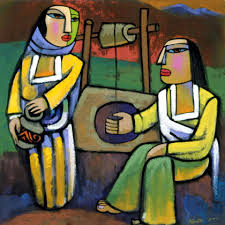
**Samaritan Woman at the Well by He Qi

Caitlin Trussell with Augustana Lutheran Church on March 8, 2026

[sermon begins after Bible reading – hang in there, it’s a great story]

John 4:5-42  [Jesus] came to a Samaritan city called Sychar, near the plot of ground that Jacob had given to his son Joseph.6 Jacob’s well was there, and Jesus, tired out by his journey, was sitting by the well. It was about noon.
7 A Samaritan woman came to draw water, and Jesus said to her, “Give me a drink.” 8 (His disciples had gone to the city to buy food.) 9 The Samaritan woman said to him, “How is it that you, a Jew, ask a drink of me, a woman of Samaria?” (Jews do not share things in common with Samaritans.) 10 Jesus answered her, “If you knew the gift of God and who it is that is saying to you, ‘Give me a drink,’ you would have asked him, and he would have given you living water.” 11 The woman said to him, “Sir, you have no bucket, and the well is deep. Where do you get that living water? 12 Are you greater than our ancestor Jacob, who gave us the well and with his sons and his flocks drank from it?” 13 Jesus said to her, “Everyone who drinks of this water will be thirsty again, 14 but those who drink of the water that I will give them will never be thirsty. The water that I will give will become in them a spring of water gushing up to eternal life.” 15 The woman said to him, “Sir, give me this water, so that I may never be thirsty or have to keep coming here to draw water.”
16 Jesus said to her, “Go, call your husband, and come back.” 17 The woman answered him, “I have no husband.” Jesus said to her, “You are right in saying, ‘I have no husband,’ 18 for you have had five husbands, and the one you have now is not your husband. What you have said is true!” 19 The woman said to him, “Sir, I see that you are a prophet. 20 Our ancestors worshiped on this mountain, but you say that the place where people must worship is in Jerusalem.” 21 Jesus said to her, “Woman, believe me, the hour is coming when you will worship the Father neither on this mountain nor in Jerusalem. 22 You worship what you do not know; we worship what we know, for salvation is from the Jews. 23 But the hour is coming and is now here when the true worshipers will worship the Father in spirit and truth, for the Father seeks such as these to worship him. 24 God is spirit, and those who worship him must worship in spirit and truth.” 25 The woman said to him, “I know that Messiah is coming” (who is called Christ). “When he comes, he will proclaim all things to us.” 26 Jesus said to her, “I am he, the one who is speaking to you.”
27 Just then his disciples came. They were astonished that he was speaking with a woman, but no one said, “What do you want?” or, “Why are you speaking with her?” 28 Then the woman left her water jar and went back to the city. She said to the people, 29 “Come and see a man who told me everything I have ever done! He cannot be the Messiah, can he?” 30 They left the city and were on their way to him.
31 Meanwhile the disciples were urging him, “Rabbi, eat something.” 32 But he said to them, “I have food to eat that you do not know about.” 33 So the disciples said to one another, “Surely no one has brought him something to eat?” 34 Jesus said to them, “My food is to do the will of him who sent me and to complete his work. 35 Do you not say, ‘Four months more, then comes the harvest’? But I tell you, look around you, and see how the fields are ripe for harvesting. 36 The reaper is already receiving wages and is gathering fruit for eternal life, so that sower and reaper may rejoice together. 37 For here the saying holds true, ‘One sows and another reaps.’ 38 I sent you to reap that for which you did not labor. Others have labored, and you have entered into their labor.”
39 Many Samaritans from that city believed in him because of the woman’s testimony, “He told me everything I have ever done.” 40 So when the Samaritans came to him, they asked him to stay with them, and he stayed there two days. 41 And many more believed because of his word. 42 They said to the woman, “It is no longer because of what you said that we believe, for we have heard for ourselves, and we know that this is truly the Savior of the world.”

[sermon begins]

In last week’s gospel episode, Nicodemus lurked at night and found Jesus where he was staying. He did not want to be seen by anyone, especially by any of his religious friends, Nic at night brings serious questions to Jesus and leaves confused. This week brings us into the light of day. High noon. In the big heat, Jesus sits down to rest at a well while the disciples go to town to rustle up some lunch. Jesus isn’t sitting by just any old well. This is Jacob’s well. Wells were THE ‘Match.com’ of 2,000 B.C.E.[1]  Jacob and Rachel met by a well in the book of Genesis.[2] Moses and Zipporah met by a well in Exodus.[3] Wells are a place of auspicious beginnings.

No need to get too nervous about where we’re headed with Jesus running into this unnamed Samaritan woman at the well. More than a “meet cute,” it is an auspicious sign that Jesus showed up by a well the way a bridegroom might. It’s auspicious because it’s consistent with language of the Gospel of John. “Jesus assumed the role of bridegroom earlier in the Gospel by providing wine for the wedding at Cana, and John the Baptist identified Jesus as the bridegroom.”[4]

John the Baptist used the bridegroom language right before Jesus walked into Samaria and sat by the well. He said, “The friend of the bridegroom…rejoices greatly at the bridegroom’s voice.” A few verses later the Samaritan woman is at the well at an usual time. Not in the typical cool hours of the morning. At noon. In the heat of the day. Perhaps her first surprise was finding anyone else at the well – followed quickly by the shock at finding herself there with a Jewish man who would speak with her. Note that Jesus doesn’t condemn her. She told him the truth about living with a man, and he added to it with more truth about her marital history. Awkward? Maybe. Regardless, their conversation avoids shame and condemnation while exposing tensions between gender and ethnicity.[5] Their conversation about water from a well reveals centuries of ethnic strife. Their unusual conversation is a beginning.

Showing up at a well at noon was unusual. Jesus met her there. His heady words to Nicodemus last week, about the world being saved through Jesus, go live in the story of the Samaritan woman this week. The words go live in a body, in her body – the body representing the bride. She is a solitary person by a well and unnamed but for her ethnicity as a Samaritan. She represents the world that Jesus was concerned about – a world that separates people into us and them.[6] This woman’s story is perfect for International Women’s Day celebrated every year for decades on March 8th to spotlight and advocate for women around the world.[7] Research supports that when women have equitable access to resources, education, and opportunities, it strengthens economic development and health while stabilizing communities.[8]

In the gospel story, the woman empowered by Jesus is a sign that the wider non-Jewish world IS Jesus’ concern. Jesus is the bridegroom. Jesus is about saving the world now. A tidy theological equation, to be sure, but what do we do with it? How does what Jesus is doing at a well figure into life for world here and now? A world at war with itself in conflicts beyond Iran, Israel, and the United States although that’s one weighing on our hearts and minds, to be sure.

Let’s start closer to home with Augustana. It’s an obvious place to begin. After all, the church is referred to in the Bible as the bride of Christ.[9] And we, as a worshipping community here this morning, are part of Christ’s church catholic, Christ’s whole universal church. What might Jesus the bridegroom, sitting with us at this very moment, have to say about us? How do we, the worshipping community of Augustana, live into what Jesus already knows about us? Sent into the city to talk with people like the Samaritan woman does. Leaving her water jar behind, she tells the people of the city, “Come and see a man who told me everything I have ever done! He cannot be the Messiah, can he?”

A few days ago, 25 of us from Augustana responded to the invitation from Multicultural Mosaic Foundation to attend their iftar as they broke their daily Ramadan fast with prayer and dinner. We’re grateful for their warm hospitality and gracious invitation to get to know each other, to learn, to ask questions, and to observe prayers. Pastor Michael and Dr. Bora presented about Lent and Ramadan as both began on the same day this year.[10] A tremendous evening of connection and respectful dialogue between Muslim and Christian neighbors. These interactions have awkward moments, but they are also world-changing building blocks. They take time and intention. They are a sign of what’s possible.

Like the woman talking with Jesus at the well, Sunday can feel like a place of relief and amazement. A place to tell the truth about ourselves and to hear the truth told about us. A place to simply be with the words of our confession. The confession of what we have done and left undone. But also the other meaning of confession which is remembering God’s promises to us and our trust in those promises. This is a place of living water and truth telling.

And, like the Samaritan woman, we head back into the city holding a sliver of doubt once the conversation happens here with Jesus. She says to the people, “He cannot be the Messiah, can he?” She takes her encounter with Jesus out for a spin, carrying her doubt right alongside of it, and invites people to wonder about Jesus with her. Embedded in the Samaritan woman’s invitation and question is an antidote to the 21st century culture that is poisoned by absolutism, anger, and judgment.

We are in a world, right now, that is suffering under absolutes. Conversation, common ground, connecting points are few and far between. The way in which we take our faith out for a spin from this sanctuary matters. THAT we take it out for a spin matters too. Our invitation may connect with others who need a place to wonder about the hope found in Jesus – a hope that does not disappoint.[11] People are scared and people are suffering. This is the world that Jesus came to save today. Right now.

Jesus did not come into the world to condemn it. Jesus came to save the world – to restore our relationship with God and with each other. Jesus did not come into the world to condemn you. Jesus came to save you – to restore your relationship with God, with the person next to you, and the with the person around the world from you. Let Jesus tell the truth about you here and be drawn into the unexpected moments of what happens next.

___________________________________________________

[1] Match.com is a dating website where people meet-and-greet each other online.

[2] Genesis 29:1-12

[3] Exodus 2:15-22

[4] John 2:1-11 and John 3:29 respectively.

Craig R. Koester. Symbolism in the Fourth Gospel: Meaning, Mystery, Community (Minneapolis: Fortress Press, 2003), 48.

[5] Reverend Ron Roshke, retired ELCA pastor in Denver, Third Sunday in Lent. March 8 2026. 2026_03_08Lent3A.pdf

[6] Koester, 48.

[7] Nicole Minkas. The role of participation and community mobilisation in preventing violence against women and girls: a programme review and critique. June 26, 2020. pmc.ncbi.nlm.nih.gov/articles/PMC8904729/

[8] Q&A Series #5: When Women Do Better, Countries Do Better – United States Department of State, 11/22/2017.

[9] Revelation 19:7-9; Ephesians 5:25-27.  See more at: http://www.openbible.info/topics/the_bride_of_christ

[10] Sacred Seasons of Reflection: Lent and Ramadan in Dialogue – Multicultural Mosaic Foundation. March 5, 2026.

[11] Romans 5:1-11

What is Truth? [OR Christian Nationalism is Neither Faithful nor Patriotic]

Caitlin Trussell with Augustana Lutheran Church on November 24, 2024 – Christ the King Sunday

[sermon begins after the Bible reading]

John 18:33-38 Then Pilate entered the headquarters again, summoned Jesus, and asked him, “Are you the King of the Jews?” 34Jesus answered, “Do you ask this on your own, or did others tell you about me?” 35Pilate replied, “I am not a Jew, am I? Your own nation and the chief priests have handed you over to me. What have you done?” 36Jesus answered, “My kingdom is not from this world. If my kingdom were from this world, my followers would be fighting to keep me from being handed over to the Jews. But as it is, my kingdom is not from here.” 37Pilate asked him, “So you are a king?” Jesus answered, “You say that I am a king. For this I was born, and for this I came into the world, to testify to the truth. Everyone who belongs to the truth listens to my voice.” 38Pilate asked him, “What is truth?”

[sermon begins]

Jesus, Jesus, he’s our man, if he can’t do it, no one can! These high holy Jesus days like Christ the King have an odd quality to them because Jesus can become a super-Jesus only vaguely resembling Jesus’ biblical ministry. This means it’s a good day to take a good, close look at Jesus in the Gospel of John. We can still cheer on Jesus, but it may sound differently when we do.

Jesus stood before Pontius Pilate in court. They debated truth as time stood oddly still. It mattered how Jesus answered Pilate because there were religious leaders who’d had it with him and simply wanted him to go away. Here’s a sampling of the accusations against him in the Gospel of John…

…Jesus attended a wedding, irritated by his mom but does what she says anyway – turning water into the finest wine as the first of his signs. [1]

…Jesus wielded a whip, clearing the temple of vendors who swindled those who lived in poverty. [2]

…Jesus talked about new life with a fearful Pharisee in the middle of the night. [3]

…Jesus met a shady woman in the light of the noonday sun, breaking gender rules in his tradition. [4]

…Jesus healed many and fed over 5,000; walked on water and was alternately called the Word made flesh, the lamb of God, the Son of God, the King of the Jews, the bread of life, the good shepherd, the light of the world, and the truth.

…Jesus quietly forgave then saved the woman caught in adultery from being executed by stoning and sent her on her way while indicting her accusers. [5]

…Jesus cried with his friends Mary and Martha then raised Lazarus from the dead. [6]

… Jesus’ feet dripped with oil poured by Mary, anointing him both as king and as one soon to die. [7]

…Jesus rode on a donkey into Jerusalem, then stripped down to his skivvies to wash his friends’ feet, before praying for his disciples.[8]

Jesus was criminalized for vulnerable acts so powerful that he threatened the status quo of the most powerful. Jesus found himself standing in front Pontius Pilate arguing about truth before he was sentenced to death by crucifixion as the King of the Jews.

There were a number of problems with Jesus being and doing any ONE of those things, much less ALL of them. The time had come to face the music. He stood in front of Pontius Pilate. Pilate was on the emperor’s payroll. He was not much interested in the petty, internal squabbles of the Jewish religious leaders. He was, however, very interested in keeping the peace. Uprisings were costly and Pilate would pay the piper for upsetting emperor. Sacrificing Jesus was a lesser of the evils in his book and his self-interest was staying alive. What did it matter that the Truth was standing right in front of Pilate as he asked, “What is truth?”

We tend to think of truth as telling a story accurately. We don’t tend to think of truth as the story itself. We rarely think of truth in terms of a person. If each of us IS a “truth” claim, then what is that truth? In other words, each moment of my life reveals what I think is important in terms of other people, myself, time, money, and God. What would that look like? What could you learn about the truth that is me or the truth that is you? We’re all invested in different things. We could even say we’re ruled by different things, justifying our choices until we make some kind of sense to ourselves. Reflection of this kind reveals what runs and rules our lives, revealing our actual king.

I’d like to pause and point out what just happened here because I think it happens a lot. We start out talking about Jesus and we end up talking about ourselves. The sermon began with parts of Jesus’ story from the Gospel of John and how he ended up in front of Pilate. Talking about Pilate turns us toward the topic of self. Naturally. Pilate is a classic human example of what not to do in the name of self-interest. It’s hard to resist distancing ourselves from him even as we ask in our own day, “What is truth?”

Adoration is part of Christ the King Sunday but it’s not the whole story.  The Feast of Christ the King is young in the church calendar. Begun in 1925 by Pope Pius XI, its purpose is to compel our hearts, minds, and lives into the reign of God on earth, over and above the pull of power in the world. [9] Not a bad idea in the 1920s given the devastation of World War I as fascism was on the rise in Germany and Italy. Not a bad idea given the timeless appeal of trading grace and love of neighbor for power. Lutherans waited until the 1970s to celebrate it. Christ the King Sunday is to the church calendar a bit like New Year’s Eve is to the Common Era Gregorian calendar that we use every day.

And just like New Year’s Eve, we can be tempted to put on a happy face and look away from the things that make us uncomfortable. Or, in times of division we can be tempted to confront others in ways that demean and degrade our shared humanity. We either mute ourselves or we scream back. Things have gotten even more complicated these days as some other Christian denominations are the face of public Christianity, believing that Jesus is only on our country’s side and NOT on the side of the whole world so loved by God. [10] The desire to distance from those Christians and to go quiet is understandable. But Christianity has always been practiced by a wide variety of people.

In the United States, our Founders separated the church and state with the belief that King George wasn’t any more divine than anyone else. Because of the Founders’ efforts, we are free to speak our minds and free to practice any religion in this country we call home. The first Amendment to the United States Constitution protects freedoms of religion, speech, press, assembly, and petition. As Jesus’ followers and as United States’ citizens, we are two things at once. It’s helpful that Christian theology makes space for being two things at once – saint and sinner, bound and free, fearful and courageous, weak and strong, wise and foolish. Being a faithful citizen fits nicely into the Founder’s framework, too. Things go awry when faithful people decide that the country must be a theocracy, that it must be Christian under divine authority. This is called Christian Nationalism and its neither faithful nor patriotic.

Our Christian church year ends with a day to remind us that we have a king, one who ended up on trial as a threat to power. Like Pilate, we are challenged by the question of Jesus’ kingship while he awaits judgment. Let’s assume for the moment that we’re all cool with the idea of Jesus as king, as Christ the King. By his own admission to Pilate, Jesus’ kingdom is not from this world. It’s not about power or prestige. It’s a kingship that’s obedient as he listens to his mother at a wedding; it’s a kingship that’s grace-full as he hangs out with the shady woman at high noon; it’s a kingship that forgives unforgiveable human failing; it’s a kingship that cries with compassion at the pain of loss; it’s a kingship that’s non-violent through trial and execution, raising not one hand in violence against the people who inflict it; and, ultimately, it’s a kingship emptied out in self-sacrifice on a cross revealing the breadth of divine power in the depth of divine love. [11]

Christ’s kingship is the exact opposite of earthly power, calling us to obedience through the command to love our neighbors as ourselves when it does NOT serve our own self-interest, and to testify before governors and kings on behalf of people without power (see last week’s sermon). A different reason to cheer on Jesus, indeed! Jesus, Jesus he’s our king, has a different kind of ring.

John’s gospel proclaims that Christ’s kingship was born in skin and solidarity, as the Word made flesh, which means that Jesus is God and God is Jesus. [12] On this Christian New Year’s Eve, we are on the cusp of a new church year that begins next Sunday with Advent. During Advent, we await the sweet baby Jesus’ birth. A child who would grow up to stand trial in front of Pontius Pilate as embodied truth and hope for a weary world. Thanks be to God and amen.

____________________________________________

[1] John 2:1-11

[2] John 2:13-25

[3] John 3:1-21

[4] John 4:1-42

[5] John 8:1-11

[6] John 11:1-57

[7] John 12:1-8

[8] John 12:12-13:11

[9] Lucy Lind Hogan, Hugh Latimer Elderdice Professor of Preaching and Worship, Wesley Theological Seminary, Washington D.C.  Commentary on John 18:33-37 for November 25, 2018.   https://www.workingpreacher.org/preaching.aspx?commentary_id=3885 AND Frank C. Senn, 2007. The Not-So-Ancient Origins of Christ the King Sunday — Lutheran Forum

[10] John 3:16-17

[11] Koester, course notes, 12/1/2010.  For further study see: Craig R. Koester, The Word of Life: A Theology of John’s Gospel (Grand Rapids: Eerdmans, 2008).

[12] John 1:1-5, 14-18

Holy Friendship – John 15:9-17

**sermon art: Crucifixion in Yellow by Abraham Rattner (1953)

Caitlin Trussell with Augustana Lutheran Church on May 5, 2024

[sermon begins after the Bible reading]

John 15:9-17 [Jesus said to his disciples:] 9“As the Father has loved me, so I have loved you; abide in my love. 10If you keep my commandments, you will abide in my love, just as I have kept my Father’s commandments and abide in his love. 11I have said these things to you so that my joy may be in you, and that your joy may be complete.
12“This is my commandment, that you love one another as I have loved you. 13No one has greater love than this, to lay down one’s life for one’s friends. 14You are my friends if you do what I command you. 15I do not call you servants any longer, because the servant does not know what the master is doing; but I have called you friends, because I have made known to you everything that I have heard from my Father. 16You did not choose me but I chose you. And I appointed you to go and bear fruit, fruit that will last, so that the Father will give you whatever you ask him in my name. 17I am giving you these commands so that you may love one another.”

[sermon begins]

Friends make life fun, and challenging, and good, and funny, and frustrating, and great. Friends can be around for the long haul or sometimes only for a particular season of life. Some people are inclined to talk about close friends as besties. Others simply let each friend defy description and hierarchy. Most people would say that friends are essential. We could argue that Jesus thought that friends were essential, too. Jesus said to his disciples, “I do not call you servants any longer, because the servant does not know what the master is doing; but I have called you friends, because I have made known to you everything that I have heard from my Father; you did not choose me, but I chose you.”[1] No longer servants. Friends. That’s astounding for Jesus to say. And it’s a particular friendship. Jesus defines it. The disciples are Jesus’ friends because they’re in the know about God.

Jesus shared with them what he heard from God the Father. Bam. Friends! Friendship connected with God means something. It means something holy because God is the source of holiness and when we say something is holy, we mean it is something touched by God – whether that’s a person, thing, time, or place.[2] Holiness is not limited to the church. Of course, God is not restricted by such feeble constraints. Bible story after Bible story remind us that God acts where God will and with who God wills, not only in the places or people we think God should be acting. But when Jesus connected friendship and God, he was talking about holy friendship of a particular kind. It’s a good day to talk about what that means for being church because Jesus taught what it means in our reading today.

His teaching is part of what’s called the Farewell Discourse in the Gospel of John, chapters 14-17. Jesus talked about what holy friendship means as he said farewell to his friends. He knew they would need that connection to sustain their witness as their day-to-day world became more challenging after his death. As they longed to have Jesus back with them, they would need to turn towards each other in the love of holy friendship with the deep conviction that their lives belonged first to God and by extension they belonged to each other.

Jesus made holy friendship simple. Not easy. Simple. Lives shared in the witness of Jesus’ good news means the love of God is at its core. Jesus revealed God’s love in his life, ministry, death, and resurrection. Holy friendship includes sharing Jesus’ ways with each other, being Jesus to each other. We preach Christ crucified and we are the resurrected body of Christ in the world. This means that suffering doesn’t have the last word. Love does.

In the simplest of terms, Jesus showed up for milestones like a wedding and a funeral.[3] Pausing to observe life’s moments with holy friends recognizes God’s promise of presence with us in every situation, good or ill. Last Sunday in worship, we celebrated with our young holy friends graduating from high school. Lifting them in prayer during their time of transition. This coming Wednesday, 60+ Ministry will worship together and eat lunch afterwards. In one day last week, I met with three sets of holy friends – parents planning a baptism, another family planning a funeral, and a couple planning their wedding. (My first hat trick as a pastor.[4]) What do these things have in common? God is in the middle of these events with God’s promises of faith, hope, and love through celebration and suffering. Showing up for each other’s milestones builds community through the bonds of holy friendship, belonging to each other in the name of Jesus.

Right after the wedding of Cana in John chapter 2, where Jesus performed his miracle of turning water into wine, we’re invited into a different story. Jesus cleared the temple of bad business practices that hurt people and worked against the community.[5] The story of Jesus’ anger and how we think about the church helps us tend to the business of the church without turning the church solely into a business. Fiscal responsibility and attending to the business of the church is worthy, it’s just not the only or last word. Jesus’ teaching about holy friendship adds to that nuance. Stewarding our resources for both the good of this faith community and the wider community forms a tension from which we witness to Christ’s love for us and for the world. Our holy friendship as stewards isn’t easy. We have different ideas about how best to use the money, time, and talents that God first gave us.

Last week, Pastor Gail preached about Peter’s redemption and transformation after the resurrection in John, chapter 21.[6] In his fear during Jesus’ trial, Peter denied knowing Jesus three times. After the resurrection, Jesus asked Peter three times if he loved him. Each time, Peter said, “Yes, Lord, I love you.” That scripture, Peter’s longing for Jesus to hear him, wrecks me every time. Three denials. Three affirmations of love and a way to make amends as Jesus told Peter to feed his sheep, to tend to the beloved people who belong to God and each other. Grace upon grace was bestowed on Peter in those moments. If Peter’s example is too lofty, let’s visit the woman caught in adultery in John, chapter 8.[7] She was a dead woman walking, about to be legally executed by stoning.  Jesus wielded reckless grace on her behalf while inviting the men around her into self-examination of their own sin. He said to them, “Let anyone among you who is without sin be the first to throw a stone at her.” With that grace-filled challenge, is any wonder that Jesus ended up executed himself?

We follow the example of Jesus in our life together. In our best moments, we love each other across healthy boundaries for our common good. Do we sometimes hurt each other by the things we do and the things we leave undone? You bet. Directly addressing hurt and shame with the people who hurt us is what holy friendship looks like. We as the church get to practice Jesus’ teaching over and over again. Holy conversations follow the example of Jesus’ conversations with Nicodemus in John chapter 3 and the woman at the well in John chapter 4. Holy conversations that name both how we are hurt and how we hurt others are a call to grace. Grace upon grace to know ourselves, too. To laugh at ourselves, shake our heads at ourselves, and open ourselves to something inside of us shifting by way of that grace so that we can better love each other, including loving our very own selves. That’s holy friendship, figuring out how to extend grace to each other because we are holy friends, yoked to Jesus by Jesus for each other.

We belong to each other through no work of our own as we do the work of belonging to each other. Jesus said, “…you did not choose me, but I chose you.” Through our baptisms by water, into Christ’s death and resurrection, the Holy Spirit works the wonders of transformation, giving us spiritual gifts for building up the body of Christ as a place of reckless belonging, a place of imperfect, holy friendship for God’s sake, for our sake, and for the sake of the world. Amen.

_____________________________________

[1] John 15:15-16a

[2] Frederick Buechner, “Holy” in Wishful Thinking (New York: Harper Collins Publishers, 1973, 1993), 45.

[3] John 2: Jesus first miracle of turning water into wine at the Wedding of Cana; John 11: The raising of Lazarus.

[4] A hat trick is a sports term that applies to achievements that happen in groups of three like a hockey player who scores three points in one game.

[5] John 2:13-25

[6] John 21:15-19

[7] John 8:1-11