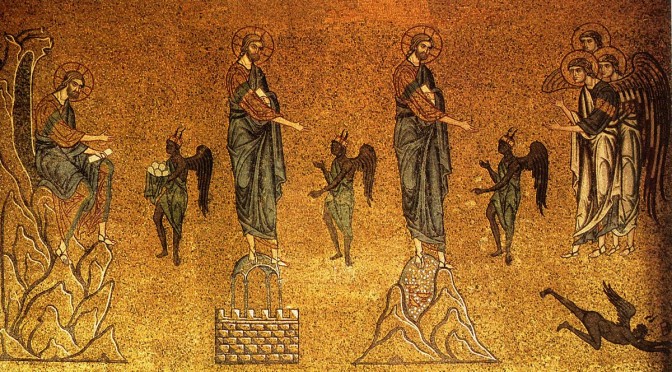
![The Imperfect Ideal in Community [OR God’s Call into Risk and Possibility]](http://caitlintrussell.org/wp-content/uploads/2026/02/The-Temptations-of-Christ-12th-century-mosaic-at-St-Mark-s-Basilica-Venice.-Temptations_of_Christ_San_Marco.sermon-Caitlin-Trussell-672x372.jpg)
**sermon art: The Temptations of Christ, 12th century mosaic at St Mark s Basilica, Venice.
Caitlin Trussell with Augustana Lutheran Church on February 22, 2026
[sermon begins after two Bible readings; Romans and Psalm 32 are at the end of the post]
Genesis 2:15-17 & 3:1-7 The Lord God took the man and put him in the garden of Eden to till it and keep it. 16 And the Lord God commanded the man, “You may freely eat of every tree of the garden, 17 but of the tree of the knowledge of good and evil you shall not eat, for in the day that you eat of it you shall die.”
3:1 Now the serpent was more crafty than any other wild animal that the Lord God had made. He said to the woman, “Did God say, ‘You shall not eat from any tree in the garden’?” 2 The woman said to the serpent, “We may eat of the fruit of the trees in the garden, 3 but God said, ‘You shall not eat of the fruit of the tree that is in the middle of the garden, nor shall you touch it, or you shall die.’ ” 4 But the serpent said to the woman, “You will not die, 5 for God knows that when you eat of it your eyes will be opened, and you will be like God, knowing good and evil.” 6 So when the woman saw that the tree was good for food and that it was a delight to the eyes and that the tree was to be desired to make one wise, she took of its fruit and ate, and she also gave some to her husband, who was with her, and he ate. 7 Then the eyes of both were opened, and they knew that they were naked, and they sewed fig leaves together and made loincloths for themselves.
Matthew 4:1-11 Jesus was led up by the Spirit into the wilderness to be tested by the devil. 2 He fasted forty days and forty nights, and afterward he was famished. 3 The tempter came and said to him, “If you are the Son of God, command these stones to become loaves of bread.” 4 But he answered, “It is written,
‘One does not live by bread alone,
but by every word that comes from the mouth of God.’ ”
5 Then the devil took him to the holy city and placed him on the pinnacle of the temple, 6 saying to him, “If you are the Son of God, throw yourself down, for it is written,
‘He will command his angels concerning you,’
and ‘On their hands they will bear you up,
so that you will not dash your foot against a stone.’ ”
7 Jesus said to him, “Again it is written, ‘Do not put the Lord your God to the test.’ ”
8 Again, the devil took him to a very high mountain and showed him all the kingdoms of the world and their glory, 9 and he said to him, “All these I will give you, if you will fall down and worship me.” 10 Then Jesus said to him, “Away with you, Satan! for it is written,
‘Worship the Lord your God,
and serve only him.’ ”
11 Then the devil left him, and suddenly angels came and waited on him.
[sermon begins]
Hanging out with babies and toddlers is a lot about love while saving them from themselves and what they don’t yet know. We watch them like mama bears when we’re with them and we limit their movement with gates and play yards when our attention is elsewhere. Trouble happens even with these safeguards and boundaries. Those moments stick with you. My mind’s eye still sees their big tumble off of a chair and down the stairs when our kids were very small. Tumbles taken under my watch. As they grew older, I started trying to safeguard them with words like, “Be safe, have fun, and use your power for good!” That encouragement was sometimes met with an eyeroll, but our son had a lifelong friend that started to answer me in a different way when they became teenagers. I’d say, “Be safe, have fun, and use your power for good.” And he’d reply, with his first finger pointing up in the air, “And not for evil,” before dashing out the door into teenaged life. Most of us are right there with him, avoiding evil with enthusiasm, establishing boundaries that we think we’ll keep.
Boundaries are a good way to think about the man and the woman in the garden in the book of Genesis. God gives them the garden for their flourishing. The garden was a boundary. Stay here. Be alive. And the garden contained a boundary. Eat from all the other trees but do not eat from THAT one. When they ate from it, they learned more than the knowledge of good and evil. They learned how to use it for themselves, to manipulate it for their own protection and advantage.[1] First, they breached the tree’s boundary. And then they tried to cover up who they were and what they’d done.
Albeit a cover up, the story of the man and woman in the garden does not use the language of sin. It’s Paul’s letter to the Romans that interprets their garden story through the cross with language of trespass and sin. I’m partial to the language of trespass in the story about the garden. Trespass conveys the man and woman’s breach of boundaries to eat from the tree. They trespassed where they didn’t belong and were specifically told by God not to go. The language of trespass adds dimension to sin by describing the movement of it. It’s our movement, our trespass against the humanity of others and the humanity in ourselves that reveals the distortion of God’s image. From this break with God comes all of our relational sins against God, each other, and our selves. Broken away from God’s image, we think we need to seek perfection. But we are in need of what only God can do – something we cannot do for ourselves.[2]
So God takes action. In skin and solidarity, God moved into the world in Jesus and ended up hung on a cross. Paul, in our reading from Romans this morning, uses all kinds of words to describe God’s movement in Jesus Christ – free gift, grace, justification, made righteous. Each of these words conveys that the burden is on God to mend the break, to atone on our behalf.
Whether we name humanity’s inherent flaw as trespasses or sin, it is on God and God’s promises to atone, to bring together, to reconcile, that which is broken between us and God. Baptized into Christ’s death and resurrection, we are baptized into the body of Christ in the form of this congregation. Over time, we remind each other of God’s intervention on our behalf. The language of sin and trespass are honesty and kindness to ourselves and each other.[3] A kindness that relieves us from the self-perfection project. A kindness that creates space for forgiving other people of their non-perfection and forgiving ourselves for our own.[4] Listen to Psalm 32 for a word of hope as honesty opens us to God.
Sinners need something that God can give – and God gives it…
“Happy are those whose transgression is forgiven, whose sin is covered.” [Psalm 32:1]
Sinners, through the cross, are given a way to tell the truth about falling short…
“Happy are those to whom the Lord imputes no iniquity, and in whose spirit there is no deceit.” [Psalm 32:2]
Sinners know that not telling this truth about themselves is exhausting…
“While I kept silence, my body wasted away through my groaning all day long. For day and night your hand was heavy upon me; my strength was dried up as by the heat of summer.” [Psalm 32:3-4]
Sinners talk to God…trusting in God’s forgiveness…
“Then I acknowledged my sin to you, and I did not hide my iniquity; I said, “I will confess my transgressions to the Lord,” and you forgave the guilt of my sin.” [Psalm 32:5]
Sinners encourage each other to talk to God…
“Therefore let all who are faithful offer prayer to you.” [Psalm 32:6]
And through it all, sinners get together to remind each other of God’s promises…
“Be glad in the Lord and rejoice, O righteous, and shout for joy, all you upright in heart.” [Psalm 32:11].
“Rejoice” is an odd biblical command that doesn’t translate well in our everyday lives. We know the feeling of joy as a spontaneous reaction, not one we dreg up from inside ourselves. Like the joy we feel when we watch Olympians unify the world in a shared spirit of human triumph. Or, closer to home, the joy we feel when we come together to tend to our church home with resounding generosity with our Welcome 150 capital campaign that sparkles with welcome, enthusiasm, faith, and renewal. Our joy is the opposite of trespassing against each other when so many different people are working together towards a shared future in the gospel. Rejoicing as much about our connections with God, each other, and our community as we delight in experiencing what’s possible when we’re inspired by God’s mission for us. Rejoicing even as we confess our trespasses against each other because Jesus calls us to forgiveness, not perfection.
Jesus’ 40 day fast in the wilderness emphasizes God’s call into risk and possibility without romanticizing the power of this world and or capitulating to the forces that defy God. In the wilderness, Jesus is tempted with power that can actually be used for good. His ministry will look like some of those very things as he heals and feeds with divine power, but he will do so committed to God’s call into self-giving ministry.[5] The same Jesus who was tended to by angels in the wilderness will process into Jerusalem and will be crucified for his ministry of divine love. Pay attention in the coming weeks to how Jesus embodies divine power and to what end.[6] While he came to fulfill the law and the prophets, he did not come to bring perfection to the masses.[7] He came to save us from ourselves but not necessarily to keep us safe or make us perfect.
We may wish that perfection was possible and try to hold each other to it. But instead, we’re given an utterly imperfect ideal called the church. As church we’re not given a path to an original perfection of what we think humanity may have been back then.[8] We’re given the challenge and comfort of community as we are now to remind each other of God’s promises moving with us into the future. In Lent, we seek to begin anew by the power of the One who is with us whether our moment reflects the sweetness of life, the suffering of betrayal by our bodies, the pain of trespass against us, the darkness and confusion of the tomb, or the joy of transformation. In these 40 days of Lent, “Be glad in the Lord and rejoice!”[9] Amen.
______________________________________________________
[1] Matthew Skinner, Professor of New Testament, Luther Seminary, St. Paul, MN. Discussion about the lectionary readings for 2/22/26. #1070: First Sunday in Lent – February 22, 2026 – Working Preacher from Luther Seminary
[2] Craig R. Koester, The Word of Life: A Theology of John’s Gospel (Grand Rapids: Eerdmans, 2008), 114.
[3] Giles Fraser, “Secular Lent is a Pale Imitation of the Real Thing…I Want Nothing to Do With It.” The Guardian on March 7, 2014. http://www.theguardian.com/commentisfree/belief/2014/mar/07/secular-lent-pale-imitation-real-thing?CMP=twt_gu
[4] Ibid. Giles Fraser quoting: Marilynne Robison in The Death of Adam: Essays on Modern Thought (New York: Mariner Books, 1998), 156.
[5] Skinner, Ibid.
[6] Ibid.
[7] Matthew 5:17-18
[8] Valerie Bridgeman, Dean and Vice President of Academic Affairs; Associate Professor of Homiletics and Hebrew Bible, Methodist Theological School in Ohio Delaware, Ohio. Lectionary readings for 2/22/26: Commentary on Genesis 2:15-17; 3:1-7 – Working Preacher from Luther Seminary.
[9] Psalm 32:11
________________________________________________
Romans 5:12-19 Just as sin came into the world through one man, and death came through sin, and so death spread to all because all have sinned 13 for sin was indeed in the world before the law, but sin is not reckoned when there is no law. 14 Yet death reigned from Adam to Moses, even over those who did not sin in the likeness of Adam, who is a pattern of the one who was to come.
15 But the free gift is not like the trespass. For if the many died through the one man’s trespass, much more surely have the grace of God and the gift in the grace of the one man, Jesus Christ, abounded for the many. 16 And the gift is not like the effect of the one man’s sin. For the judgment following one trespass brought condemnation, but the gift following many trespasses brings justification. 17 If, because of the one man’s trespass, death reigned through that one, much more surely will those who receive the abundance of grace and the gift of righteousness reign in life through the one man, Jesus Christ.
18 Therefore just as one man’s trespass led to condemnation for all, so one man’s act of righteousness leads to justification and life for all. 19 For just as through the one man’s disobedience the many were made sinners, so through the one man’s obedience the many will be made righteous.
Psalm 32
Happy are they whose transgressions | are forgiven,
and whose sin is | put away!
2 Happy are they to whom the Lord im- | putes no guilt,
and in whose spirit there | is no guile!
3 While I held my tongue, my bones with- | ered away,
because of my groaning | all day long.
4 For your hand was heavy upon me | day and night;
my moisture was dried up as in the | heat of summer.
5 Then I acknowledged my sin to you, and did not con- | ceal my guilt.
I said, “I will confess my transgressions to the Lord.” Then you forgave me the guilt | of my sin.
6 Therefore all the faithful will make their prayers to you in | time of trouble;
when the great waters overflow, they | shall not reach them.
7 You are my hiding-place; you preserve | me from trouble;
you surround me with shouts | of deliverance.
8 “I will instruct you and teach you in the way that | you should go;
I will guide you | with my eye.
9 Do not be like horse or mule, which have no | understanding;
who must be fitted with bit and bridle, or else they will | not stay near you.”
10 Great are the tribulations | of the wicked;
but mercy embraces those who trust | in the Lord.
11 Be glad, you righteous, and rejoice | in the Lord;
shout for joy, all who are | true of heart.