Tag Archives: Isaiah

Impossible Hope [OR Joseph is Our Guy] Matthew 1:18-25

**sermon art: Joseph by Laura James (2000)

Caitlin Trussell with Augustana Lutheran Church on December 21, 2025

[sermon begins after three short Bible readings – hang in there]

Matthew 1:18-25 Now the birth of Jesus the Messiah took place in this way. When his mother Mary had been engaged to Joseph, but before they lived together, she was found to be pregnant from the Holy Spirit. 19 Her husband Joseph, being a righteous man and unwilling to expose her to public disgrace, planned to divorce her quietly. 20 But just when he had resolved to do this, an angel of the Lord appeared to him in a dream and said, “Joseph, son of David, do not be afraid to take Mary as your wife, for the child conceived in her is from the Holy Spirit. 21 She will bear a son, and you are to name him Jesus, for he will save his people from their sins.” 22 All this took place to fulfill what had been spoken by the Lord through the prophet:
23 “Look, the virgin shall become pregnant and give birth to a son,
and they shall name him Emmanuel,”
which means, “God is with us.” 24 When Joseph awoke from sleep, he did as the angel of the Lord commanded him; he took her as his wife 25 but had no marital relations with her until she had given birth to a son, and he named him Jesus.

Isaiah 7:10-16  The Lord spoke to Ahaz, saying, 11 “Ask a sign of the Lord your God; let it be deep as Sheol or high as heaven.” 12 But Ahaz said, “I will not ask, and I will not put the Lord to the test.” 13 Then Isaiah said, “Hear then, O house of David! Is it too little for you to weary mortals that you weary my God also? 14 Therefore the Lord himself will give you a sign. Look, the young woman is with child and shall bear a son and shall name him Immanuel. 15 He shall eat curds and honey by the time he knows how to refuse the evil and choose the good. 16 For before the child knows how to refuse the evil and choose the good, the land before whose two kings you are in dread will be deserted.”

Romans 1:1-7 Paul, a servant of Christ Jesus, called to be an apostle, set apart for the gospel of God, 2 which he promised beforehand through his prophets in the holy scriptures, 3 the gospel concerning his Son, who was descended from David according to the flesh 4 and was declared to be Son of God with power according to the spirit of holiness by resurrection from the dead, Jesus Christ our Lord, 5 through whom we have received grace and apostleship to bring about the obedience of faith among all the gentiles for the sake of his name, 6 including you who are called to belong to Jesus Christ,
7 To all God’s beloved in Rome, who are called to be saints:
Grace to you and peace from God our Father and the Lord Jesus Christ.

[sermon begins]


O come, o come, Emmanuel.   We sang from longing hearts of an impossible hope as we gathered for worship today. We sang the seven names of the One for whom we wait during Advent. All seven come from the first several chapters of the Bible’s book of Isaiah and are traditionally sung in the last seven days of Advent—one per day. The prophet Isaiah lived about 700 years before Jesus at a time when the Assyrians were gobbling up territories for their empire and had begun a slow march towards Judah and Jerusalem. The poignant poetry of the hymn ties us to these ancient Jewish roots of impossible hope in the face of overwhelming odds.[1] The impossible hope of ancient people is invoked in Paul’s letter to the Roman church and the reading from Matthew’s gospel.

Paul greets the Roman church with the words of the prophet Isaiah who referred to servants of God’s household bringing the good news of God’s restoration.[2] As God’s servant, Paul expands the ancient impossible hope of the Jews to include everyone else, a.k.a. the gentiles. Us. In Advent, we remember that the birth of Jesus is not the beginning a story but the continuation of an ancient one birthed by Sarah and Abraham, freed by Moses, and led by negligent kings challenged by pesky prophets like Isaiah.

Matthew opens his gospel with a genealogy of Jesus right up through Joseph. Then, there’s a BIG wrinkle. Mary is pregnant with a growing, impossible hope. Over time, we’ve learned to tell this complicated story in a simple way. So simple that even a child can tell it. Last week our young friends here at Augustana put on costumes, learned their timing, and preached the story of Jesus through fun and funny lines. Their telling of this good news was a mash-up from the gospels of Luke and Matthew and called, “The Newest Angel,” including Joseph’s surprise at Mary’s pregnancy and how he planned to unburden himself from it.

The gospel writer gives the summary:

“Now the birth of Jesus the Messiah took place in this way. When his mother Mary had been engaged to Joseph, but before they lived together, she was found to be with child from the Holy Spirit.”

That’s it. Nothing flashy. But there is someone who gets a newsflash. Joseph. His betrothed, Mary, is pregnant and he is not the father. His hopes crushed. Confronted with the news, his initial plan is legal. Dismiss Mary in divorce. Send her on her way quietly, saving her from public disgrace but shattering her private hopes. Joseph justifies his position. Not only in his own mind but in the eyes of the law. No harm, no foul. He is good to go. Legal. Justified. Resolved.

“But just when he had resolved to do this, an angel of the Lord appeared to him in a dream.”[3]

The angel, the Lord’s messenger, thwarts Joseph’s justified resolve and instills hope once more. It’s rough when a good resolve swirls down the drain. Resolve feels good. It feels right and powerful, knowing what to do. Powerlessness? Not so much. Here’s a clue to part of the good news today. If there’s room for Joseph in the nativity story, then there is room for me, and there is room for you.[4]

Our personal stories are stories within stories. Many of us have stories that sound either too good to be true or too mind-bending to be believed. If we were sitting in a small space with just a few of us and enough time, we’d hear surprising stories that connect us in their depth and in their truth. Stories that create who we are and how we move through the world but sometimes surprise even ourselves the telling. How many of us get used to telling our strange tales of impossible hope that have become normal in our own lives but surprise other people. Jesus’ birth story is along this line for Christians. We tell a strange tale, my friends. We celebrate it in sacred scripture. We sing about it. We display nativities representing Jesus, Mary, and Joseph. But it’s a strange one.

The good news is that there’s room for us in the Nativity story because Joseph’s first instinct was to resolve a problem on his own. But then he is invited into grace. The angel tells Joseph to take Mary as his wife and to name the baby conceived by the Holy Spirit, “Jesus.” The angel’s annunciation in Matthew’s gospel is to Joseph and not to Mary.[5] The angel tells an unexpected, mysterious story. A story that doesn’t amount to anything he can share with friends as justification for staying with Mary, especially considering the vague paternity. And, still, he obeys the angel and extends grace to Mary.

Joseph obeys and offers Mary grace without any knowledge of what this means. Just around the corner, what he can’t see is the visit from the magi from the east. Strange people from a faraway place who come to visit Jesus with gifts of gold, frankincense, and myrrh.[6] He can’t see the magi’s decision to thwart King Herod.[7] He can’t see King Herod’s edict to slaughter all infants and toddlers less than two years old because they may or may not be the rumored Messiah.[8] He can’t see his and Mary’s escape and refuge in Egypt.[9] There’s so much that Joseph can’t see when he agrees to take Mary as his wife and name the baby Jesus.

James Harnish, a long-time Christian pastor, recalls a story from when he was in college. He went to see a professor with a very intelligent friend who had a lot of questions about his faith and was frustrated by the simplistic answers people gave him. His friend asked the professor, “How can I [follow] Christ when I don’t know all that it will mean?” The professor answered, “None of us knows all that it’s going to mean, but we know enough [to follow Christ] and we spend the rest of our lives finding out what it means.”[10]

Joseph is obedient without an “i” dotted or “t” crossed. Some of us see ourselves in Joseph because, like him, our resolve to do what we want can be thwarted by grace. We do not save ourselves from ourselves. The name “Jesus” means “God saves” or “God is salvation.”[11] He will be born and named Jesus “for he will save his people from their sins.” Week-after-week we scratch the surface of what this means for us. Some of us wonder about intellectual problems raised by scripture that don’t jive with our experience or knowledge. Some of us struggle with the mystery and want it solved so that then we can have faith. Some of us are drawn to action on behalf of people who need help but don’t know where to start or how to keep going. Some of us long for an answer to suffering. For all of us in those moments, Joseph is our guy.

In light of Joseph’s lack of information, his obedience to the angel’s wild request is shocking, confusing, and disturbing.[12] If we let it, our familiarity with Jesus’ birth story means that our quiet, matter-of-fact way of telling it can oversimplify what God is doing all around us. God’s audacity in slipping into powerless, vulnerable skin is echoed by Joseph’s powerless vulnerability as well as our own. Like Joseph, we spend the rest of our lives figuring out what it means to follow Jesus. Like Joseph, we watch, wait, and wonder as Emmanuel, God with us, shows up. Our familiarity can oversimplify our Advent waiting, too. In Advent, we remember that Jesus’ birth is the continuation of an ancient story. Jesus Christ has come.[13] Also, in Advent we know that his birth isn’t the end of the story.[14] Jesus Christ will come.[15] Advent is a pregnant pause as we look ahead with impossible hope for God’s renewal, restoration, and peace by the grace of God.[16]

_______________________________________________________

[1] Joel B. Green, Senior Professor of New Testament Interpretation, Fuller Theological Seminary, Pasadena, CA. Commentary on Romans 1:1-7 – Working Preacher from Luther Seminary for December 21, 2025.

[2] Isaiah 40:9, 52:7

[3] Matthew 1:20

[4] James Harnish. When God Comes Down. (Nashville: Abingdon Press, 2012), 20.

[5] Eugene Park, Professor of New Testament San Francisco Theological Seminary of the University of Redlands San Anselmo, CA. Commentary on Matthew 1:18-25 – Working Preacher from Luther Seminary for December 21, 2025.

[6] Matthew 2:1-11

[7] Matthew 1:8 and 12

[8] Matthew 2:16-18

[9] Matthew 2:13-15

[10] Harnish, 23.

[11] Park, ibid.

[12] Harnish, 19.

[13] Fleming Rutledge. Advent: The Once and Future Coming of Jesus Christ (Grand Rapids: Eerdmans Publishing Co, 2018), 266.

[14] Green, ibid.

[15] Rutledge, ibid.

[16] Ibid.

__________________________________________________________

 

A sermon for Phil and for you – Luke 2:25-32

Pastor Caitlin Trussell with Augustana Lutheran Church on March 1, 2016

[sermon begins after Bible reading – additional readings at end of sermon; Phil chose the scripture as part of planning his own funeral.]

Luke 2:25-32  Now there was a man in Jerusalem whose name was Simeon;* this man was righteous and devout, looking forward to the consolation of Israel, and the Holy Spirit rested on him. It had been revealed to him by the Holy Spirit that he would not see death before he had seen the Lord’s Messiah.* Guided by the Spirit, Simeon* came into the temple; and when the parents brought in the child Jesus, to do for him what was customary under the law, Simeon* took him in his arms and praised God, saying,
‘Master, now you are dismissing your servant* in peace,
according to your word;
for my eyes have seen your salvation,
   which you have prepared in the presence of all peoples,
a light for revelation to the Gentiles
and for glory to your people Israel.’

[sermon begins]

Mary and Joseph are faithful, religious parents.  Part of what this means is that they bring Jesus to Jerusalem at the designated time in infancy to present him to the Lord.  Reverent and expectant, they likely approach the temple with the kind of anticipation many families approach the baptismal font.[1]  It is a big day in the life of this small, holy family.  Into the city of Jerusalem they go, winding their way through town and into this holy place.  They’re not entirely sure what will happen but there is ritual that can be anticipated.  What couldn’t be anticipated is Simeon.

Simeon also winds his way into the temple that day as guided by the Holy Spirit.  Likely an old man, “it had been revealed to him that he would not see death before he had seen the Lord’s Messiah.”[2]  In his enthusiasm at finally meeting the Messiah, he scoops Jesus away from his mother and into his own arms.  That would have been surprising enough for Jesus’ parents.  But Simeon adds to the strangeness of the moment by praising God in song:

“Master, now you are dismissing your servant in peace, according to your word; for my eyes have seen your salvation, which you have prepared in the presence of all peoples, a light for revelation to the Gentiles and for glory to your people Israel.”[3]

It’s easy to get swept away into the beauty of Simeon’s Song along with its heady lyrics.  He sings about God’s salvation in the presence of all people, Jew and Gentile alike.  Simeon’s excitement is infectious.  Art work depicting Simeon singing to the baby Jesus is filled with joy, awe and tears.  What’s easy to miss is that Simeon is ready to die.  This song is entitled the Nunc Dimittis which means in Latin, “Now send away.”[4]  It’s a song sung in Communion liturgies and compline prayers at the end of the day.  It’s a song of comfort but it is also stark.  Simeon is so faithful and so ready to die.

Phil’s choosing of his own funeral scripture gives us a glimpse of his own faithfulness.  He chose more scripture than is included today.  A bit like he couldn’t stop once he got going on it.  The main theme across the scripture he chose is God’s faithfulness.  All about who God IS.  God’s faithfulness, not our own.  And, yet, the many stories I’ve heard about Phil from Kevin and others of you, are a testimony to Phil’s faith.

A favorite story, told by Phil to Kevin, is one from when Phil was very small.  Small enough to be lifted onto the counter by his parents.  Small enough to lean into them as they leaned toward him so that they could share in their “three-corner kiss.”  Phil was raised by faithful parents who shared their love of him and their love of God with him.  As a baby he was baptized in the sacrament that washed him in God’s promises.

Phil trusted in God’s promises along the way – as a child of the Depression, as a soldier in the Army, as a business and music major in college, as a husband of sixteen years who lost his wife to cancer, and as a choir member totaling 64 years of his life.  God’s faithful promises were lived in and by Phil as he became a Stephen Minister as well as a long-time home communion visitor – taking hope and forgiveness through the sacrament of Holy Communion to people who could no longer get to church.  Along with these ministries, many of you shared with me that Phil would call you on your birthday.  Kevin told me that Phil would take the birthday lists from the church newsletter so that he could track and celebrate your birthdays with a phone call.  Such a gift.

Ultimately, Phil’s faith was a gift.  A gift to him from God that continued to give to the people around him.  Living his gift of faith came with the clarity about his own imperfections and the limits of his humanity.  He worshiped Sunday after Sunday with the awareness and humility of someone in need of a savior.  He worshiped to hear Jesus’ promise of forgiveness and love again…and again…and again.  In the end, Phil was ready.  His body and mind as fragile as his tattered, well-worn Bible with the pages falling out.

As Phil and his parents shared their “three-corner kiss,” they shared the love of God the Father, God the Son, and God the Holy Spirit through their love for each other.  As Simeon shared the joy of God’s salvation, he sang praises to God, holding the baby Jesus, guided by the Holy Spirit.  The testimony of these two faithful people was separated by millennia and also separated by Jesus’ death on a cross.  In the waters of baptism, God’s promises claim Phil through that cross.  God’s promises also claim you.  At the beginning of the service we gave a Thanksgiving for Baptism.  Hear those words again:

When we were baptized in Christ Jesus, we were baptized into his death. We were buried therefore with him by baptism into death, so that as Christ was raised from the dead by the glory of the Father, we too might live a new life. For if we have been united with him in a death like his, we shall certainly be united with him in a resurrection like his.[5]

This is God’s promise for Phil as his baptismal journey on earth ends with his death and he is received into the peace of a loving God.  And this is God’s promise for you.  You are now dismissed in peace, according to the Word of God.[6]  Amen.


[1] David Lose.  “The Oddest Christmas Carol” on Luke 2:25-38 for Working Preacher on December 25, 2011.  https://www.workingpreacher.org/craft.aspx?post=1510

[2] Luke 2:26

[3] Luke 2:29

[4] Lose, ibid.

[5] Evangelical Lutheran Worship (hymnal). Life Passages: Funeral. (Minneapolis: Augsburg Fortress, 2006), 280.

[6] Luke 2:29 – Simeon sings, “Master, now you are dismissing your servant in peace, according to your word…”


Isaiah 12:2-6  Surely God is my salvation; I will trust, and will not be afraid, for the Lord God is my strength and my might; he has become my salvation. 3With joy you will draw water from the wells of salvation.

4And you will say in that day: Give thanks to the Lord, call on his name; make known his deeds among the nations; proclaim that his name is exalted. 5Sing praises to the Lord, for he has done gloriously; let this be known in all the earth. 6Shout aloud and sing for joy, O royal Zion, for great in your midst is the Holy One of Israel.


Psalm 139:1-10

1Lord, you have searched me and known me.
2 You know when I sit down and when I rise up;
you discern my thoughts from far away.
3 You search out my path and my lying down,
and are acquainted with all my ways.
4 Even before a word is on my tongue,
Lord, you know it completely.
5 You hem me in, behind and before,
and lay your hand upon me.
6 Such knowledge is too wonderful for me;
it is so high that I cannot attain it.
7 Where can I go from your spirit?
Or where can I flee from your presence?
8 If I ascend to heaven, you are there;
if I make my bed in Sheol, you are there.
9 If I take the wings of the morning
and settle at the farthest limits of the sea,
10 even there your hand shall lead me,
and your right hand shall hold me fast.

Lamentations 3:21-26

But this I call to mind,
and therefore I have hope:
The steadfast love of the Lord never ceases,
his mercies never come to an end;
they are new every morning;
great is your faithfulness.
‘The Lord is my portion,’ says my soul,
‘therefore I will hope in him.’
The Lord is good to those who wait for him,
to the soul that seeks him.
It is good that one should wait quietly
for the salvation of the Lord.

Burpees, Eye-rolls, and Other Moving Parts – Luke 4:14-21, 1 Corinthians 12:12-30, and Nehemiah 8:1-3, 5-6, 8-10

Caitlin Trussell with Augustana Lutheran Church on January 24, 2016

[sermon begins after the Luke reading – two more readings follow the sermon]

Luke 4:12-21 Then Jesus, filled with the power of the Spirit, returned to Galilee, and a report about him spread through all the surrounding country. 15 He began to teach in their synagogues and was praised by everyone. 16 When he came to Nazareth, where he had been brought up, he went to the synagogue on the sabbath day, as was his custom. He stood up to read, 17 and the scroll of the prophet Isaiah was given to him. He unrolled the scroll and found the place where it was written: 18 “The Spirit of the Lord is upon me, because he has anointed me to bring good news to the poor. He has sent me to proclaim release to the captives and recovery of sight to the blind, to let the oppressed go free, 19 to proclaim the year of the Lord’s favor.” 20 And he rolled up the scroll, gave it back to the attendant, and sat down. The eyes of all in the synagogue were fixed on him. 21 Then he began to say to them, “Today this scripture has been fulfilled in your hearing.”

[sermon begins]

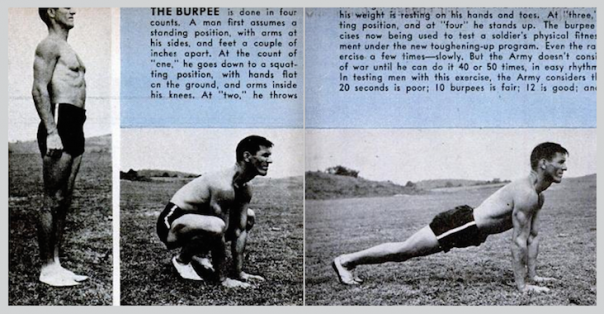
There’s this thing called a burpee.  It’s a whole body effort that begins by standing.  There’s a quick move to bring the body flat to the floor with chest, stomach, knees, and toes all touching the ground. A quick pop back up to the feet to standing and then jumping in the air to finish.  The burpee was developed in 1940 by Royal H. Burpee, a physiologist in New York City, to assess physical health in non-active people by asking them to do four in a row and taking their heartrates.[1]  The American military picked up the move in 1942 and by 1946 required a one-minute test of max number of burpees.  41 reps was considered excellent and 27 was considered poor.

Burpees came to mind when reading these Bible texts for today. In three of the readings, there’s talk about body parts, whole bodies, movement, and even some weeping which isn’t out of the question when doing max rep burpees.

In story from Nehemiah, “all the people stood up” to hear the reading of the law.  “Lifting their hands” they responded to Ezra’s prayers with an “Amen, Amen.”  “Then they bowed their heads and worshiped the Lord with their faces to the ground.”  That is a lot of body movement in unison by a large group.  Then the people wept, convicted as Ezra read the law “with interpretation…so that people understood the reading.”  The people hear the law, understand that they are caught by it, and they start to cry.  However, they are not left to their despair.

Nehemiah, Ezra, and the Levites tell the people that this is the Lord’s holy day.  The people are instructed to stop crying, to go eat fat and drink wine and “send portions of them to those for whom nothing is prepared.”  Why?  Because “the joy of the Lord is their strength.”  Conviction by the law of God, by the knowledge that we have not been on the side of our neighbor, is unsettling.  Despair is inevitable if conviction by the law is the only word.

The reading from First Corinthians gives us a solid bit of law through the poetry of Paul.  Listen to Paul’s words again:

“Indeed, the body does not consist of one member but of many. 15 If the foot would say, ‘Because I am not a hand, I do not belong to the body,’ that would not make it any less a part of the body. 16 And if the ear would say, ‘Because I am not an eye, I do not belong to the body,’ that would not make it any less a part of the body. 17 If the whole body were an eye, where would the hearing be? If the whole body were hearing, where would the sense of smell be? 18 But as it is, God arranged the members in the body, each one of them, as he chose. . 19 If all were a single member, where would the body be? 20 As it is, there are many members, yet one body. 21 The eye cannot say to the hand, ‘I have no need of you,’ nor again the head to the feet, ‘I have no need of you.’”

Paul’s talk about eyes not needing hands or the head not needing feet infers that the church in Corinth is behaving in just such an exclusionary manner.  The talk of eyes getting rid of hands or the head getting rid of feet brings to mind the language of dismembering – taking a body apart.  Paul’s description using body parts is applicable because one of the Biblical descriptors of the church is the body of Christ.  He is especially focused on the discovery that some people are dis-membering certain other people from the church, from the body of Christ, for whatever reason that someone deems as non-need.

Lutheran Christian identity is as old as Christianity itself because it can identify its antecedents well before the 16th century Reformation.  However, the way the Reformation came down means that Lutheranism has dis-memberment as part of its ethos.  Meaning that the denomination formed on a foundation of disagreement that resulted in broken community.  We know what this looks like from the outside and from the inside.  It can make us quick to judge others through whether we think we need them or not.

This talk about church and denomination makes me want to broaden this conversation in the direction of politics.  It’s a political time and it’s simple to find dismembering kind of talk in public and in private.  Talk that makes the leap to who cares about this country and the Constitution and who doesn’t.  Talk that makes clear that if you care about this country you’ll believe certain things and act in certain ways.  Talk that includes a lot of eye-rolling up, down, and across the aisle.

As I think about the public dialogue that includes eye-rolling, I realize that even my eyes can get away from me.  My own eye rolls that communicate disbelief and disrespect in one fell swoop.  Eye rolls that disconnect people before their thought is even completed.  My sister and I talked a long while back about those eyes rolls and disrespect.  Whether it’s the eye roll that happens by a parent to teen or a teen to a parent.  Or maybe the eye roll at your spouse’s back.  Or even the eye-roll about a public servant, a politician.  All of this eye-rolling amounts to a cut direct that dismembers one person from another.  There’s a bit of homework for your week.  Catch yourself as you roll your eyes.  Think about why you’re doing it and the effect on what it means for you to listen and respond differently to someone.

For people of the church, people called into a body of Christ, Paul’s description is convicting and a possible antidote to the eye-roll.  Convicted by these words about holding together across differences.  We may not have equal passion about same things.  We may not believe the same things.  We are certainly not gifted for the same things.  This congregation is a group of people who are confronted by difference all the time.  That’s part of being the body of Christ.  We also don’t choose the people who are in the body with us.   Paul writes, “For in the one Spirit we were all baptized into one body—Jews or Greeks, slaves or free—and we were all made to drink of one Spirit.”

The Middle School youth of this congregation have some recent practice with Paul’s words.  Last weekend, at the Rocky Mountain Synod’s Middle School Youth Gathering, they had a chance to figure out what their spiritual gifts might be and how they add to mix in the body of Christ.  Some gifts that make the list in First Corinthians are forms of assistance, healing, prophesying, deeds of power, teaching, leadership, and interpretation.  Identifying their spiritual gifts give these young people a baptismal understanding of themselves beyond what the wider culture might have to say about them and what they offer the world.  This is something the church gives people by way of the Spirit.  Another possible antidote in a culture of celebrity, accumulation, and eye-rolling.

In Luke, it’s Jesus’ turn to make a stand – no jump and clap needed for added emphasis.  He stands as he reads in the synagogue.  Something he’s done all over Galilee before returning to his hometown “filled with the power of the Spirit.”

Luke tells us that, “Jesus unrolled the scroll [of Isaiah] and found the place where it was written: 18 “The Spirit of the Lord is upon me, because he has anointed me to bring good news to the poor. He has sent me to proclaim release to the captives and recovery of sight to the blind, to let the oppressed go free, 19 to proclaim the year of the Lord’s favor.”  20 And he rolled up the scroll, gave it back to the attendant, and sat down. The eyes of all in the synagogue were fixed on him. 21 Then he began to say to them, “Today this scripture has been fulfilled in your hearing.”

In that synagogue and here today Jesus makes these promises.  He’s anointed by the Spirit to proclaim freedom, sight, and good news.  Not only to proclaim these things but has fulfilled them in his person.  Note Jesus uses the word “today.”  Fulfillment in the present tense so long ago.  We can make as much sense of his promises as did the people in the Nazorean synagogue.  And still, with confidence in those promises, we find that the joy of the Lord is our strength.  Thanks be to God.


[1] Sally Tamarkin, “A Brief History of the Burpee.” Huffpost Healthy Living, May 2, 2014. http://www.huffingtonpost.com/2014/05/02/burpee-history_n_5248575.html

Two more of the Bible readings:

Nehemiah 8:1-3, 5-6, 8-10 all the people gathered together into the square before the Water Gate. They told the scribe Ezra to bring the book of the law of Moses, which the Lord had given to Israel. 2 Accordingly, the priest Ezra brought the law before the assembly, both men and women and all who could hear with understanding. This was on the first day of the seventh month. 3 He read from it facing the square before the Water Gate from early morning until midday, in the presence of the men and the women and those who could understand; and the ears of all the people were attentive to the book of the law.

5 And Ezra opened the book in the sight of all the people, for he was standing above all the people; and when he opened it, all the people stood up. 6 Then Ezra blessed the Lord, the great God, and all the people answered, “Amen, Amen,” lifting up their hands. Then they bowed their heads and worshiped the Lord with their faces to the ground.

8 So they read from the book, from the law of God, with interpretation. They gave the sense, so that the people understood the reading.

9 And Nehemiah, who was the governor, and Ezra the priest and scribe, and the Levites who taught the people said to all the people, “This day is holy to the Lord your God; do not mourn or weep.” For all the people wept when they heard the words of the law. 10 Then he said to them, “Go your way, eat the fat and drink sweet wine and send portions of them to those for whom nothing is prepared, for this day is holy to our Lord; and do not be grieved, for the joy of the Lord is your strength.”

1 Corinthians 12:12-30 For just as the body is one and has many members, and all the members of the body, though many, are one body, so it is with Christ. 13 For in the one Spirit we were all baptized into one body—Jews or Greeks, slaves or free—and we were all made to drink of one Spirit. 14 Indeed, the body does not consist of one member but of many. 15 If the foot would say, “Because I am not a hand, I do not belong to the body,” that would not make it any less a part of the body. 16 And if the ear would say, “Because I am not an eye, I do not belong to the body,” that would not make it any less a part of the body. 17 If the whole body were an eye, where would the hearing be? If the whole body were hearing, where would the sense of smell be? 18 But as it is, God arranged the members in the body, each one of them, as he chose. 19 If all were a single member, where would the body be? 20 As it is, there are many members, yet one body. 21 The eye cannot say to the hand, “I have no need of you,” nor again the head to the feet, “I have no need of you.” 22 On the contrary, the members of the body that seem to be weaker are indispensable, 23 and those members of the body that we think less honorable we clothe with greater honor, and our less respectable members are treated with greater respect; 24 whereas our more respectable members do not need this. But God has so arranged the body, giving the greater honor to the inferior member, 25 that there may be no dissension within the body, but the members may have the same care for one another. 26 If one member suffers, all suffer together with it; if one member is honored, all rejoice together with it.

27 Now you are the body of Christ and individually members of it. 28 And God has appointed in the church first apostles, second prophets, third teachers; then deeds of power, then gifts of healing, forms of assistance, forms of leadership, various kinds of tongues. 29 Are all apostles? Are all prophets? Are all teachers? Do all work miracles? 30 Do all possess gifts of healing? Do all speak in tongues? Do all interpret? 31 But strive for the greater gifts.