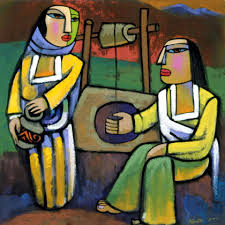
**Samaritan Woman at the Well by He Qi
Caitlin Trussell with Augustana Lutheran Church on March 8, 2026
[sermon begins after Bible reading – hang in there, it’s a great story]
John 4:5-42 [Jesus] came to a Samaritan city called Sychar, near the plot of ground that Jacob had given to his son Joseph.6 Jacob’s well was there, and Jesus, tired out by his journey, was sitting by the well. It was about noon.
7 A Samaritan woman came to draw water, and Jesus said to her, “Give me a drink.” 8 (His disciples had gone to the city to buy food.) 9 The Samaritan woman said to him, “How is it that you, a Jew, ask a drink of me, a woman of Samaria?” (Jews do not share things in common with Samaritans.) 10 Jesus answered her, “If you knew the gift of God and who it is that is saying to you, ‘Give me a drink,’ you would have asked him, and he would have given you living water.” 11 The woman said to him, “Sir, you have no bucket, and the well is deep. Where do you get that living water? 12 Are you greater than our ancestor Jacob, who gave us the well and with his sons and his flocks drank from it?” 13 Jesus said to her, “Everyone who drinks of this water will be thirsty again, 14 but those who drink of the water that I will give them will never be thirsty. The water that I will give will become in them a spring of water gushing up to eternal life.” 15 The woman said to him, “Sir, give me this water, so that I may never be thirsty or have to keep coming here to draw water.”
16 Jesus said to her, “Go, call your husband, and come back.” 17 The woman answered him, “I have no husband.” Jesus said to her, “You are right in saying, ‘I have no husband,’ 18 for you have had five husbands, and the one you have now is not your husband. What you have said is true!” 19 The woman said to him, “Sir, I see that you are a prophet. 20 Our ancestors worshiped on this mountain, but you say that the place where people must worship is in Jerusalem.” 21 Jesus said to her, “Woman, believe me, the hour is coming when you will worship the Father neither on this mountain nor in Jerusalem. 22 You worship what you do not know; we worship what we know, for salvation is from the Jews. 23 But the hour is coming and is now here when the true worshipers will worship the Father in spirit and truth, for the Father seeks such as these to worship him. 24 God is spirit, and those who worship him must worship in spirit and truth.” 25 The woman said to him, “I know that Messiah is coming” (who is called Christ). “When he comes, he will proclaim all things to us.” 26 Jesus said to her, “I am he, the one who is speaking to you.”
27 Just then his disciples came. They were astonished that he was speaking with a woman, but no one said, “What do you want?” or, “Why are you speaking with her?” 28 Then the woman left her water jar and went back to the city. She said to the people, 29 “Come and see a man who told me everything I have ever done! He cannot be the Messiah, can he?” 30 They left the city and were on their way to him.
31 Meanwhile the disciples were urging him, “Rabbi, eat something.” 32 But he said to them, “I have food to eat that you do not know about.” 33 So the disciples said to one another, “Surely no one has brought him something to eat?” 34 Jesus said to them, “My food is to do the will of him who sent me and to complete his work. 35 Do you not say, ‘Four months more, then comes the harvest’? But I tell you, look around you, and see how the fields are ripe for harvesting. 36 The reaper is already receiving wages and is gathering fruit for eternal life, so that sower and reaper may rejoice together. 37 For here the saying holds true, ‘One sows and another reaps.’ 38 I sent you to reap that for which you did not labor. Others have labored, and you have entered into their labor.”
39 Many Samaritans from that city believed in him because of the woman’s testimony, “He told me everything I have ever done.” 40 So when the Samaritans came to him, they asked him to stay with them, and he stayed there two days. 41 And many more believed because of his word. 42 They said to the woman, “It is no longer because of what you said that we believe, for we have heard for ourselves, and we know that this is truly the Savior of the world.”
[sermon begins]
In last week’s gospel episode, Nicodemus lurked at night and found Jesus where he was staying. He did not want to be seen by anyone, especially by any of his religious friends, Nic at night brings serious questions to Jesus and leaves confused. This week brings us into the light of day. High noon. In the big heat, Jesus sits down to rest at a well while the disciples go to town to rustle up some lunch. Jesus isn’t sitting by just any old well. This is Jacob’s well. Wells were THE ‘Match.com’ of 2,000 B.C.E.[1] Jacob and Rachel met by a well in the book of Genesis.[2] Moses and Zipporah met by a well in Exodus.[3] Wells are a place of auspicious beginnings.
No need to get too nervous about where we’re headed with Jesus running into this unnamed Samaritan woman at the well. More than a “meet cute,” it is an auspicious sign that Jesus showed up by a well the way a bridegroom might. It’s auspicious because it’s consistent with language of the Gospel of John. “Jesus assumed the role of bridegroom earlier in the Gospel by providing wine for the wedding at Cana, and John the Baptist identified Jesus as the bridegroom.”[4]
John the Baptist used the bridegroom language right before Jesus walked into Samaria and sat by the well. He said, “The friend of the bridegroom…rejoices greatly at the bridegroom’s voice.” A few verses later the Samaritan woman is at the well at an usual time. Not in the typical cool hours of the morning. At noon. In the heat of the day. Perhaps her first surprise was finding anyone else at the well – followed quickly by the shock at finding herself there with a Jewish man who would speak with her. Note that Jesus doesn’t condemn her. She told him the truth about living with a man, and he added to it with more truth about her marital history. Awkward? Maybe. Regardless, their conversation avoids shame and condemnation while exposing tensions between gender and ethnicity.[5] Their conversation about water from a well reveals centuries of ethnic strife. Their unusual conversation is a beginning.
Showing up at a well at noon was unusual. Jesus met her there. His heady words to Nicodemus last week, about the world being saved through Jesus, go live in the story of the Samaritan woman this week. The words go live in a body, in her body – the body representing the bride. She is a solitary person by a well and unnamed but for her ethnicity as a Samaritan. She represents the world that Jesus was concerned about – a world that separates people into us and them.[6] This woman’s story is perfect for International Women’s Day celebrated every year for decades on March 8th to spotlight and advocate for women around the world.[7] Research supports that when women have equitable access to resources, education, and opportunities, it strengthens economic development and health while stabilizing communities.[8]
In the gospel story, the woman empowered by Jesus is a sign that the wider non-Jewish world IS Jesus’ concern. Jesus is the bridegroom. Jesus is about saving the world now. A tidy theological equation, to be sure, but what do we do with it? How does what Jesus is doing at a well figure into life for world here and now? A world at war with itself in conflicts beyond Iran, Israel, and the United States although that’s one weighing on our hearts and minds, to be sure.
Let’s start closer to home with Augustana. It’s an obvious place to begin. After all, the church is referred to in the Bible as the bride of Christ.[9] And we, as a worshipping community here this morning, are part of Christ’s church catholic, Christ’s whole universal church. What might Jesus the bridegroom, sitting with us at this very moment, have to say about us? How do we, the worshipping community of Augustana, live into what Jesus already knows about us? Sent into the city to talk with people like the Samaritan woman does. Leaving her water jar behind, she tells the people of the city, “Come and see a man who told me everything I have ever done! He cannot be the Messiah, can he?”
A few days ago, 25 of us from Augustana responded to the invitation from Multicultural Mosaic Foundation to attend their iftar as they broke their daily Ramadan fast with prayer and dinner. We’re grateful for their warm hospitality and gracious invitation to get to know each other, to learn, to ask questions, and to observe prayers. Pastor Michael and Dr. Bora presented about Lent and Ramadan as both began on the same day this year.[10] A tremendous evening of connection and respectful dialogue between Muslim and Christian neighbors. These interactions have awkward moments, but they are also world-changing building blocks. They take time and intention. They are a sign of what’s possible.
Like the woman talking with Jesus at the well, Sunday can feel like a place of relief and amazement. A place to tell the truth about ourselves and to hear the truth told about us. A place to simply be with the words of our confession. The confession of what we have done and left undone. But also the other meaning of confession which is remembering God’s promises to us and our trust in those promises. This is a place of living water and truth telling.
And, like the Samaritan woman, we head back into the city holding a sliver of doubt once the conversation happens here with Jesus. She says to the people, “He cannot be the Messiah, can he?” She takes her encounter with Jesus out for a spin, carrying her doubt right alongside of it, and invites people to wonder about Jesus with her. Embedded in the Samaritan woman’s invitation and question is an antidote to the 21st century culture that is poisoned by absolutism, anger, and judgment.
We are in a world, right now, that is suffering under absolutes. Conversation, common ground, connecting points are few and far between. The way in which we take our faith out for a spin from this sanctuary matters. THAT we take it out for a spin matters too. Our invitation may connect with others who need a place to wonder about the hope found in Jesus – a hope that does not disappoint.[11] People are scared and people are suffering. This is the world that Jesus came to save today. Right now.
Jesus did not come into the world to condemn it. Jesus came to save the world – to restore our relationship with God and with each other. Jesus did not come into the world to condemn you. Jesus came to save you – to restore your relationship with God, with the person next to you, and the with the person around the world from you. Let Jesus tell the truth about you here and be drawn into the unexpected moments of what happens next.
___________________________________________________
[1] Match.com is a dating website where people meet-and-greet each other online.
[2] Genesis 29:1-12
[3] Exodus 2:15-22
[4] John 2:1-11 and John 3:29 respectively.
Craig R. Koester. Symbolism in the Fourth Gospel: Meaning, Mystery, Community (Minneapolis: Fortress Press, 2003), 48.
[5] Reverend Ron Roshke, retired ELCA pastor in Denver, Third Sunday in Lent. March 8 2026. 2026_03_08Lent3A.pdf
[6] Koester, 48.
[7] Nicole Minkas. The role of participation and community mobilisation in preventing violence against women and girls: a programme review and critique. June 26, 2020. pmc.ncbi.nlm.nih.gov/articles/PMC8904729/
[8] Q&A Series #5: When Women Do Better, Countries Do Better – United States Department of State, 11/22/2017.
[9] Revelation 19:7-9; Ephesians 5:25-27. See more at: http://www.openbible.info/topics/the_bride_of_christ
[10] Sacred Seasons of Reflection: Lent and Ramadan in Dialogue – Multicultural Mosaic Foundation. March 5, 2026.
[11] Romans 5:1-11